How to Test for Water: A GCSE & A-Level Guide

You're staring at a chemistry question. There's a clear, colourless liquid in a test tube, and the exam wants one thing from you. Don't panic. It might be water. It might be something pretending to be water. Those are not the same problem.
Students often blur two questions together and lose marks because of it. First, is water present? Second, is the sample pure water? If you answer one when the question asked the other, the examiner won't reward good intentions.
Your Exam Mission Should You Choose to Accept It
A classic exam trap goes like this. You get an unknown liquid. It looks harmless, transparent, almost boring. A rushed student writes, “It is water because it is clear.” That answer sounds neat and gets almost nothing.
Chemistry does not care what a liquid looks like. Plenty of liquids are clear and colourless. Examiners love this because it separates guesswork from actual science.
The smarter approach is to treat the question like a mini investigation. You need a chemical test for water if the question asks whether water is present. You need a physical test if the question asks whether the water is pure. Those are different tools for different jobs.
Examiner mindset: Identify the question type first. Presence of water and purity of water are not interchangeable.
This matters outside the classroom too. In the UK, water testing is part of a serious legal system, not just a school practical. The Water Supply (Water Quality) Regulations 2016 require constant monitoring, and recent reporting shows compliance for public water supplies remains above 99% according to this UK water testing overview. That's useful context because it reminds you that testing water is about evidence, not appearance.
If revision has felt messy, use one system for facts and another for practice. A good place to tighten that up is Vivora's exam study advice, especially if you keep revising topics without checking whether you can apply them under pressure.
And if you want to turn weak spots into targeted practice, AI Powered Revision can help you drill exact chemistry question types instead of rereading notes and hoping for the best.
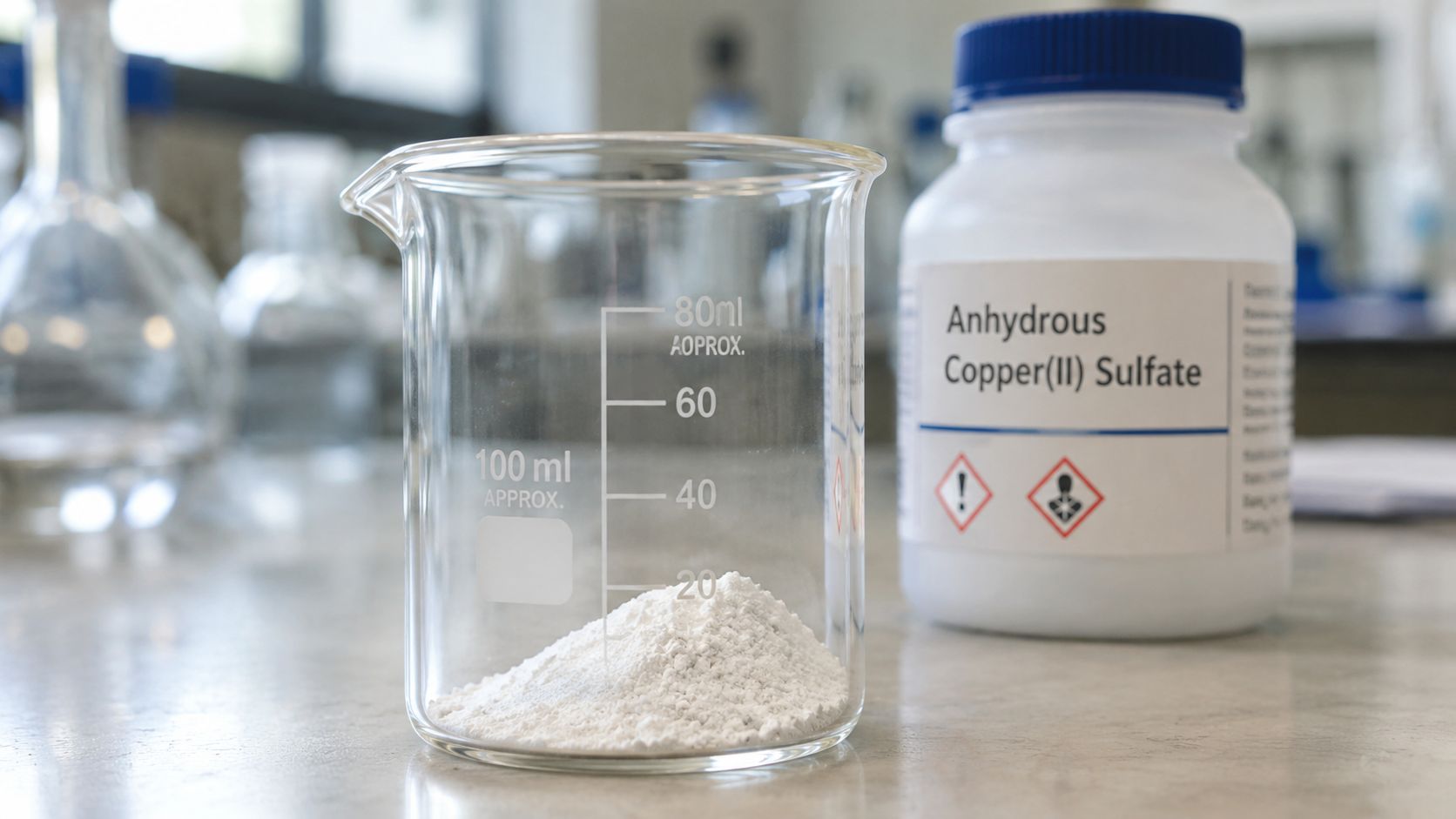
The Anhydrous Copper Sulfate Test for Water
This is the test most students need to know cold. If a paper asks for a chemical way to test for water, anhydrous copper(II) sulfate is one of the standard answers.
What you must remember
The key word is anhydrous. That means without water.
Anhydrous copper(II) sulfate is a white powder. If water is present, it turns blue. If you only memorise one colour change from this whole topic, make it this one.
How to do the test properly
A simple method works well in an exam answer:
- Place a small amount of anhydrous copper(II) sulfate in a test tube, spotting tile, or watch glass.
- Add a few drops of the liquid being tested.
- Watch for the colour change.
- If the white solid turns blue, water is present.
That's the practical method. Short. Clear. Mark-friendly.
Where students slip is in the wording. Don't say “it dissolves so water is present” unless that is what you observed and the question supports it. The mark is usually tied to the white to blue change, not to vague comments about mixing.
Use the full name once, then write copper sulfate if you want. But never forget the word anhydrous when you describe the starting solid.
Why the colour changes
This isn't magic. The copper(II) sulfate takes in water and becomes a hydrated salt. In other words, water molecules become part of the crystal structure.
That's why the blue colour appears. The hydrated form is different from the anhydrous form, so it has different properties, including colour.
A common equation you may need is:
CuSO₄ + 5H₂O → CuSO₄·5H₂O
The product is hydrated copper(II) sulfate, often called copper(II) sulfate pentahydrate.
If you're aiming for stronger answers, the phrase water of crystallisation is worth knowing. It means water that is chemically associated with the crystal structure of a compound.
Here's a quick visual explanation if you want to see the idea in action:
What examiners like to see
A strong answer usually includes these points:
- Name the reagent: anhydrous copper(II) sulfate
- State the starting colour: white
- State the result: turns blue if water is present
- Explain if needed: the salt becomes hydrated
Here's the difference between a weak and strong answer:
| Answer style | Example |
|---|---|
| Weak | Add copper sulfate and see if it changes |
| Strong | Add the liquid to white anhydrous copper(II) sulfate. If water is present, it turns blue because the salt becomes hydrated. |
If you want chemistry practice beyond just this one method, the range of MasteryMind subjects is useful because this topic often overlaps with salts, crystallisation, practical skills, and physical properties.
Using Cobalt Chloride Paper to Detect Water
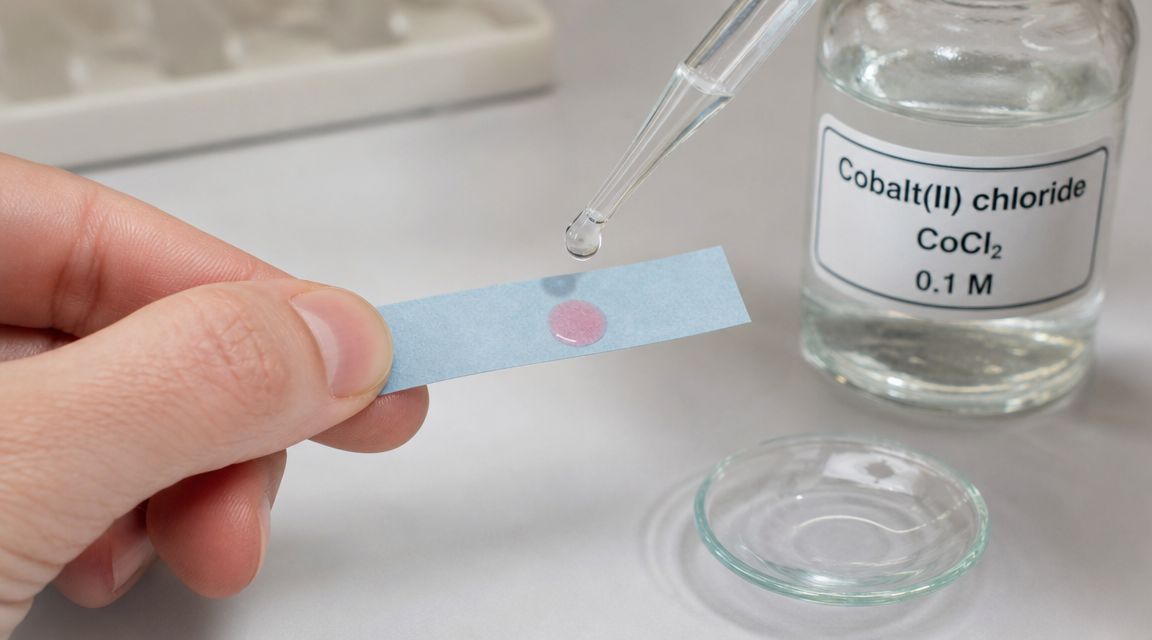
If copper sulfate is the classic lab answer, cobalt chloride paper is the quick-check version. It's handy when you need a simple indicator for water, especially if moisture is present as vapour.
The colour change that wins marks
Dry cobalt chloride paper is blue. When water is present, it turns pink. Some students write lilac or pinkish, but blue to pink is the safest wording for an exam.
The method is straightforward. Expose the paper to the sample, or to a gas if you're testing for water vapour. If the paper changes from blue to pink, water is present.
Why this test is useful
This method is fast and portable. That makes it good for checking whether a gas contains water vapour, where using a powder would be awkward.
It also helps you think more carefully about what “water present” means. Water doesn't have to be a puddle or a liquid sample. It can be present in the air or mixed into another substance in a less obvious way.
Blue cobalt chloride paper turning pink tells you water is present. It does not tell you the sample is pure water.
Where students get caught out
The biggest mistake is mixing up the two common tests:
- Copper sulfate: white to blue
- Cobalt chloride paper: blue to pink
Learn them as a pair, but don't swap the colours. That's one of those errors that looks tiny and costs marks immediately.
Also, cobalt chloride paper is often described as a reversible test. If it dries out again, the colour can change back. That's chemically interesting, but in an exam the key point is still the observed colour change.
Proving Purity The Boiling Point Method
Once you know water is present, a different question appears. Is it pure water, or water with dissolved substances in it?
Students need to stop thinking like guessers and start thinking like chemists. You cannot decide purity by looking at a sample. Real water quality checks use many different measures. The Drinking Water Inspectorate reports that UK water companies test for substances including E. coli, lead, nitrate, and pesticide residues, as explained in this summary of modern drinking-water testing. So “pure” is not the same as “looks clean”.
The laboratory method
For school chemistry, the standard physical test is the boiling point.
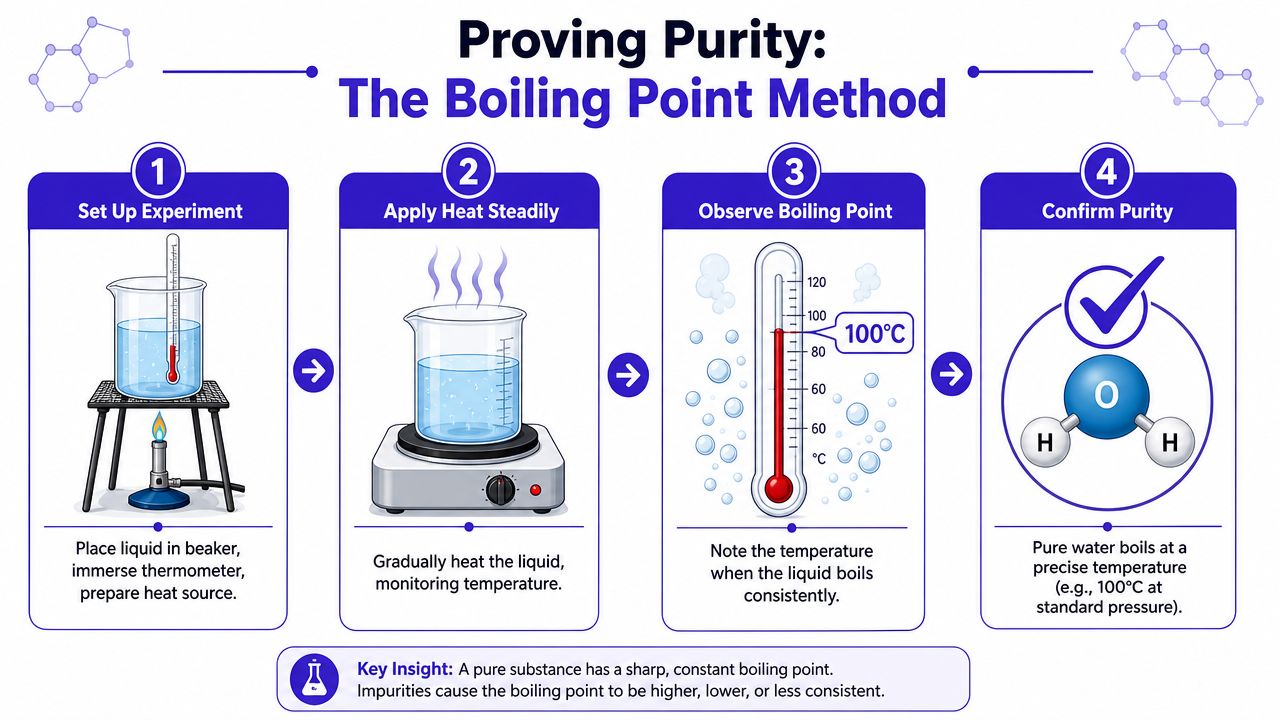
Pure water boils at 100°C at standard pressure. If the sample boils over a range, or at a different temperature, that suggests impurities are present.
A basic setup usually includes:
- A beaker or flask containing the liquid
- A thermometer placed correctly
- A heat source such as a Bunsen burner or hot plate
- A tripod and gauze if you're heating with a Bunsen burner
How to describe it in an exam
A solid exam answer might look like this:
- Put the water sample into a beaker or flask.
- Place a thermometer so the bulb is in the liquid but not pressed against the glass.
- Heat the sample steadily.
- Record the temperature when the liquid boils consistently.
- If it boils at 100°C, the sample is pure water at standard pressure.
That last phrase matters. Some exam boards like students to recognise that boiling point depends on pressure. At GCSE, you usually won't need a long discussion. At A-level, it shows better precision.
Why impurities change the boiling point
Dissolved substances interfere with how easily water molecules escape into the gas phase. As a result, the liquid needs a higher temperature before it boils.
That's why salt water does not behave exactly like pure water. It's also linked to another useful idea: impurities usually lower the freezing point as well.
This gives you a useful exam principle:
| Question asks | Best test |
|---|---|
| Is water present? | Chemical test such as anhydrous copper(II) sulfate or cobalt chloride paper |
| Is the water pure? | Physical test such as boiling point |
Practical rule: A sample can contain water and still be impure. Presence and purity are different claims, so they need different evidence.
Small details that make big differences
Students often know the theory but lose marks on practical detail. Watch these:
- Thermometer position matters. If the bulb touches the side of the beaker, you may measure the glass temperature instead of the liquid properly.
- Heat gently near the boiling point. If you blast the sample too hard, your reading can jump and become messy.
- Look for a steady reading. A boiling point is not one random number grabbed in a hurry.
If the exam asks for “how to test purity”, don't answer with “use cobalt chloride paper”. That only shows water is there. It tells you nothing about whether dissolved impurities are present.
Exam-Losing Mistakes and How to Avoid Them
This topic should be a source of easy marks. Yet students still drop them through avoidable errors.
The reason is simple. They remember a fragment of the method, not the logic behind it. Then the paper changes the wording slightly, and the answer falls apart.
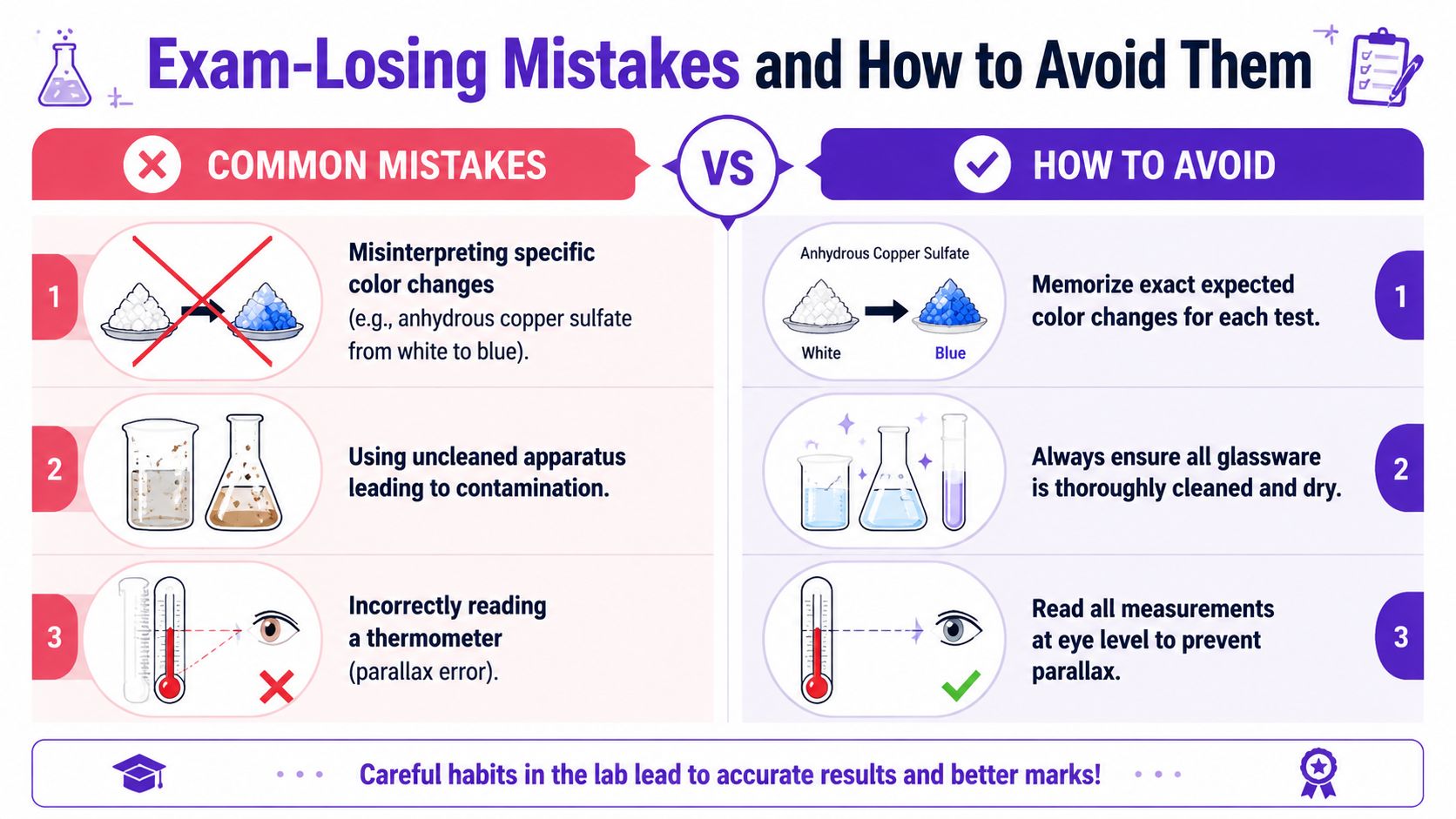
Mistake one: trusting your eyes
A clear liquid is not automatically pure water. That's not chemistry. That's a guess.
This matters beyond school practicals. Even in surface testing, simple visual checks can be misleading. The water-break test is known to be subjective and can miss hydrophilic contaminants, as explained in this discussion of why visual water-break checks have limits. The scientific lesson is bigger than that one method: what looks clean can still be contaminated.
Mistake two: using the wrong starting substance
If your copper(II) sulfate is already blue, that means it's hydrated already. You can't use that to show a white-to-blue change.
Students also muddle the cobalt chloride paper colours. Keep this memory hook if it helps:
- Copper sulfate starts white
- Cobalt chloride paper starts blue
Short. Sharp. Hard to confuse if you drill it properly.
Mistake three: writing vague observations
“Changed colour” is weak. Which colour? From what to what?
Examiners award marks for specific observations. You need precision:
- white to blue
- blue to pink
- boils at 100°C
That is the language of marks.
“If the observation could apply to three different practicals, it's too vague for full marks.”
Mistake four: poor technique in purity tests
Boiling point work looks easy until practical detail goes wrong.
Common problems include:
- Thermometer at the wrong angle
- Reading the scale from the side
- Heating too quickly
- Using dirty apparatus
Each one can distort your result. Even if the theory in your head is right, the method on the page has to sound competent.
A good recovery strategy is to practise these as mini error-spotting questions using GCSE Past Papers, because examiners love asking what went wrong and how to improve the method.
And if exam mistakes are starting to feel personal rather than fixable, it helps to remember that stress can make simple topics feel harder than they are. This guide on managing exam season mental struggles is worth a look if your revision has turned into panic and avoidance.
Practise Exam Questions and Model Answers
Time to test whether you know this or just recognise it.
Quick recall
Question 1
State the colour change when water is added to anhydrous copper(II) sulfate.
Model answer
White to blue.
Why this scores: it is exact. Not “it changes colour”. Not “it goes blue-ish”. Exact wording wins easy marks.
Method question
Question 2
Describe a chemical test for water.
Model answer
Add the sample to anhydrous copper(II) sulfate. If water is present, the white copper(II) sulfate turns blue.
Why this scores: it names the reagent, gives the observation, and states the conclusion.
Application question
Question 3
A student says a sample is pure water because it is clear and colourless. Explain why this is not a valid conclusion.
Model answer
A clear, colourless appearance does not prove a liquid is pure water because other substances can also look clear and colourless. Purity should be tested using a physical property such as the boiling point.
Why this scores: it rejects the weak evidence and replaces it with a valid method.
Longer response
Question 4
Describe how you would test whether a sample of water is pure.
Model answer
Heat the sample and measure its boiling point with a thermometer. Pure water boils at 100°C at standard pressure. If the sample boils at a different temperature, or over a range of temperatures, it is not pure.
Why this scores: it gives the method, the expected result, and how to interpret a different result.
For timed drills on questions like these, Exam Practice for GCSE is useful because this topic improves fastest when you answer, check, and redo rather than just reread.
If you want sharper exam technique without wasting hours on random revision, MasteryMind gives UK learners examiner-aligned practice, instant feedback, and targeted support across GCSE and A-Level subjects. It's a practical way to turn “I sort of know this” into answers that score.
Ready to master this topic?
Practise with quizzes, blurt exercises and exam questions on MasteryMind.
7 days Premium · Then free forever · No card, no charge