Unseen Poetry Analysis: Master It for Exams
You've probably had this moment already. You turn the page, see a poem you've never read before, and your brain does that unhelpful thing where it says, “Great. No idea. I'm finished.”
You're not finished. You're looking at a task that feels personal and mysterious, but it's very mark-scheme driven. That matters. Examiners aren't rewarding mind reading or a magical “poetry brain”. They're rewarding clear interpretation, supported evidence, and comments on how the writer's choices create meaning.
That's why unseen poetry analysis is learnable. If you know what the marker is trained to notice, you stop guessing and start building answers.
Why Unseen Poetry Terrifies Everyone (And How to Beat It)
The fear makes sense. Unseen poetry feels unfair because you can't revise the exact text in advance. You can revise Macbeth quotes. You can revise An Inspector Calls themes. You can't memorise a poem you haven't met yet.
But the exam isn't asking for prior knowledge. It's asking whether you can read closely, think clearly, and explain your ideas under pressure. That's a different skill, and it can be trained.
Why the pressure feels so real
In OCR GCSE English Literature, unseen poetry isn't a tiny side task. It carries 40 marks across two questions, combining analysis of one named poem with comparison to another unfamiliar poem in the same paper, as explained in this guide to OCR unseen poetry assessment. That's why teachers keep banging on about practice. The paper expects you to move from first reading to supported analysis fast.
If you're revising independently, a structured platform like Online Revision for GCSE can help you build that habit of reading, selecting evidence, and writing to the mark allocation.
The mindset shift that changes everything
Students often think strong unseen poetry analysis means “getting the poem right”. That's not how examiners read your answer.
They're asking things like:
- Have you answered the question directly?
- Have you used short, relevant quotations?
- Have you commented on methods, not just meaning?
- Have you explained an effect, rather than naming a device and moving on?
That's good news. It means you do not need a perfect interpretation. You need a defensible one.
Practical rule: If your idea fits the words on the page and you can support it, it's valid enough to score.
What usually goes wrong
Panic pushes students into one of two bad habits:
- Paraphrase mode. They retell the poem in easier words and call it analysis.
- Technique spotting mode. They label devices mechanically without saying why they matter.
Neither one matches what the examiner wants. A stronger response sits in the middle. It says what the poem seems to suggest, then proves that idea with language, structure, or form.
That's how we beat the fear. Not by pretending unseen poetry is easy, but by treating it like a process. Read with purpose. Spot patterns. Build a line of argument. Keep linking back to the question.
Once you start seeing the task through examiner psychology, the poem stops looking like a trap and starts looking like evidence.
The First Five Minutes Your Reading Game Plan
The opening minutes matter more than students think. Not because you need a brilliant insight instantly, but because the quality of your reading decides the quality of everything you write afterwards.
Most weak answers don't collapse in paragraph three. They go wrong in minute one, when the student reads too fast, panics, and starts underlining random phrases.
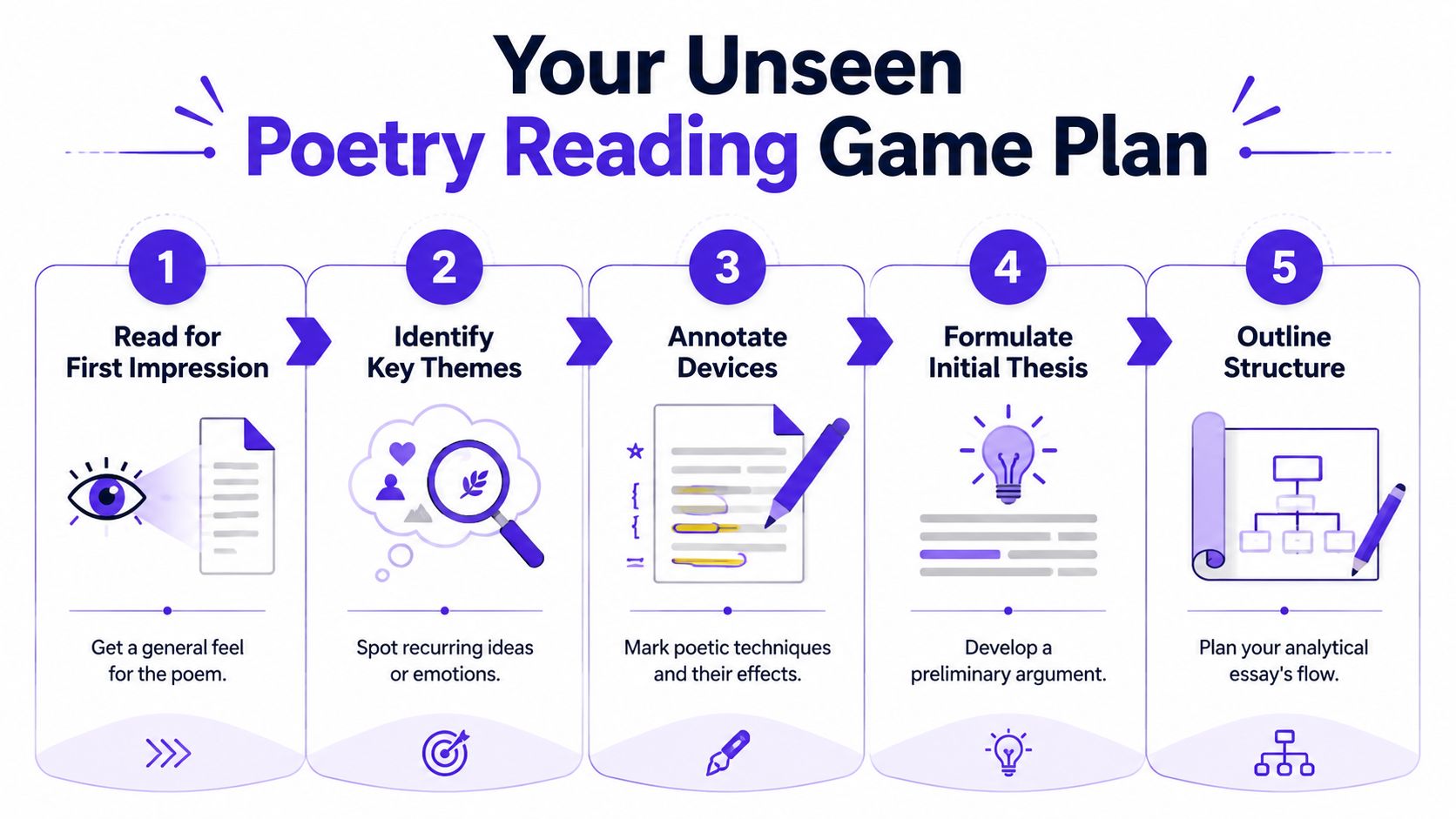
Read once for mood, then again for method
A reliable GCSE-style workflow is to read the poem at least twice, then annotate and choose 2–3 short quotations for a PEEL or PETER response, as set out in this unseen poetry guide with examiner-facing advice. That double read matters because your first impression gives you the poem's emotional weather, while the second read lets you test and refine it.
On the first read, ask simple questions:
- What mood hits first? Calm, bitter, confused, affectionate, threatening?
- Who seems to be speaking?
- What relationship or situation appears to be at the centre?
- Where does the poem feel steady, and where does it feel strange?
Don't annotate everything. That's how students waste time and end up with a page covered in colour but no actual plan.
What to scan for on the second read
A strong first-pass method is to scan for repetition, anomalies, and metre or rhythm before diving into interpretation, as recommended in this expert method for analysing any unseen poem. In plain English, that means looking for what the poem repeats, what breaks the pattern, and how the lines move.
Try this quick checklist:
Repetition
Repeated words, sounds, images, or sentence patterns often point to the poem's main concern. If a word keeps returning, the poet probably wants your attention there.Anomalies
Something odd usually matters. A single short line in a longer poem. A sudden exclamation. A jarring word choice. A shift from “we” to “I”. These are often rich marks.Rhythm and movement
You don't need to become a metrical expert in the exam hall. Just notice whether the poem feels flowing, abrupt, hesitant, heavy, song-like, or broken.
If a pattern changes, ask why it changes there. That question often produces your best analysis.
Your annotations should do a job
Good annotation isn't decoration. It should help you write faster later.
A useful page might include:
| What you note | Why it helps |
|---|---|
| A word or phrase repeated | Gives you a pattern to track |
| A tonal shift halfway through | Helps you structure a paragraph |
| Short quotations beside the question focus | Saves time when writing |
| A margin note on effect | Turns observation into argument |
If revision feels passive at the moment, active recall proves helpful. Read a poem, close it, and force yourself to say the mood, shift, and best quotations from memory. That's the kind of habit built by tools and routines designed to Master active recall for revision.
A simple five-minute routine
When the poem appears, do this:
- Read the question first so you know what idea you're hunting.
- Read the poem once without panicking about devices.
- Read it again with a pen, circling repetition, shifts, and anything unusual.
- Select a handful of short quotations that answer the question.
- Write a one-line argument in the margin about what the poet seems to be saying.
That last step is huge. It stops your essay becoming a tour of random techniques and turns it into a response.
Decoding the Poem What Examiners Actually Want
Students often hear “analyse language, structure, and form” so many times that the phrase stops meaning anything. Let's fix that.
The examiner is not rewarding feature spotting. They're rewarding your ability to move up a ladder: from text, to evidence, to effect, to interpretation. That's the core engine of high-level unseen poetry analysis.
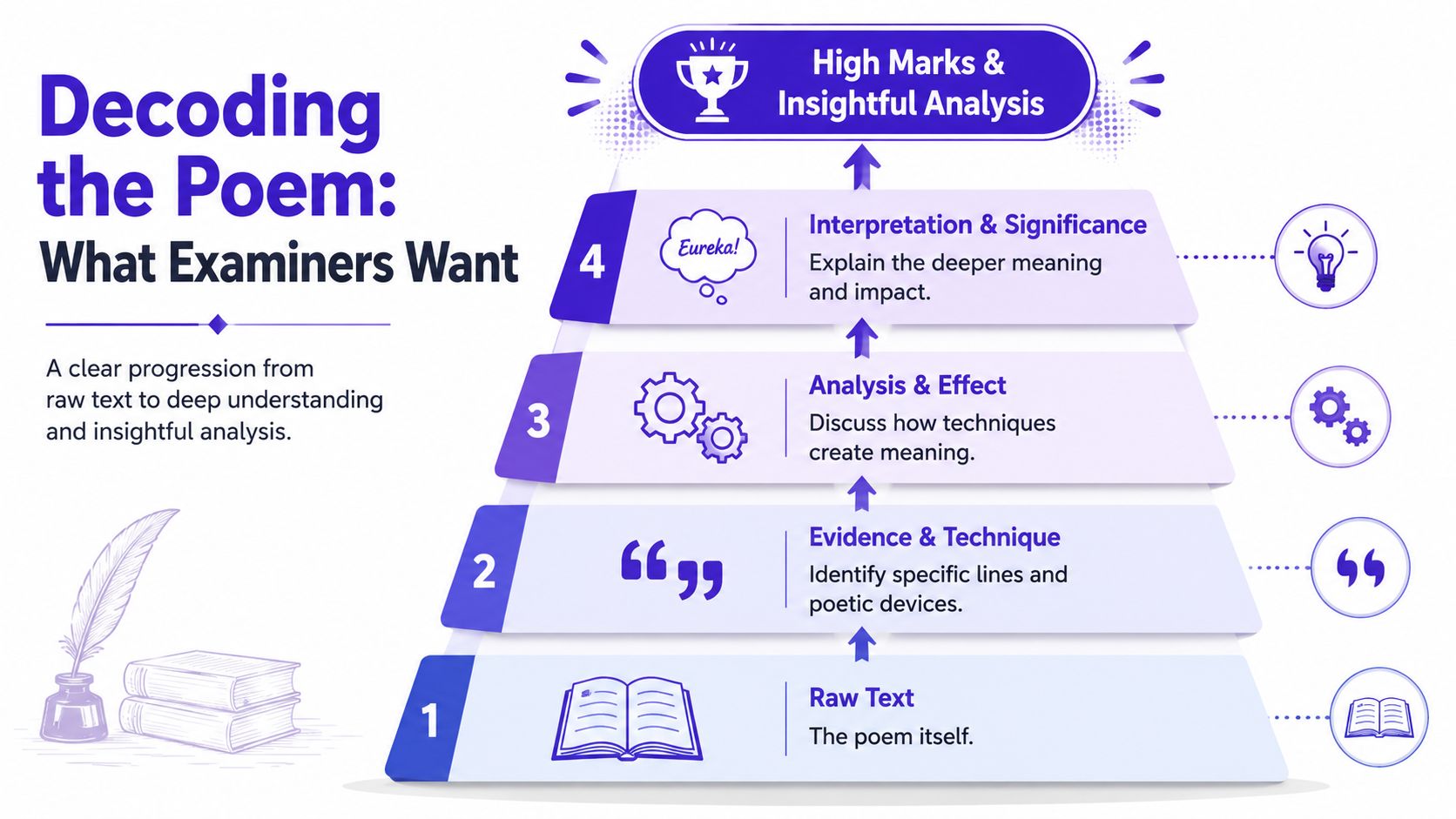
AO thinking in plain English
Teachers talk about AOs because they shape the mark scheme. Students should translate them into marker questions.
For unseen poetry, the marker is broadly looking for this:
| What you do | What the examiner sees |
|---|---|
| You give a clear interpretation | You understand the poem and answer the question |
| You use brief references from the text | Your ideas are supported, not guessed |
| You comment on language, structure, and form | You can explain writer's methods |
| You connect methods to meaning | You are analysing, not listing |
That's why vague comments score poorly. “The writer uses a metaphor” is not analysis. “The metaphor turns love into something fragile and temporary, which makes the speaker sound insecure” is analysis.
Language means word choice with consequences
Language is the easiest place to start because it's visible. A student can point to a verb, adjective, image, or metaphor and say something sensible.
But examiner-friendly language analysis has a shape:
- Pick a precise word or short phrase.
- Explore its connotations.
- Link that choice to tone, attitude, or theme.
- Tie it back to the question.
Here's the difference.
Weak comment:
The poet uses the word “dark” which is negative.
Stronger comment:
The adjective “dark” creates more than a gloomy setting. It suggests uncertainty and fear, so the speaker seems emotionally trapped rather than merely sad.
Notice what changed. The second version doesn't just identify a mood word. It explains what that word does to the meaning.
Examiner insight: The marker can only reward what you explain. If the effect stays in your head and never reaches the page, it doesn't count.
Structure means placement, movement, and change
Students often avoid structure because they think it means technical jargon. It doesn't. Structure is just the poem's shape over time.
Ask questions like these:
- Where does the poem begin emotionally?
- Does the speaker's attitude shift?
- Which line or stanza feels like a turning point?
- Are ideas withheld, repeated, or contrasted?
- Do the line breaks speed things up or hold things back?
A sharp structural comment often begins with movement. The poem shifts. The speaker moves. The tone turns. The final line leaves us with something.
Here's a quick comparison:
| Structural observation | Better analytical move |
|---|---|
| The poem has short lines | The short lines create hesitation, making the speaker sound cautious |
| There is enjambment | The enjambment pushes the thought forwards, suggesting urgency or lack of control |
| The ending is different | The ending undercuts the earlier confidence and leaves a more uneasy impression |
Form means the type of poem and the rules it follows
Form is the broad container. Is it song-like? Dramatic? Regular? Fragmented? Is it a sonnet, a monologue, a free verse poem? Even if you can't name the exact form, you can still comment on what the poem feels like as a whole.
Students get confused here because they think they must identify a textbook label. Not true. If you notice that the poem feels tightly controlled or deliberately loose, that's already useful.
For example:
- A regular shape can suggest control, routine, certainty, or restraint.
- A fragmented shape can suggest conflict, instability, memory, or emotional strain.
- A direct address to “you” can make the poem feel intimate, pleading, accusatory, or conversational.
The high-mark habit
The strongest answers keep asking one extra question: so what?
You've found a metaphor. So what?
You've spotted enjambment. So what?
You've noticed repetition. So what?
That question pushes you past device labelling and into interpretation. And interpretation is where better marks live.
A practical sentence frame can help:
The poet's use of ___ suggests ___, which makes the speaker seem ___ and helps present ___.
It's not fancy. It works.
Building Bulletproof Paragraphs That Score High Marks
You are halfway through an unseen poem in the exam. You have spotted a strong image, underlined two good quotations, and then the panic starts. How do you turn that into a paragraph that earns marks instead of a paragraph that merely sounds busy?
A high-scoring paragraph helps the examiner tick off Assessment Objectives with very little effort. That matters more than students often realise. The marker is trained to reward a clear, relevant argument for AO1 and precise analysis of the writer's methods for AO2. If your paragraph makes both easy to see, you are already helping your own score.
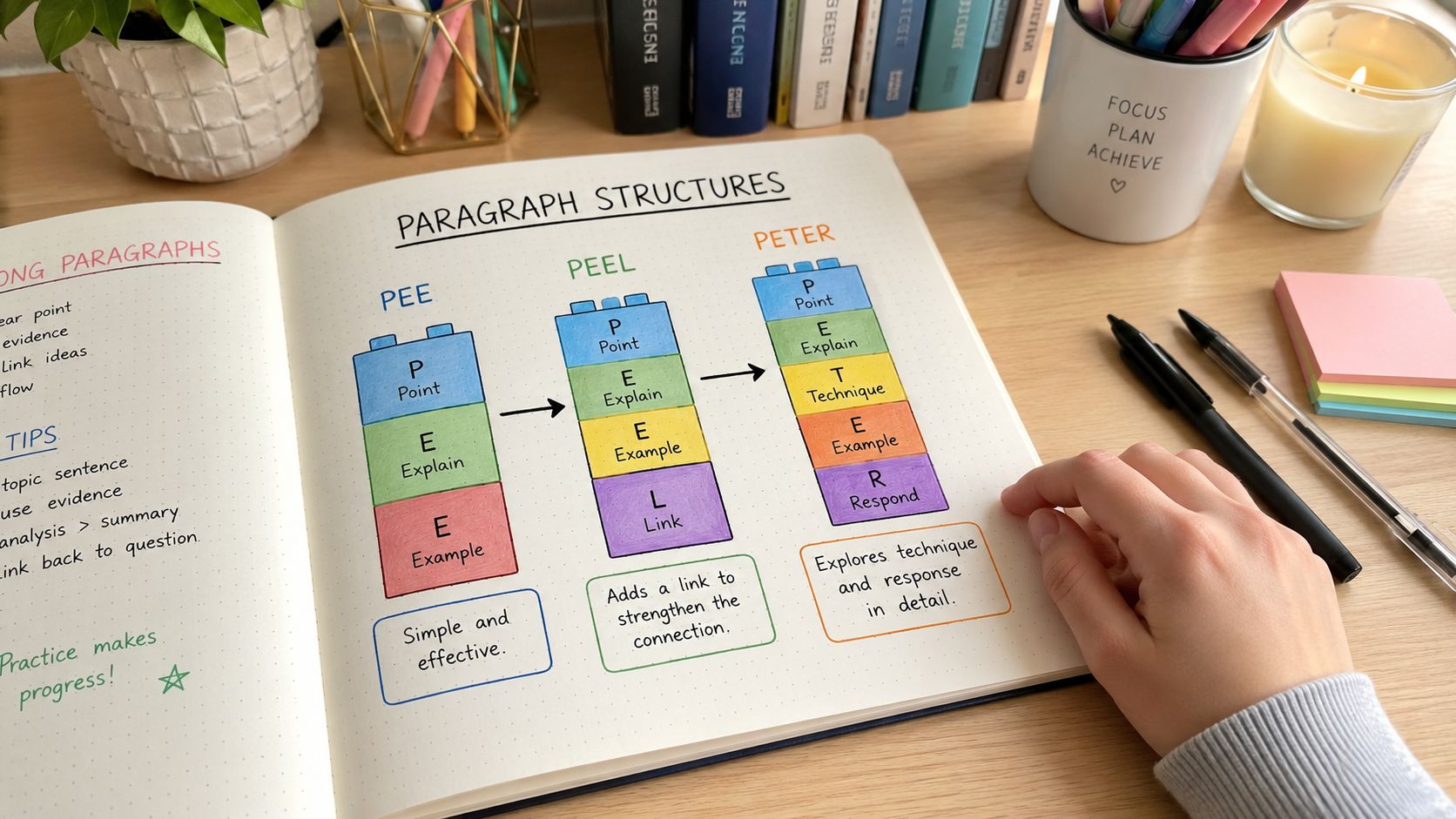
Why paragraph structures still work
Students sometimes reject PEEL or PETER because they sound formulaic. Teachers sometimes worry they flatten real interpretation. Both concerns are understandable.
Used well, though, a paragraph model works like a tray in a canteen. It does not choose the meal for you. It keeps everything from sliding off. In unseen poetry, that structure helps students keep hold of the three things examiners need to see together: an idea, evidence, and analysis.
A useful paragraph usually includes:
- A clear point that answers the task
- Short evidence from the poem
- An explanation of what the quotation suggests
- Analysis of the method such as language, form, or structure
- A link back to the poem's wider meaning
That sequence is not about sounding mechanical. It is about making your thinking visible.
What the examiner is trained to look for
Markers do not award extra credit because a paragraph uses a fancy label like “pathetic fallacy” or “sibilance” if the explanation goes nowhere. They are looking for a line of thought they can follow.
In practice, they tend to reward paragraphs that do three things:
- Stay rooted in the question
- Use quotations briefly and accurately
- Explain how a method shapes meaning, tone, or attitude
That is why a simple, precise paragraph often beats a dramatic, vague one. The examiner can find AO1 and AO2 quickly. If they have to hunt for your point, you make the mark harder to award.
Weak paragraph versus strong paragraph
Let's use an invented line:
“The windows watched the empty street”
Now compare the difference.
| Version | What happens |
|---|---|
| Weak | The poet uses personification in “windows watched”. This creates imagery and makes the poem interesting. |
| Strong | The personification in “windows watched” makes the setting feel unsettling, as if the house itself is alert to absence. The adjective “empty” adds isolation, so the street seems abandoned rather than calm. Together, these choices present the speaker's world as uneasy and exposed. |
The weaker answer identifies a method, but it stops at feature-spotting. The stronger answer gives the examiner something rewardable. It interprets the effect, stays close to the quotation, and links language to the poem's atmosphere.
A paragraph you can actually build under pressure
Here is a model you can adapt in the exam:
The poet presents loneliness as threatening rather than peaceful. In “windows watched”, the personification makes the surroundings seem disturbingly alert, as if absence itself is being observed. The word “empty” then sharpens that feeling, because the street feels abandoned and vulnerable instead of quiet. This use of personification helps present isolation as something oppressive, which answers the question directly and gives the examiner clear AO1 and AO2 evidence.
Notice the order. Point first. Then quotation. Then effect. Then bigger meaning.
That order matters because stressed students often do the reverse. They drop in a quotation, name a technique, and hope meaning appears afterwards. It rarely does.
A quick test for every paragraph
Before you move on, check your paragraph against these questions:
- Does the first sentence give a direct argument about the poem?
- Is my quotation short enough to analyse properly?
- Have I explained the effect of the writer's choice?
- Have I shown how that choice supports the poem's wider idea or tone?
- Could an examiner spot AO1 and AO2 within a few seconds?
If the answer is yes, your paragraph is doing its job.
Timed practice helps this become automatic. Using Exam Practice for A-Level can help students rehearse that paragraph decision-making under realistic conditions, so clear structure still holds up when the clock is running.
Later in revision, it helps to hear a teacher talk through what strong analytical writing sounds like in real time. This video is useful for that:
Mastering Timed Conditions and Comparison Questions
Timed conditions change behaviour. Students who analyse well in class often rush in the exam and start writing before their thinking is ready. That's when answers become repetitive, vague, or unfinished.
The comparison question adds another pressure. You've already worked hard on one poem, and now you're expected to hold a second one in your head and make sensible links without drifting into summary.
Timing is really a decision problem
Most students don't need to write faster first. They need to decide faster.
That means:
- Choosing fewer, better quotations
- Dropping weak points quickly
- Avoiding a long introduction
- Writing complete paragraphs instead of half-planned fragments
A practice environment that mirrors exam pressure can help students get used to that decision-making. One example is Exam Practice for A-Level, which offers timed, examiner-aligned work modes for UK learners.
This kind of visual practice environment can make the pressure feel more familiar before the actual paper:

How to compare without writing two mini-essays
The biggest comparison mistake is separation. Students write a paragraph on poem A, then a paragraph on poem B, and call it comparison. That usually feels bolt-on.
A stronger method is to compare through a central idea.
For example, if the question is about conflict, your paragraph might begin like this:
Both poems present conflict as emotionally damaging, but one speaker sounds defeated while the other sounds resistant.
Now you have a comparative line of argument. From there, you can bring in each poem's methods.
Try this structure:
| Step | What to do |
|---|---|
| Start with a shared idea | Name the similarity or difference clearly |
| Use one quotation from poem A | Analyse the method and effect |
| Link directly to poem B | Use a comparative phrase like “similarly” or “by contrast” |
| Use one quotation from poem B | Analyse its method and effect |
| End with the significance | Show what the comparison reveals overall |
Comparative phrases that actually help
You don't need clunky sentence starters. You need useful links.
- Both poems suggest...
- By contrast, the second poem...
- Similarly, the speaker in...
- Unlike the first poem, this one...
- This creates a harsher effect than in...
Don't compare techniques for the sake of it. Compare what each poet is doing with those techniques.
That's the key. “Both writers use imagery” is weak because almost every poem does. “Both writers use natural imagery, but one makes nature comforting while the other makes it threatening” is comparison with purpose.
What to do under pressure
If the clock is nasty and you're starting to wobble, simplify:
- Pick two solid comparison points.
- Use short quotations only.
- Focus on effect and difference.
- Keep returning to the wording of the question.
A short, clear comparison is worth far more than an ambitious, messy one.
Common Pitfalls and How to Practise Like a Pro
Most students don't lose marks because they're incapable of analysis. They lose marks because of habits. The good news is that habits can change much faster than confidence.
The mistakes that keep appearing
Here are the big ones.
Retelling instead of analysing
If you spend a paragraph explaining what happens in the poem, the examiner learns very little about your analytical skill. Keep plot or situation summary brief.Feature spotting without effect
Naming alliteration, enjambment, metaphor, and caesura doesn't earn much by itself. You need to explain what those choices do.Vague effect language
“This makes the reader think” is usually too generic. Think more precisely. Does it create pity, tension, uncertainty, admiration, discomfort?Huge quotations
Long copied chunks often hide weak analysis. Short quotations force you to stay precise.Ignoring the question focus
A decent paragraph about imagery won't score well if the question asks about power and your paragraph never returns to power.
The better alternative
Use this swap table when you practise:
| Instead of this | Do this |
|---|---|
| “The poem is about sadness” | “The poem presents grief as lingering and difficult to escape” |
| “The writer uses a metaphor” | “The metaphor turns memory into something heavy, making the emotion feel inescapable” |
| “This makes the reader think” | “This creates unease because the speaker sounds uncertain about their own feelings” |
| “The quote shows...” | “The verb suggests...” or “The image implies...” |
Strong answers sound specific. They don't sound inflated.
A practice routine that actually builds skill
Reading lots of poems helps, but only if you practise actively. Passive reading can make you feel busy without changing your writing much.
A stronger weekly routine looks like this:
- Read one unfamiliar poem and write a one-sentence argument about it.
- Annotate for patterns such as repetition, contrast, and shifts.
- Choose only a few quotations and justify why they matter.
- Write one paragraph under time pressure rather than always doing full essays.
- Review your own work by checking whether each paragraph contains interpretation, evidence, method, and effect.
If you want a bank of structured exam materials for this kind of repetition, GCSE Past Papers are useful because they let you practise the reading-to-writing jump that unseen poetry demands.
What good practice feels like
Good practice is a bit uncomfortable. You should be forcing yourself to decide, to trim, to explain, and to improve wording. If every practice session feels easy, you're probably staying in your comfort zone.
Teachers know this already: students improve fastest when they stop asking, “What's the right answer?” and start asking, “How can I prove this reading from the text?”
That's the whole game in unseen poetry analysis. Read carefully. Notice patterns. Build a claim. Support it with exact words. Explain effects with precision. Do that often enough, and the poem on exam day won't feel friendly, but it will feel manageable.
If you want structured support with unseen poetry, essay planning, active recall, and exam-style practice across GCSE and A-Level subjects, MasteryMind is a practical place to revise. It's built around UK specifications, with tasks and feedback designed to reflect how marks are awarded.
Ready to master this topic?
Practise with quizzes, blurt exercises and exam questions on MasteryMind.
7 days Premium · Then free forever · No card, no charge