Pearson Edexcel · GCSE · Art and Design
Course version: Pearson-GCSE-Art-and-Design · Version from Mar 2026
Fine Art – Drawing
This study guide covers the essential principles and practices of Fine Art Drawing for GCSE. It explores expressive mark-making, the use of diverse materials, and how drawing underpins all four Assessment Objectives in your portfolio.
- 7 min read
- 3 worked examples
- 3 practice questions
- 6 key terms
Check what you remember
Read the wording for your board, then hide it and explain Mark-Making in your own words. Rough notes are fine. This is a self-check, with no mark or grade.
Reference: Pearson Edexcel
The different lines, dots, marks, patterns, and textures created in an artwork.
Study Notes
Overview
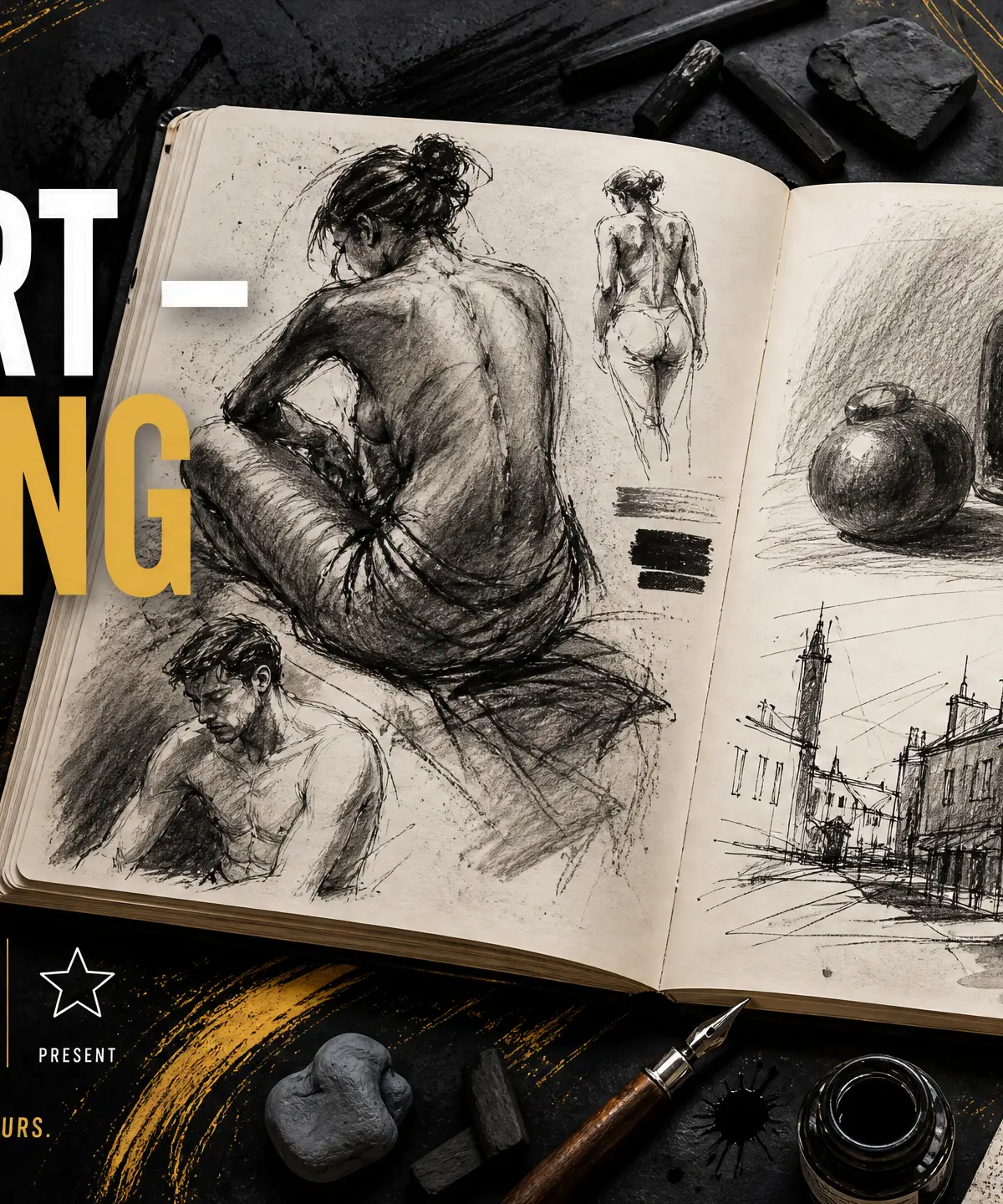
Drawing in Fine Art is far more than producing finished pictures; it is a fundamental language of inquiry. It involves the use of expressive and descriptive mark-making to record observations, explore concepts, and communicate ideas visually. Throughout your GCSE Art and Design course, examiners expect to see drawing integrated deeply into your creative journey. It should not be treated as a series of disjointed tasks, but rather as the connective tissue that links your initial research to your final, resolved outcomes.
Key Knowledge & Theory
Core Concepts
Mark-Making as LanguageMark-making is the foundation of all drawing. A mark is any line, dot, stroke, or texture applied to a surface. In GCSE Fine Art, candidates are rewarded for purposeful mark-making. Every mark should be intentional—whether used to describe texture, suggest movement, or create atmosphere. The difference between a smooth, flowing ink line and a rough, gestural charcoal stroke is significant; examiners look for evidence that you have chosen your marks deliberately to communicate specific intentions.
Tonal Values and FormUnderstanding how light interacts with objects is crucial. Creating a sense of three-dimensional form on a two-dimensional surface requires a deep understanding of tonal values (the range of lightness and darkness). Candidates must move beyond drawing mere outlines to thinking in terms of shapes and tonal relationships.
Integration Across Assessment ObjectivesDrawing must be evident across all four Assessment Objectives (AOs). It is used to develop ideas (AO1), explore materials and techniques (AO2), record observations (AO3), and present personal responses (AO4). Neglecting drawing in the developmental stages significantly limits the marks awarded.
Key Practitioners/Artists
| Name | Period/Style | Key Works | Relevance |
|---|---|---|---|
| Egon Schiele | Early 20th Century / Expressionism | Self-Portrait with Physalis | Master of expressive contour lines and psychologically intense figure drawing. Essential for exploring emotion and identity. |
| Alberto Giacometti | Mid 20th Century / Modernism | Portrait of James Lord | Demonstrates drawing as a process of searching inquiry. His scratchy, layered marks show how to build form through observation. |
| Käthe Kollwitz | Early 20th Century / Expressionism | The Mothers | Achieved extraordinary emotional power through tonal contrast in charcoal and graphite. Brilliant reference for social or emotional themes. |
| David Hockney | Contemporary / Pop Art | The Arrival of Spring (iPad drawings) | Shows how drawing can be playful and deeply observational across both traditional and digital media. |
Technical Vocabulary
- Contour Line: A line that defines the edge or form of an object, often used to suggest volume.
- Chiaroscuro: The use of strong contrasts between light and dark to achieve a sense of volume in modelling three-dimensional objects.
- Gestural Drawing: A loose, energetic style of drawing that captures the movement, feeling, or essence of the subject rather than precise details.
- Hatching/Cross-Hatching: Creating tonal or shading effects with closely spaced parallel lines (hatching) or intersecting sets of parallel lines (cross-hatching).
- Foreshortening: A technique used in perspective to create the illusion of an object receding strongly into the distance or background.
Practical Skills
Techniques & Processes
**Observational Drawing (AO3)**Drawing from direct observation is the backbone of recording.
- Look more than you draw: Spend 60% of your time studying the subject's proportions, light, and textures.
- Think in shapes and tones: Avoid the common mistake of drawing an outline and 'colouring it in'. Instead, map out the areas of light and shadow.
- Use construction lines: Lightly sketch basic proportions before committing to heavy marks or details.
Expressive Mark-MakingExperiment with how you hold your drawing tool. Holding a pencil near the tip gives tight control for detailed work; holding it further back allows for looser, more expressive strokes from the shoulder rather than the wrist. Vary the pressure to create lines that swell and taper.
Materials & Equipment
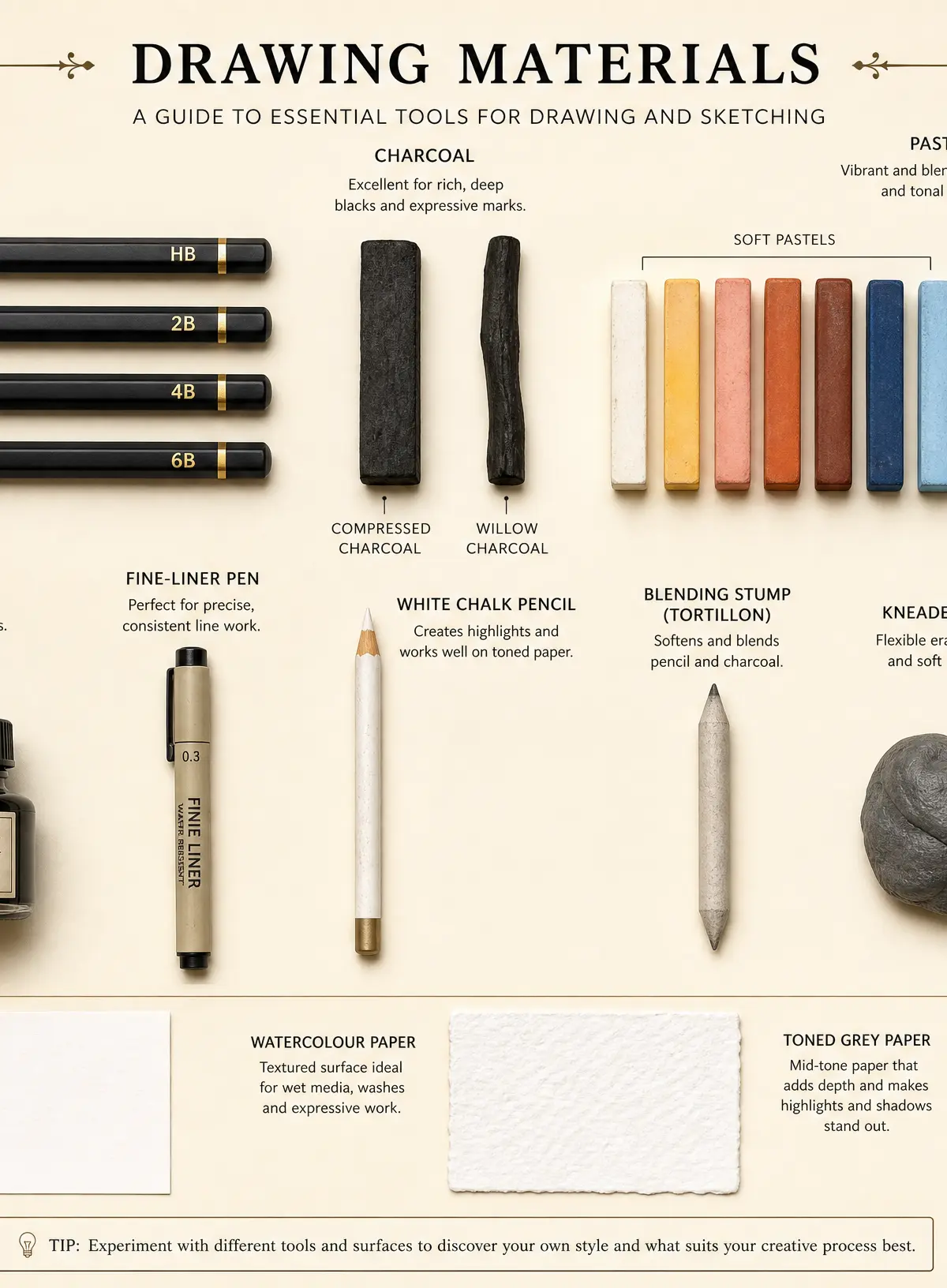
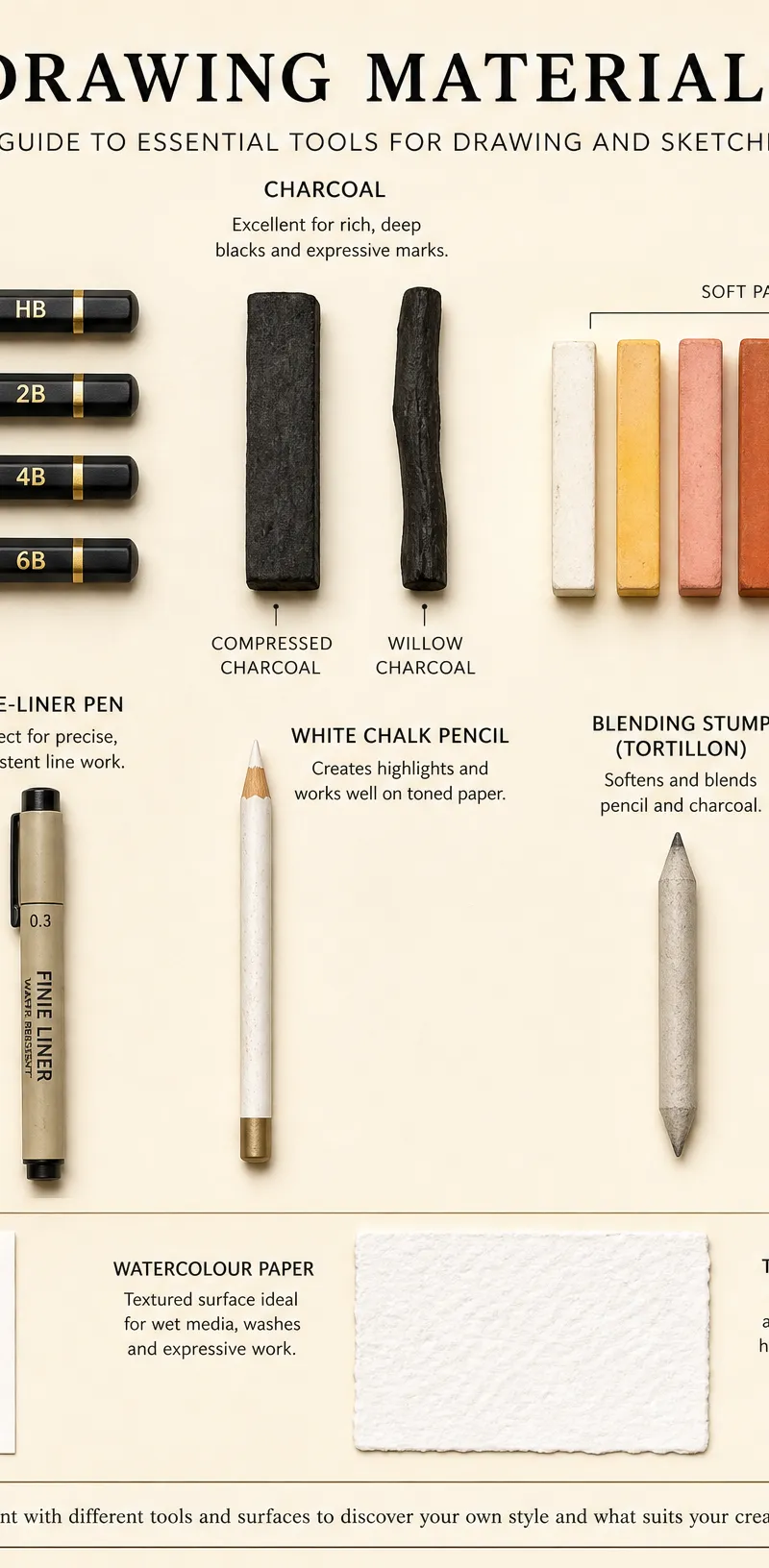
- Graphite Pencils: Essential for versatile sketching. Use H grades for light, precise construction lines, and B grades (2B to 8B) for rich, dark tones.
- Charcoal: Willow charcoal is light and easily blended, perfect for establishing tonal areas. Compressed charcoal is dense and dark, ideal for bold, permanent marks.
- Ink: Dip pens and fine-liners provide decisive lines. Indian ink can be diluted with water to create tonal washes.
- Pastels: Soft pastels offer vibrant, blendable colour; hard pastels are better for precise details.
- Surfaces: Experimenting with surfaces is vital for AO2. Try smooth cartridge paper for detail, textured watercolour paper for expressive washes, and toned paper (grey or brown) to allow the addition of both dark shadows and white highlights.
Portfolio/Coursework Guidance
Assessment Criteria
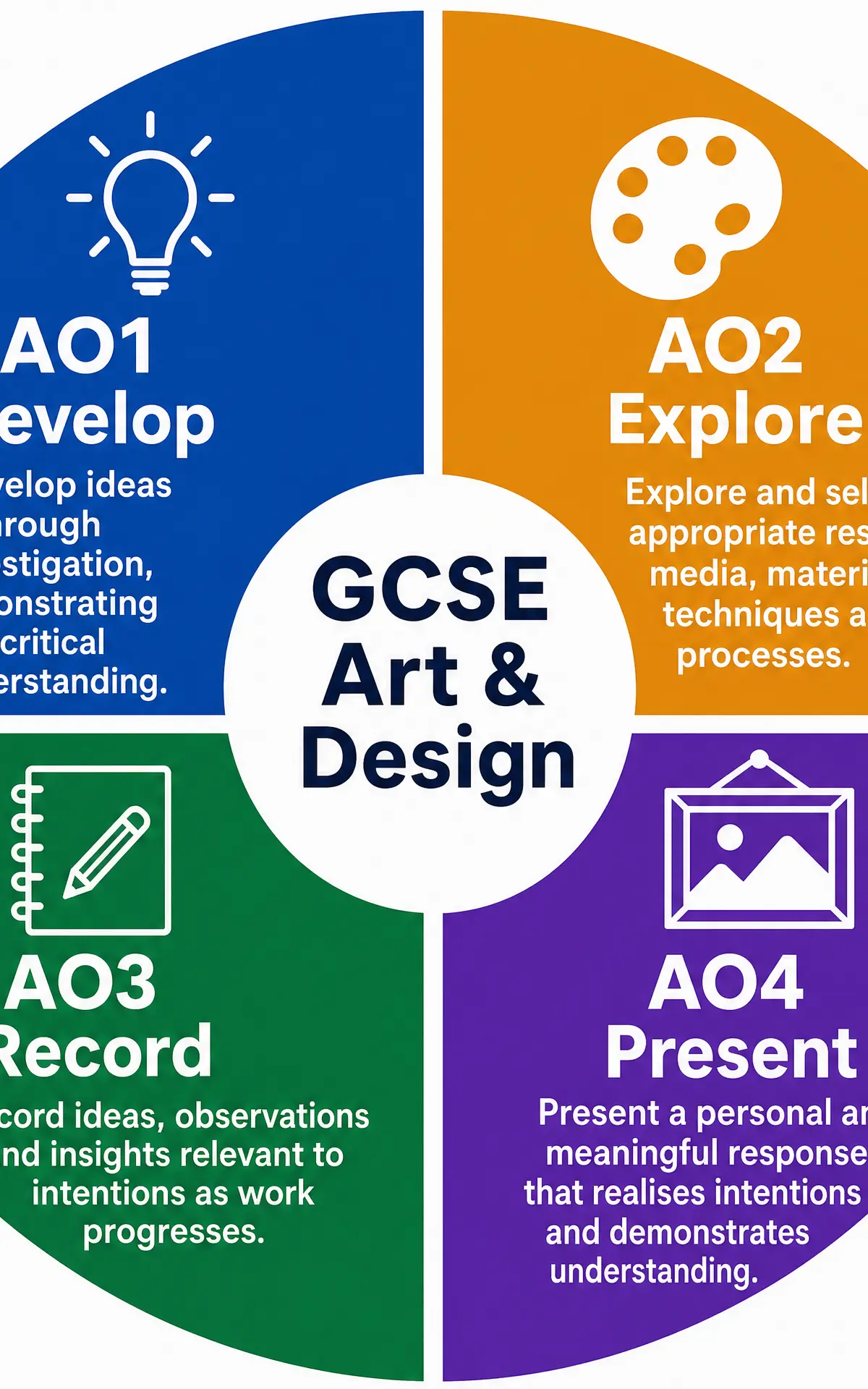
Examiners assess your portfolio across four objectives:
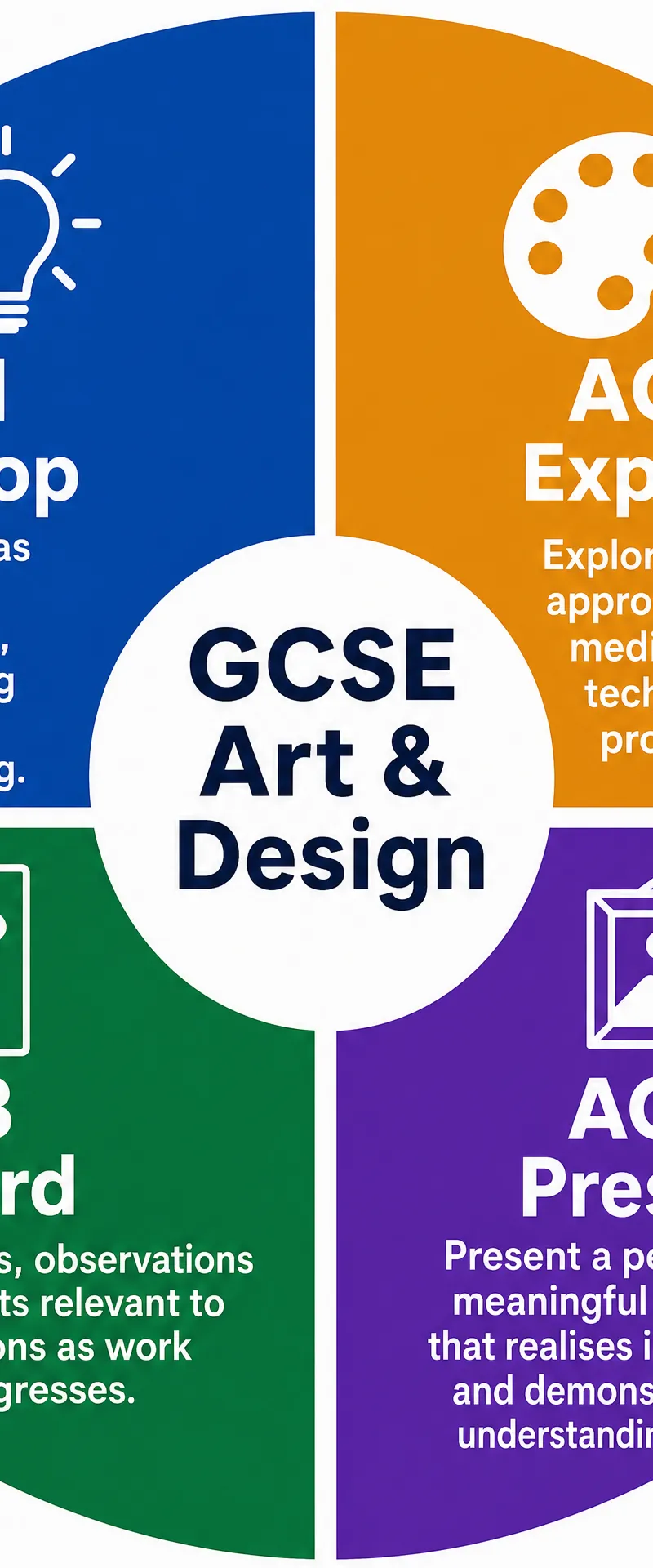
- AO1 (Develop): Developing ideas through investigations, demonstrating critical understanding of sources (artists).
- AO2 (Explore): Exploring and selecting appropriate resources, media, materials, techniques, and processes.
- AO3 (Record): Recording ideas, observations, and insights relevant to intentions as work progresses.
- AO4 (Present): Presenting a personal and meaningful response that realises intentions and demonstrates understanding of visual language.
Building a Strong Portfolio
To secure high marks, your sketchbook must show a coherent journey.
- Show your working: Do not just present finished pieces. Include your mistakes, your experiments, and your quick sketches.
- Purposeful Annotation: Annotation must analyze and reflect, not just describe. Do not write "I drew this in pencil." Write "I used a 6B pencil to create heavy, expressive marks, influenced by Kollwitz, to convey a sense of tension in the figure."
- Iterative Development: Show how one drawing leads to the next. If you try an ink wash that fails, annotate why it failed, and show how you solved the problem in the next drawing using charcoal.
Exam Component
Practical Exam Preparation (Externally Set Task)
The Externally Set Task (EST) requires you to respond to a starting point provided by the exam board. You will have a preparatory period followed by a timed supervised period (usually 10 hours) to create your final outcome.
Preparatory Period Strategy
- Treat the prep period exactly like your coursework portfolio.
- Immediately begin gathering primary source material (AO3) through observational drawing.
- Research relevant artists (AO1) and create transcription drawings to understand their techniques.
- Experiment with different drawing media (AO2) to find the best way to express your ideas.
- Plan your final composition carefully through a series of thumbnail sketches.
The Timed Period
- Your final piece (AO4) must clearly connect to the drawing and development work in your preparatory studies.
- Do not attempt a completely new technique in the exam; use the media you have mastered during the prep period.
Podcast Episode
Listen to the full audio guide for expert advice, examiner insights, and a quick-fire recall quiz.
Visual Resources
2 diagrams and illustrations
Interactive Diagrams
1 interactive diagram to visualise key concepts
Conceptual Flow Outline
The Iterative Drawing Process across Assessment Objectives
Worked Examples
3 worked examples — open one to explore the question and available guidance.
Practice Questions
Try the question, then reveal an answer plan or example response
Explain the difference between drawing from a primary source and drawing from a secondary source, and state why examiners prefer primary sources.
Hint: Think about what you can see when an object is actually in front of you versus looking at a flat photograph.
Evaluate the suitability of using a fine-liner pen versus willow charcoal for a rapid, gestural figure study.
Hint: Consider the physical properties of each medium and how quickly they can cover an area or be altered.
Describe how you would structure the annotation for a page of experimental mixed-media drawings to ensure maximum marks for AO2.
Hint: Don't just list what you did. Think about the cycle of intention, action, and evaluation.
Exam technique
How to turn what you know into marks
How to approach the question
For the Externally Set Task, choose a starting point that immediately sparks visual ideas. Do not spend weeks thinking; start drawing immediately. Let the process of observational drawing generate your ideas.
How to structure your answer
For written annotations: 1. State the material/technique used. 2. Explain WHY you used it. 3. Evaluate its success (what worked/what didn't). 4. State how this will influence your next step.
Timing
In practical exams, time management is about pacing your development. Dedicate roughly 20% of prep time to AO1 (Research), 30% to AO3 (Recording), 30% to AO2 (Experimentation), and 20% to planning. The 10-hour timed period is exclusively for AO4 (Presenting).
Common pitfalls
- Treating drawing as a series of disjointed tasks rather than part of a substantive project.
- Failing to integrate drawing as a core element of the development process.
- Lack of purposeful annotation to analyze and reflect on drawing developments.
- Insufficient evidence of drawing across all four Assessment Objectives.
What the command words want
- Analyse
- Break down the drawing into its formal elements (line, tone, composition) and discuss how they work together.
- Compare
- Look at two different techniques or artists and explicitly discuss their similarities and differences in approach.
- Explain
- State the intention behind the visual choices. Why was that specific technique used?
- Describe
- Detail the visual elements: what marks, tones, and textures are visible?
- Evaluate
- Judge the success of the drawing or experiment. Be critical about what could be improved.
- Identify
- Name the material, technique, or artist clearly.
Watch or listen (optional)
Test your understanding of Fine Art – Drawing
Active recall beats re-reading. Take an instant quiz now to test what you’ve learned and lock it into long-term memory.
7 days Premium · Then the free plan continues · No card, no charge