AQA · A-Level · Biology
All Cells Arise from Other Cells
Master the foundation of all biology: Cells. This comprehensive guide covers cell structure, specialisation, microscopy, and cell division, providing the essential knowledge needed to secure top marks in your GCSE exams.
- 7 min read
- 3 worked examples
- 5 practice questions
- 6 key terms
Study Notes
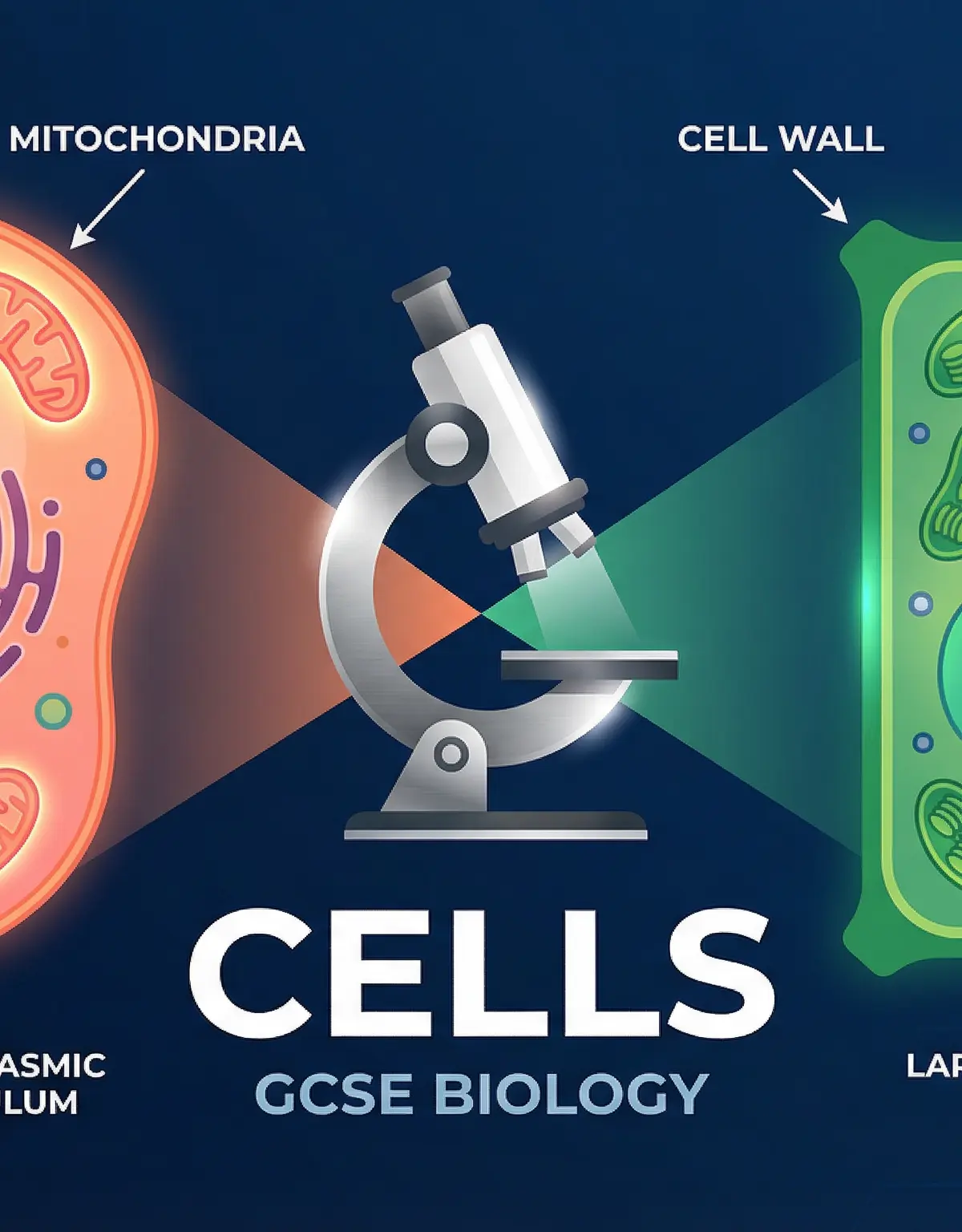
Overview
Welcome to the foundation of GCSE Biology: Cells. Understanding cells is critical because every living organism is made of them, and every other topic in the specification—from human physiology to genetics and ecology—builds upon this core knowledge. Examiners frequently test this topic both as standalone questions and as synoptic links within longer, multi-topic questions. By mastering cell structure, function, and division, you provide yourself with a solid framework for the entire biology course.
This guide covers the key differences between eukaryotic and prokaryotic cells, the function of sub-cellular structures, how cells become specialised for specific roles, the mathematics of microscopy, and the crucial processes of the cell cycle and mitosis. Pay close attention to the required practical on microscopy, as this is a highly examined area where candidates often lose marks on simple unit conversions and method descriptions.
Key Concepts
Concept 1: Eukaryotic and Prokaryotic Cells
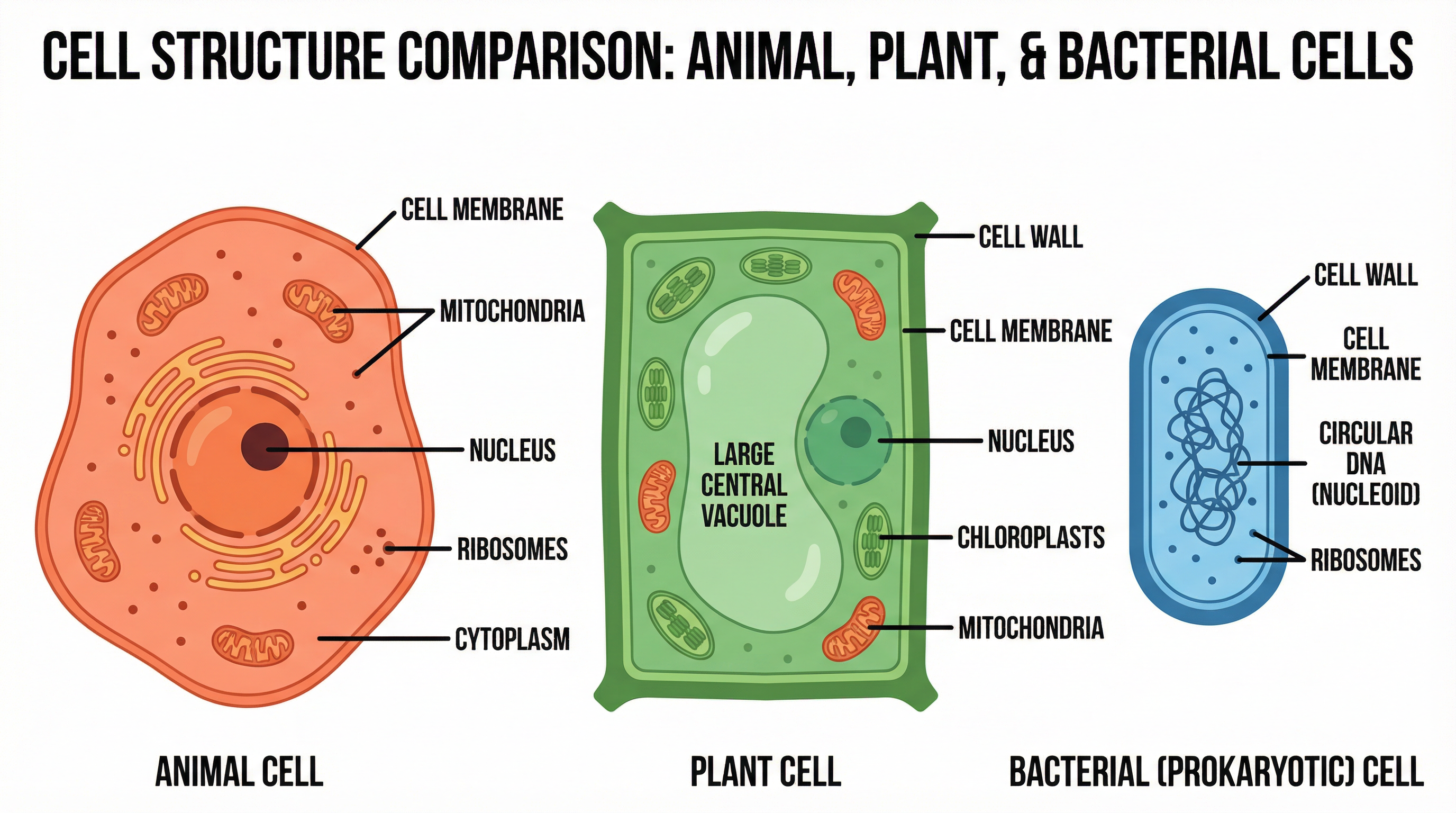
All living cells can be classified into two broad categories: eukaryotic and prokaryotic. Eukaryotic cells, which make up animals, plants, and fungi, are complex and contain a true, membrane-bound nucleus where their genetic material (DNA) is stored. They also contain other membrane-bound organelles such as mitochondria and chloroplasts. Prokaryotic cells, such as bacteria, are much smaller and simpler. They lack a true nucleus; instead, their genetic material consists of a single circular strand of DNA that floats freely in the cytoplasm, often accompanied by smaller rings of DNA called plasmids.
Example: A typical animal cell (eukaryotic) might be 10 - 30 \mu m in diameter, whereas a typical bacterial cell (prokaryotic) is only about 1 \mu m in length. This means a eukaryotic cell is roughly 10 to 100 times larger than a prokaryotic cell.
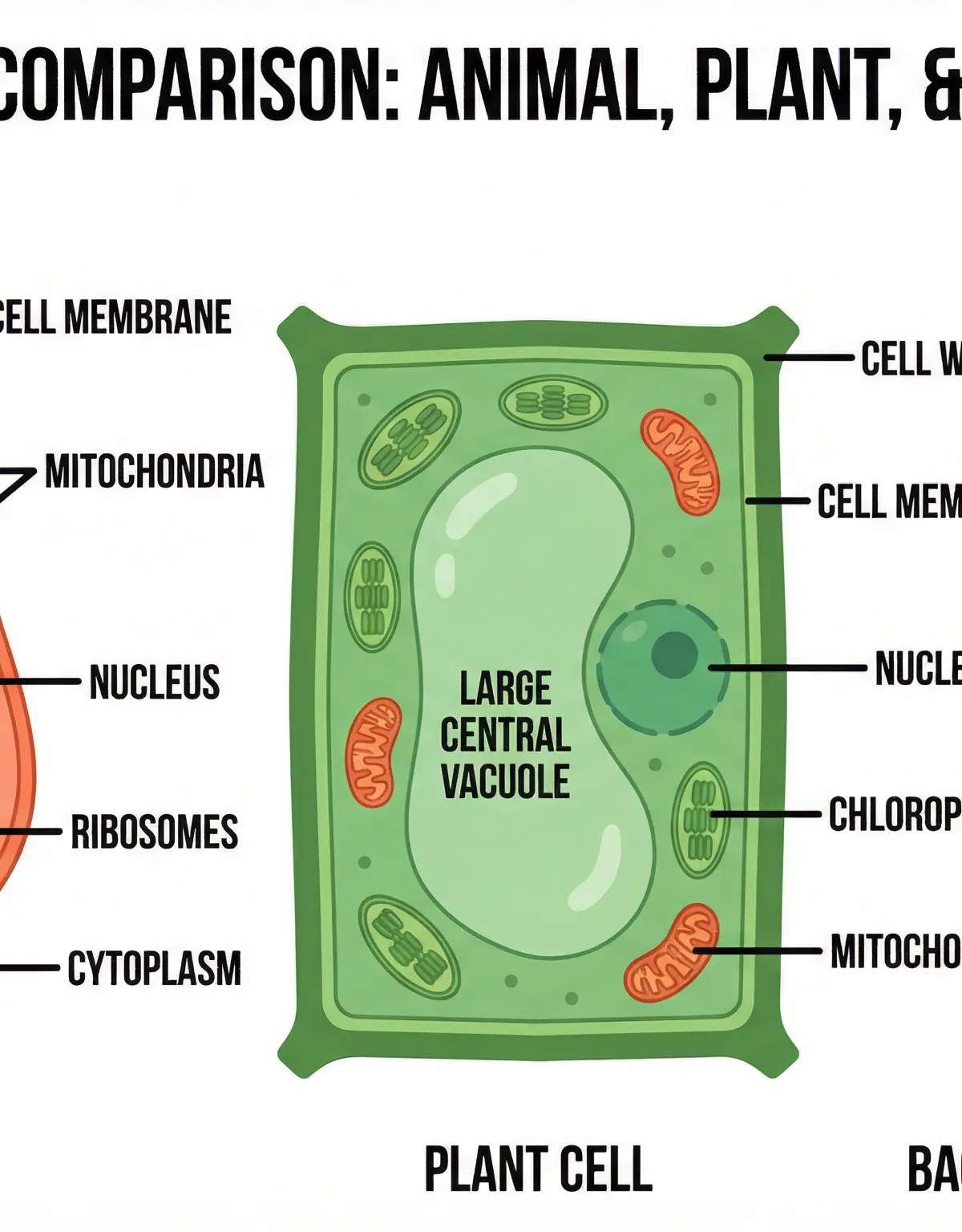
Concept 2: Animal and Plant Cell Structure
Both animal and plant cells share several core sub-cellular structures. The nucleus controls the activities of the cell and contains genetic material. The cytoplasm is a gel-like substance where most chemical reactions take place, containing enzymes that control these reactions. The cell membrane holds the cell together and controls the passage of substances in and out. Mitochondria are the site of most reactions for aerobic respiration, releasing the energy the cell needs to function. Ribosomes are the site of protein synthesis.
Plant cells have three additional structures that animal cells do not. The rigid cell wall, made of cellulose, supports the cell and strengthens it. The permanent vacuole contains cell sap (a weak solution of sugar and salts) and helps keep the cell turgid. Chloroplasts are the site of photosynthesis, containing a green pigment called chlorophyll which absorbs light needed for this process.
Concept 3: Cell Specialisation and Differentiation
Cells don't all look the same. As an organism develops, cells differentiate to form different types of cells, acquiring different sub-cellular structures to enable them to carry out a certain function. This process is called cell specialisation.
For example, a sperm cell is specialised for reproduction. Its function is to get the male DNA to the female DNA. It has a long tail and streamlined head to help it swim to the egg, lots of mitochondria to provide the energy needed, and enzymes in its acrosome to digest through the egg cell membrane.
A nerve cell is specialised for rapid signalling. Its function is to carry electrical signals from one part of the body to another. These cells are long (to cover more distance) and have branched connections at their ends to connect to other nerve cells and form a network throughout the body.
A root hair cell is specialised for absorbing water and minerals. They are cells on the surface of plant roots, which grow into long "hairs" that stick out into the soil. This gives the plant a large surface area for absorbing water and mineral ions from the soil.
Concept 4: The Cell Cycle and Mitosis
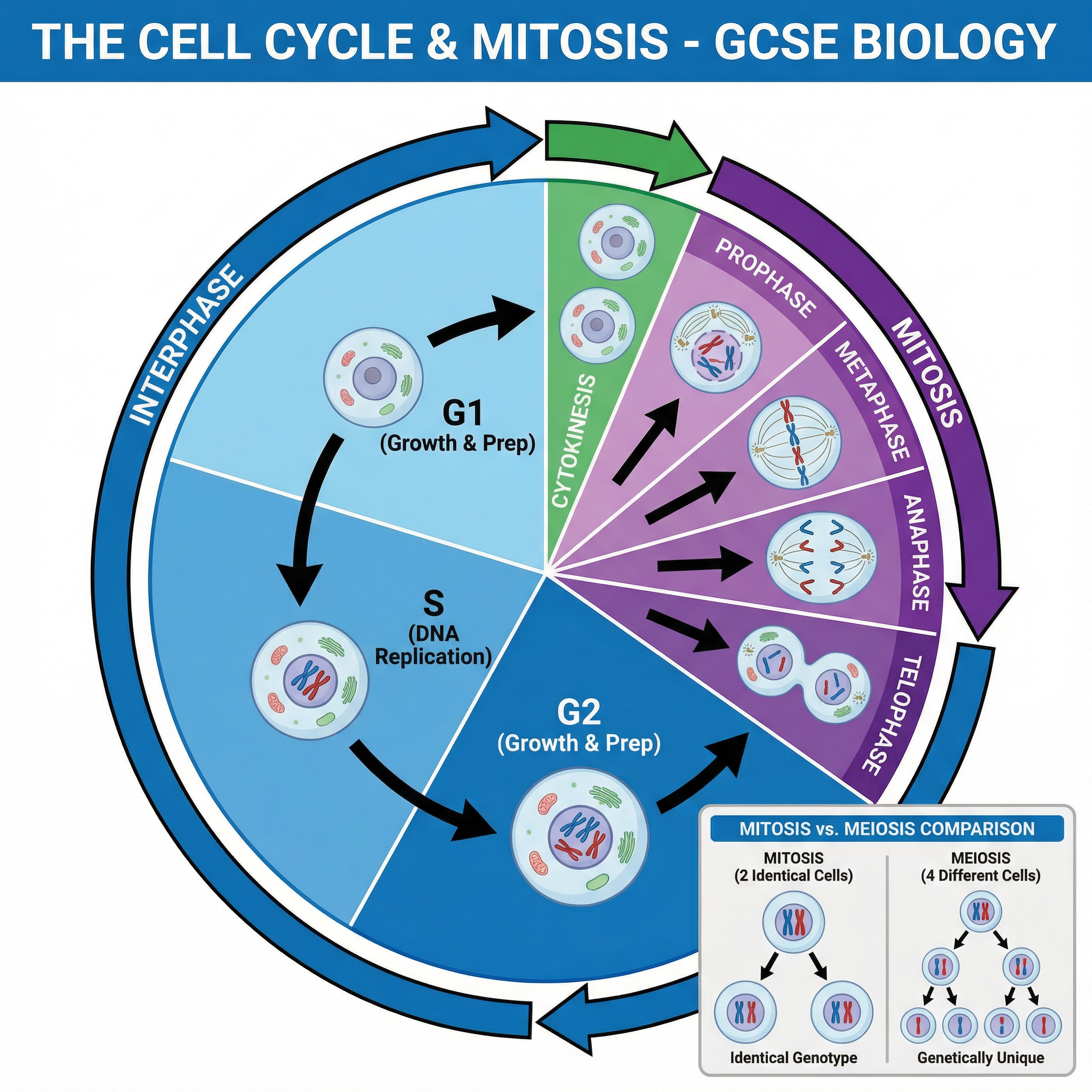
Body cells in multicellular organisms divide to produce new cells as part of a series of stages called the cell cycle. The stage of the cell cycle when the cell divides is called mitosis. Multicellular organisms use mitosis to grow or replace cells that have been damaged. The end result of mitosis is two new cells identical to the original cell, with the same number of chromosomes.
Before a cell can divide, it must grow and increase the amount of sub-cellular structures such as mitochondria and ribosomes. It then duplicates its DNA, so there is one copy for each new cell. The DNA is copied and forms X-shaped chromosomes. Once its contents and DNA have been copied, the cell is ready for mitosis. The chromosomes line up at the centre of the cell and cell fibres pull them apart. The two arms of each chromosome go to opposite ends of the cell. Membranes form around each of the sets of chromosomes, which become the nuclei of the two new cells. Finally, the cytoplasm and cell membrane divide.

Mathematical/Scientific Relationships
Magnification Equation
To calculate the magnification of an image, or to find the actual size of an object if you know the magnification, you must use the magnification equation:
\text{Magnification} = \frac{\text{Image Size}}{\text{Actual Size}}
Key rules for using this formula:
- Always ensure units are the same before dividing. Usually, you will need to convert millimetres (mm) to micrometres (\mu m).
- To convert from mm to \mu m, multiply by 1000.
- To convert from \mu m to mm, divide by 1000.
- Image size is the size of the object as it appears in the drawing or photograph (measure this with your ruler).
- Actual size is the real-life size of the specimen.
Practical Applications
Required Practical: Microscopy
You must know how to use a light microscope to observe, draw and label a selection of plant and animal cells, including a magnification scale.
Method for preparing an onion slide:
- Add a drop of water to the middle of a clean slide.
- Cut up an onion and separate it out into layers. Use tweezers to peel off some epidermal tissue from the bottom of one of the layers.
- Using the tweezers, place the epidermal tissue into the water on the slide.
- Add a drop of iodine solution. Iodine is a stain. Stains are used to highlight objects in a cell by adding colour to them.
- Place a cover slip on top. To do this, stand the cover slip upright on the slide, next to the water droplet. Then carefully tilt and lower it so it covers the specimen. Try not to get any air bubbles under there, as they will obstruct your view of the specimen.
Examiner Tip: When asked to draw cells from a microscope slide, use a sharp pencil, draw clear, unbroken lines, do not use shading or colouring, ensure the drawing takes up at least half the space available, and draw label lines with a ruler.
Visual Resources
2 diagrams and illustrations
Interactive Diagrams
2 interactive diagrams to visualise key concepts
Conceptual Flow Outline
Flowchart showing the sequence of events in the cell cycle and mitosis.
Conceptual Flow Outline
Concept map illustrating how an undifferentiated stem cell can differentiate into various specialised cells.
Worked Examples
3 worked examples — open one to explore the question and available guidance.
Practice Questions
Test your understanding — click to reveal model answers
Name two sub-cellular structures found in plant cells but not in animal cells.
Hint: Think of the acronym CVW.
Explain how a sperm cell is adapted for its function.
Hint: What is the job of a sperm cell? What physical features help it do that job?
A student observed a plant cell using a light microscope. The actual length of the cell was 0.05 mm. The student drew the cell. The drawn cell was 20 mm long. Calculate the magnification of the drawing.
Hint: Use the formula: Magnification = Image Size ÷ Actual Size. Are the units the same?
Evaluate the use of embryonic stem cells compared to adult stem cells in medical research and treatments.
Hint: Consider the biological advantages/disadvantages and the ethical issues for both types.
Explain the advantages of using an electron microscope instead of a light microscope to view cells.
Hint: Think about magnification and resolution.