AQA · A-Level · Biology
Course version: 7402 · Version from Sept 2016
Many cancer treatments are directed at controlling the rate of cell…
Full specification wording
All cells arise from other cells: Many cancer treatments are directed at controlling the rate of cell division.
Because cancer is uncontrolled division, treatments target the cell cycle.
Checked against the AQA 7402 specification (opens in a new tab) on .
- Point 11 of 14
- 4 key terms
Study notes
From the checked teaching notes for this specification point.
The idea
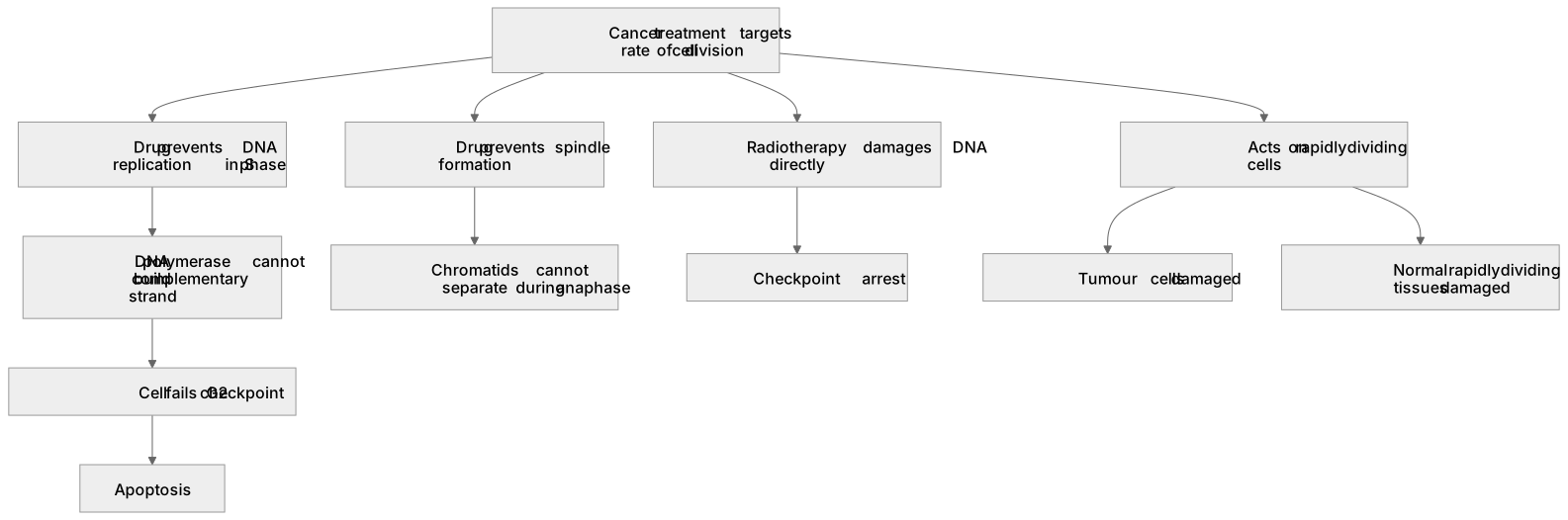
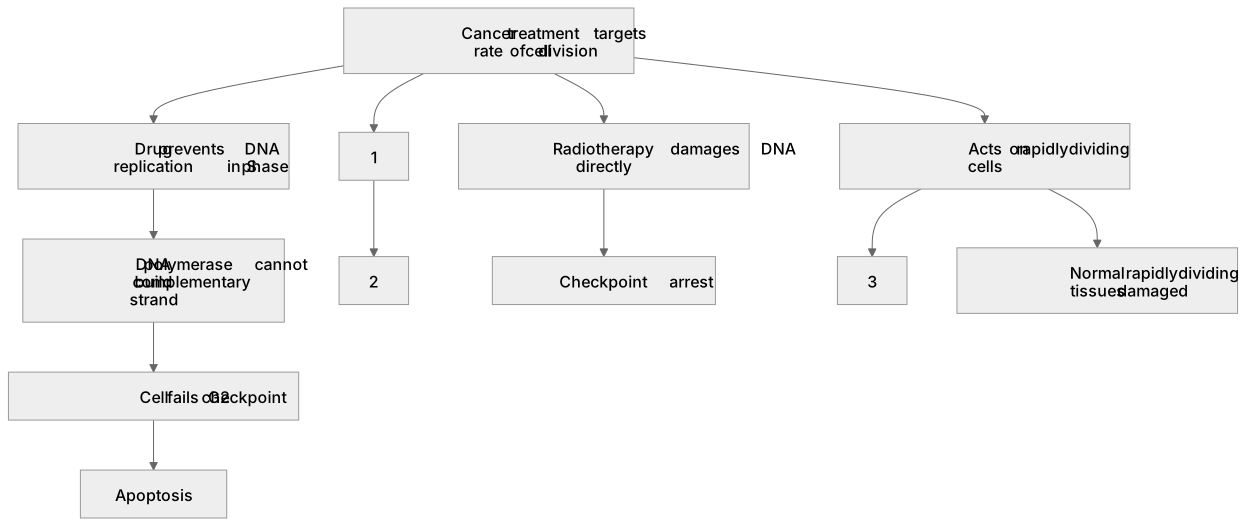
Because cancer is uncontrolled division, treatments target the cell cycle. Some drugs prevent DNA replication during S phase by resembling or damaging nucleotides, stopping DNA polymerase from building a complementary strand. A cell unable to replicate its DNA may fail the G₂ checkpoint and undergo apoptosis. Other drugs, like vinca alkaloids, prevent spindle formation, so chromatids cannot separate during anaphase. Radiotherapy damages DNA directly, triggering checkpoint arrest. A major difficulty is selectivity: treatments act on rapidly dividing cells, so normal tissues that divide quickly, like hair follicles and bone marrow, are also damaged.
What earns the marks
- A drug preventing DNA replication stops the cell completing interphase and dividing.
- A drug preventing spindle formation stops chromatids separating during anaphase.
- Treatments affect rapidly dividing cells, damaging both tumour cells and normal rapidly dividing tissues.
- A named side effect explained by damage to a normal rapidly dividing tissue, such as hair loss or reduced white blood cell production.
- The cell may undergo apoptosis once the cycle is arrested at a checkpoint.
Common mistakes and how to put them right
Saying drugs kill only cancer cells, when they act on any rapidly dividing cell.
Saying a spindle inhibitor prevents DNA replication, or a replication inhibitor prevents spindle formation.
Explaining side effects by the drug being poisonous rather than its effect on normal dividing tissue.
Claiming treatment repairs or removes the mutation from the DNA.
Writing that treatment stops growth rather than stopping cell division.
Exam tips
- Name the specific stage of the cell cycle the treatment acts on, such as S phase or anaphase, to provide a complete explanation.
- For side effects, explicitly name the normal tissue, state that it divides rapidly, and link it to the symptom.
- If data show cell number falling with dose, describe the trend first and then explain it using cell cycle mechanisms.
Try the lesson
The start of the All cells arise from other cells: Many cancer treatments are directed at controlling the rate of cell division. lesson, made from checked teaching notes for this specification point.
Have a go first
Many cancer treatments are directed at controlling the rate of cell division. Why do these treatments often cause side effects such as hair loss and gastrointestinal issues?
Listen
Because cancer is uncontrolled division, treatments target the cell cycle. Some drugs prevent DNA replication during S phase by resembling or damaging nucleotides, stopping DNA polymerase from building a complementary strand. A cell unable to replicate its DNA may fail the G₂ checkpoint and undergo apoptosis. Other drugs, like vinca alkaloids, prevent spindle formation, so chromatids cannot separate during anaphase. Radiotherapy damages DNA directly, triggering checkpoint arrest. A major difficulty is selectivity: treatments act on rapidly dividing cells, so normal tissues that divide quickly, like hair follicles and bone marrow, are also damaged. A strong answer earns marks for these points. A drug preventing DNA replication stops the cell completing interphase and dividing. A drug preventing spindle formation stops chromatids separating during anaphase. Treatments affect rapidly dividing cells, damaging both tumour cells and normal rapidly dividing tissues. A named side effect explained by damage to a normal rapidly dividing tissue, such as hair loss or reduced white blood cell production. Exam tip: Name the specific stage of the cell cycle the treatment acts on, such as S phase or anaphase, to provide a complete explanation.
See it
Key words
Say what each word means before you turn the card.
inhibiting DNA replication
Try answering aloud or in your head before turning the card.
preventing spindle formation
Try answering aloud or in your head before turning the card.
rapidly dividing normal tissue
Try answering aloud or in your head before turning the card.
side effects and dose
Try answering aloud or in your head before turning the card.
See every definition
- inhibiting DNA replication
- Some drugs prevent DNA replication during S phase by resembling or damaging nucleotides, stopping DNA polymerase from building a complementary strand.
- preventing spindle formation
- Other drugs, like vinca alkaloids, prevent spindle formation, so chromatids cannot separate during anaphase.
- rapidly dividing normal tissue
- Treatments act on rapidly dividing cells, so normal tissues that divide quickly, like hair follicles and bone marrow, are also damaged.
- side effects and dose
- A named side effect is explained by damage to a normal rapidly dividing tissue, such as hair loss or reduced white blood cell production.
Label the diagram
Some boxes have lost their names. Pick the right name for each number.
1Box 1
2Box 2
3Box 3
There is more to this lesson
The full lesson goes on to check your understanding and help you earn the marks. Create a free account to carry on, with your progress saved.
A week of Premium from your first lesson · Then the free plan continues · No card, no charge
Test your understanding of All cells arise from other cells: Many cancer treatments are directed at controlling the rate of cell division.
Active recall beats re-reading. Take an instant quiz now to test what you’ve learned and lock it into long-term memory.
A week of Premium from your first lesson · Then the free plan continues · No card, no charge