AQA · A-Level · Biology
Course version: 7402 · Version from Sept 2016
Due to the degenerate nature of the genetic code, not all such mutations…
Full specification wording
Alteration of the sequence of bases in DNA can alter the: Due to the degenerate nature of the genetic code, not all such mutations result in a change to the encoded amino acid.
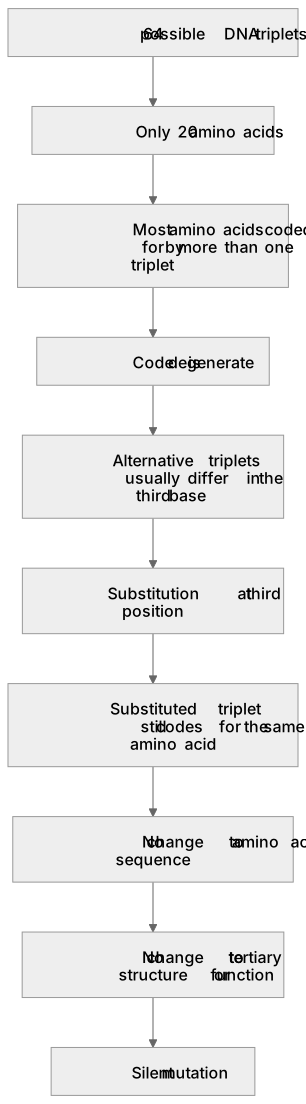
There are 64 possible DNA triplets but only 20 amino acids, so most amino acids are coded for by more than one triplet: the code is degenerate.
Checked against the AQA 7402 specification (opens in a new tab) on .
- Point 6 of 8
Study notes
From the checked teaching notes for this specification point.
The idea
There are 64 possible DNA triplets but only 20 amino acids, so most amino acids are coded for by more than one triplet: the code is degenerate. The alternative triplets for an amino acid usually differ in the third base, so a substitution at that third position often still specifies the same amino acid. When it does, the amino acid sequence of the polypeptide is unchanged, the tertiary structure is unchanged and the protein works normally. This is called a silent mutation, and it is why many mutations have no effect on the phenotype at all. Substitutions in the first or second base are far more likely to change the amino acid.
What earns the marks
- More than one triplet or codon coding for the same amino acid.
- The substituted triplet still coding for the same amino acid.
- No change to the amino acid sequence of the polypeptide, so no change to its tertiary structure or function.
- Stating that a substitution in the third base of a triplet is the most likely to be silent.
- Distinguishing degenerate from universal, where a question about expressing a gene in another species requires universal.
Common mistakes and how to put them right
Answering why bacteria can make a human protein with the code is degenerate, which mark schemes explicitly reject.
Put it right: The required point is that the code is universal.
Claiming degeneracy means one triplet can code for several amino acids, which reverses the definition.
Assuming every substitution is silent.
Thinking a silent mutation means no mutation happened, when the DNA base sequence has genuinely changed.
Using codon for the DNA triplet when the question refers to DNA.
Exam tips
- Learn the three properties of the code as a set, each with a typical question, so you pick the right one under pressure.
- If asked why a mutation had no effect on the protein, name degeneracy and say the new triplet codes for the same amino acid.
- Count triplets and amino acids in your answer: 64 against 20 is a quick, creditable justification.
Try the lesson
The start of the Alteration of the sequence of bases in DNA can alter the: Due to the degenerate nature of the genetic code, not all such mutations result in a change to the encoded amino acid. lesson, made from checked teaching notes for this specification point.
Have a go first
What does it mean that the genetic code is degenerate?
Listen
There are 64 possible DNA triplets but only 20 amino acids, so most amino acids are coded for by more than one triplet: the code is degenerate. The alternative triplets for an amino acid usually differ in the third base, so a substitution at that third position often still specifies the same amino acid. When it does, the amino acid sequence of the polypeptide is unchanged, the tertiary structure is unchanged and the protein works normally. This is called a silent mutation, and it is why many mutations have no effect on the phenotype at all. Substitutions in the first or second base are far more likely to change the amino acid. A strong answer earns marks for these points. more than one triplet or codon coding for the same amino acid. the substituted triplet still coding for the same amino acid. no change to the amino acid sequence of the polypeptide, so no change to its tertiary structure or function. stating that a substitution in the third base of a triplet is the most likely to be silent. Exam tip: Learn the three properties of the code as a set, each with a typical question, so you pick the right one under pressure.
See it
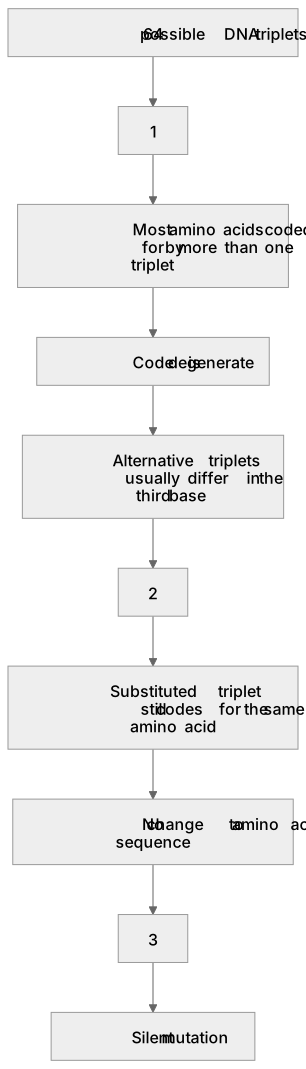
Label the diagram
Some boxes have lost their names. Pick the right name for each number.
1Box 1
2Box 2
3Box 3
There is more to this lesson
The full lesson goes on to check your understanding and help you earn the marks. Create a free account to carry on, with your progress saved.
A week of Premium from your first lesson · Then the free plan continues · No card, no charge
Test your understanding of Alteration of the sequence of bases in DNA can alter the: Due to the degenerate nature of the genetic code, not all such mutations result in a change to the encoded amino acid.
Active recall beats re-reading. Take an instant quiz now to test what you’ve learned and lock it into long-term memory.
A week of Premium from your first lesson · Then the free plan continues · No card, no charge