AQA · A-Level · Biology
Course version: 7402 · Version from Sept 2016
Gene mutations occur spontaneously.
Full specification wording
Alteration of the sequence of bases in DNA can alter the: Gene mutations occur spontaneously.
Spontaneous mutations happen by chance during normal cell activity, primarily as errors in DNA replication, without external causes or relation to an organism's needs.
Checked against the AQA 7402 specification (opens in a new tab) on .
- Point 2 of 8
Study notes
From the checked teaching notes for this specification point.
The idea
Spontaneous mutations happen by chance during normal cell activity, primarily as errors in DNA replication, without external causes or relation to an organism's needs. Every gene has a low, measurable natural mutation rate. This is crucial for evolution, as variation must exist in a population before a selection pressure arises. For example, an allele conferring antibiotic resistance appears by random mutation. The antibiotic acts as a selection pressure, determining which individuals survive and reproduce. Consequently, the frequency of the advantageous allele increases over generations. The pressure does not create the allele; organisms do not mutate to adapt.
What earns the marks
- State that mutations occur at random or by chance, primarily as errors during DNA replication.
- Establish that the mutation occurs before, and independently of, any environmental selection pressure.
- Identify that the mutation produces a new allele, creating genetic variation within the population.
- Explain that selection pressures act on existing variation, increasing the survival and reproductive success of individuals with the advantageous allele.
- Conclude that the frequency of the advantageous allele increases over many generations.
Common mistakes and how to put them right
Writing that an antibiotic, pesticide or pathogen caused the mutation.
Put it right: The mutation is spontaneous and pre-existing.
Stating that organisms mutate to adapt or because they need to, which implies purposeful change rather than random mutation.
Using the term 'gene' where 'allele' is required to describe the new genetic variant.
Saying the 'number' of alleles increases rather than the 'frequency' or 'proportion' of the allele.
Assuming mutation only happens when a mutagen is present, ignoring the natural spontaneous mutation rate.
Exam tips
- Write natural selection answers in a fixed chronological order: mutation, new allele, survival advantage, reproduce and pass on the allele, allele frequency increases over generations.
- Never let the selection pressure appear before the mutation in your sentence order.
- Explicitly state 'over many generations' when describing a change in allele frequency.
Try the lesson
The start of the Alteration of the sequence of bases in DNA can alter the: Gene mutations occur spontaneously. lesson, made from checked teaching notes for this specification point.
Have a go first
Gene mutations are described as spontaneous. What does this mean?
Listen
Spontaneous mutations happen by chance during normal cell activity, primarily as errors in DNA replication, without external causes or relation to an organism's needs. Every gene has a low, measurable natural mutation rate. This is crucial for evolution, as variation must exist in a population before a selection pressure arises. For example, an allele conferring antibiotic resistance appears by random mutation. The antibiotic acts as a selection pressure, determining which individuals survive and reproduce. Consequently, the frequency of the advantageous allele increases over generations. The pressure does not create the allele; organisms do not mutate to adapt. A strong answer earns marks for these points. State that mutations occur at random or by chance, primarily as errors during DNA replication. Establish that the mutation occurs before, and independently of, any environmental selection pressure. Identify that the mutation produces a new allele, creating genetic variation within the population. Explain that selection pressures act on existing variation, increasing the survival and reproductive success of individuals with the advantageous allele. Exam tip: Write natural selection answers in a fixed chronological order: mutation, new allele, survival advantage, reproduce and pass on the allele, allele frequency increases over generations.
See it
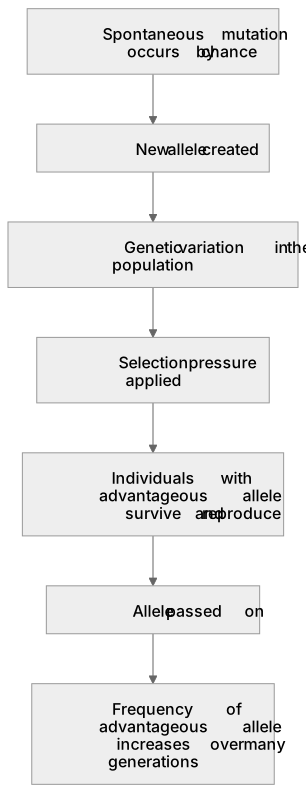
Put it in order
Put these steps in the order they happen.
- 1. Frequency of advantageous allele increases over many generations
- 2. Allele passed on
- 3. Genetic variation in the population
- 4. Individuals with advantageous allele survive and reproduce
- 5. Spontaneous mutation occurs by chance
- 6. New allele created
- 7. Selection pressure applied
Label the diagram
Some boxes have lost their names. Pick the right name for each number.
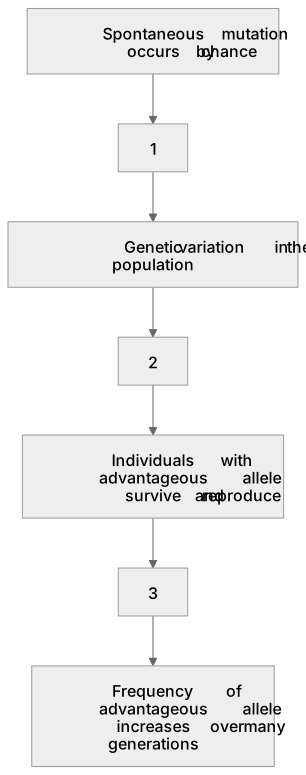
1Box 1
2Box 2
3Box 3
There is more to this lesson
The full lesson goes on to check your understanding and help you earn the marks. Create a free account to carry on, with your progress saved.
A week of Premium from your first lesson · Then the free plan continues · No card, no charge
Test your understanding of Alteration of the sequence of bases in DNA can alter the: Gene mutations occur spontaneously.
Active recall beats re-reading. Take an instant quiz now to test what you’ve learned and lock it into long-term memory.
A week of Premium from your first lesson · Then the free plan continues · No card, no charge