AQA · A-Level · Biology
Course version: 7402 · Version from Sept 2016
Mutations can result in a different amino acid sequence in the encoded…
Full specification wording
Alteration of the sequence of bases in DNA can alter the: Mutations can result in a different amino acid sequence in the encoded polypeptide.
DNA triplets are transcribed into mRNA codons.
Checked against the AQA 7402 specification (opens in a new tab) on .
- Point 4 of 8
- 4 key terms
Study notes
From the checked teaching notes for this specification point.
The idea
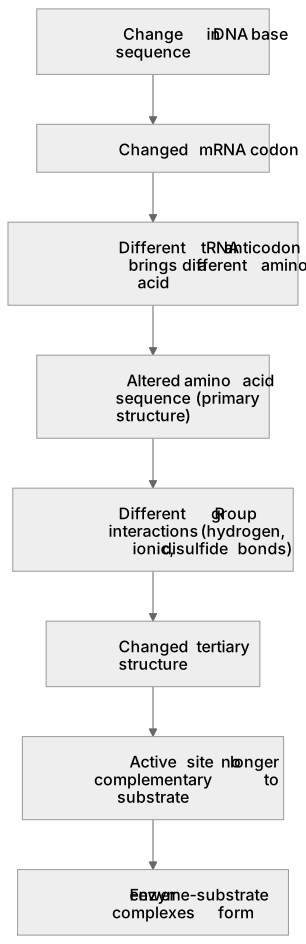
DNA triplets are transcribed into mRNA codons. Most codons are read by a complementary tRNA anticodon carrying a specific amino acid, but stop codons terminate translation without a tRNA. A mutation changing the base sequence can alter the amino acid added. This changes the R group at that position. Polypeptide tertiary structure is held by R group interactions (hydrogen, ionic, disulfide bonds). A different R group alters these bonds, changing the 3D shape.
For example: If an enzyme's active site changes shape, it is no longer complementary to the substrate, preventing enzyme-substrate complexes from forming.
What earns the marks
- A change in the DNA base sequence changes the mRNA codon.
- A different tRNA anticodon brings a different amino acid, altering the primary structure.
- Different R group interactions (such as ionic or disulfide bonds) change the tertiary structure.
- The active site is no longer complementary, so fewer enzyme-substrate complexes form.
- An altered signalling protein can cause rapid, uncontrollable cell division in tumours.
Common mistakes and how to put them right
Stating that 'different amino acids are formed' instead of 'a different sequence of amino acids is produced'.
Claiming the primary structure is unchanged while the tertiary structure changes.
Put it right: A changed amino acid sequence is a changed primary structure.
Saying the enzyme is 'denatured' by a mutation.
Put it right: Denaturation describes the effect of heat or extreme pH, not genetic changes.
Exam tips
- Detail the full sequence: base sequence, codon, amino acid sequence, R group interactions, tertiary structure, then function.
- Explicitly write 'tertiary structure', as examiners often ignore '3D structure' on its own.
Try the lesson
The start of the Alteration of the sequence of bases in DNA can alter the: Mutations can result in a different amino acid sequence in the encoded polypeptide. lesson, made from checked teaching notes for this specification point.
Have a go first
Which statement correctly describes a possible consequence of a substitution mutation in a gene?
Listen
DNA triplets are transcribed into mRNA codons. Most codons are read by a complementary tRNA anticodon carrying a specific amino acid, but stop codons terminate translation without a tRNA. A mutation changing the base sequence can alter the amino acid added. This changes the R group at that position. Polypeptide tertiary structure is held by R group interactions (hydrogen, ionic, disulfide bonds). A different R group alters these bonds, changing the 3D shape. For example, if an enzyme's active site changes shape, it is no longer complementary to the substrate, preventing enzyme-substrate complexes from forming. A strong answer earns marks for these points. A change in the DNA base sequence changes the mRNA codon. A different tRNA anticodon brings a different amino acid, altering the primary structure. Different R group interactions (such as ionic or disulfide bonds) change the tertiary structure. The active site is no longer complementary, so fewer enzyme-substrate complexes form. Exam tip: Detail the full sequence: base sequence, codon, amino acid sequence, R group interactions, tertiary structure, then function.
See it
Put it in order
Put these steps in the order they happen.
- 1. Different R group interactions (hydrogen, ionic, disulfide bonds)
- 2. Fewer enzyme-substrate complexes form
- 3. Changed tertiary structure
- 4. Change in DNA base sequence
- 5. Changed mRNA codon
- 6. Active site no longer complementary to substrate
- 7. Different tRNA anticodon brings a different amino acid
- 8. Altered amino acid sequence (primary structure)
Key words
Say what each word means before you turn the card.
codons and anticodons
Try answering aloud or in your head before turning the card.
amino acid sequence
Try answering aloud or in your head before turning the card.
R group interactions
Try answering aloud or in your head before turning the card.
tertiary structure
Try answering aloud or in your head before turning the card.
See every definition
- codons and anticodons
- DNA triplets are transcribed into mRNA codons, and most codons are read by a complementary tRNA anticodon carrying a specific amino acid.
- amino acid sequence
- A mutation changing the base sequence can alter the amino acid added, so the encoded polypeptide has a different amino acid sequence.
- R group interactions
- Polypeptide tertiary structure is held by these bonds, namely hydrogen, ionic and disulfide bonds, and a different R group alters them.
- tertiary structure
- The 3D shape of a polypeptide, held by R group interactions, which changes when a different R group alters these bonds.
Label the diagram
Some boxes have lost their names. Pick the right name for each number.
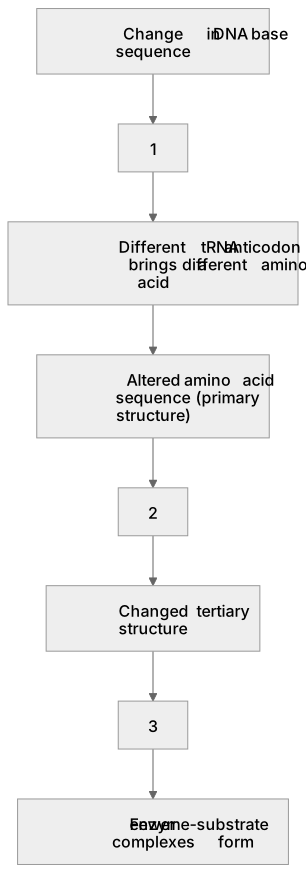
1Box 1
2Box 2
3Box 3
There is more to this lesson
The full lesson goes on to check your understanding and help you earn the marks. Create a free account to carry on, with your progress saved.
A week of Premium from your first lesson · Then the free plan continues · No card, no charge
Test your understanding of Alteration of the sequence of bases in DNA can alter the: Mutations can result in a different amino acid sequence in the encoded polypeptide.
Active recall beats re-reading. Take an instant quiz now to test what you’ve learned and lock it into long-term memory.
A week of Premium from your first lesson · Then the free plan continues · No card, no charge