AQA · A-Level · Biology
Course version: 7402 · Version from Sept 2016
Disaccharides are formed by the condensation of two monosaccharides:…
Full specification wording
Carbohydrates: Disaccharides are formed by the condensation of two monosaccharides: maltose is a disaccharide formed by condensation of two glucose molecules sucrose is a disaccharide formed by condensation of a glucose molecule and a fructose molecule lactose is a disaccharide formed by condensation of a glucose molecule and a galactose molecule.
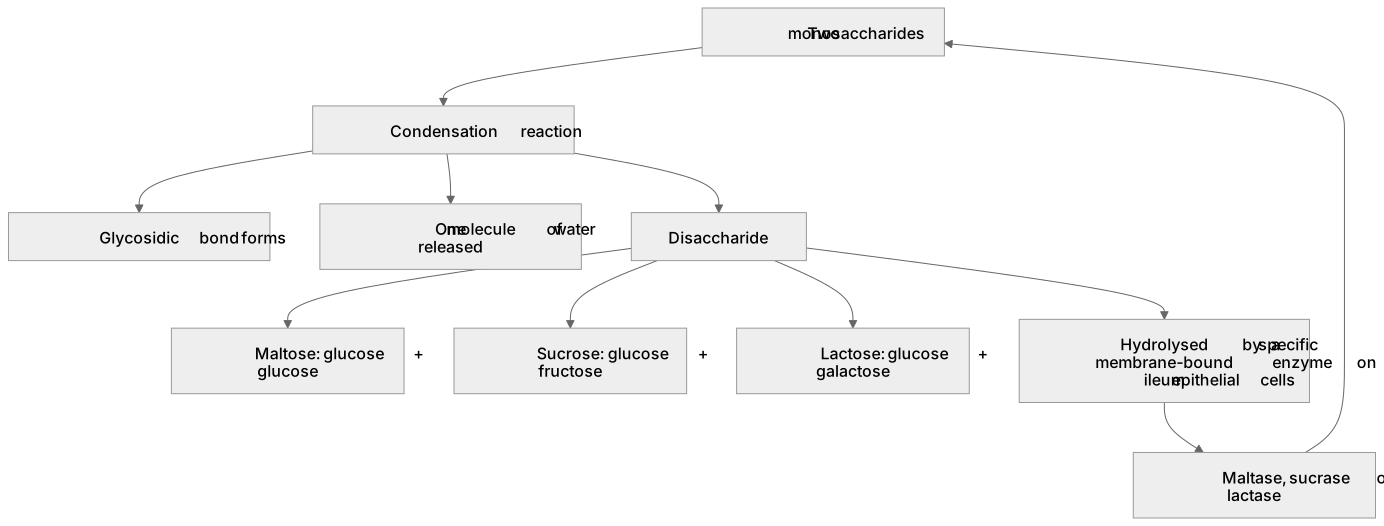
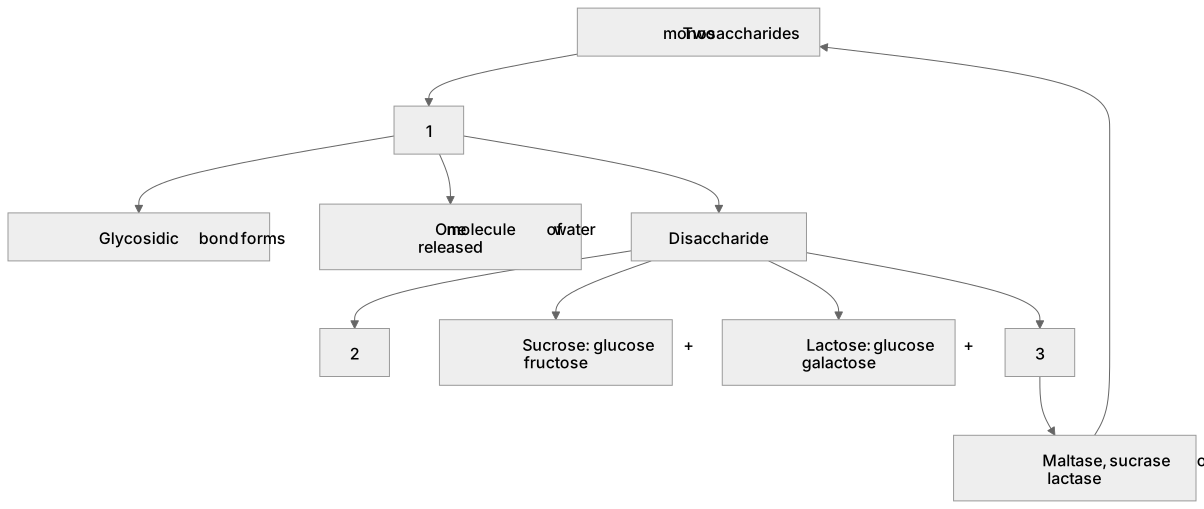
A disaccharide is two monosaccharides joined by a condensation reaction: one glycosidic bond forms and one molecule of water is released.
Checked against the AQA 7402 specification (opens in a new tab) on .
- Point 3 of 8
- 4 key terms
Study notes
From the checked teaching notes for this specification point.
The idea
A disaccharide is two monosaccharides joined by a condensation reaction: one glycosidic bond forms and one molecule of water is released. Learn the three pairings exactly. Maltose is glucose plus glucose, and is the product of starch digestion by amylase. Sucrose is glucose plus fructose, and is the sugar transported in phloem. Lactose is glucose plus galactose, and is the sugar of mammalian milk. Each is hydrolysed back to its monosaccharides by a specific membrane-bound enzyme on the epithelial cells of the ileum - maltase, sucrase and lactase - which is why a person lacking lactase cannot absorb lactose and suffers digestive symptoms. Disaccharides are still small and soluble, so they act as transport and dietary sugars rather than as stores.
What earns the marks
- Stating that two monosaccharides join by condensation, forming a glycosidic bond and releasing water.
- Maltose as two glucose molecules.
- Sucrose as glucose and fructose, and lactose as glucose and galactose.
- Identifying maltose as a disaccharide that must be hydrolysed into glucose before it is respired.
- Naming the specific enzyme that hydrolyses a named disaccharide.
Common mistakes and how to put them right
Swapping the pairings, most often giving sucrose as glucose and galactose.
Describing a disaccharide as a monomer of a polysaccharide.
Saying a disaccharide is formed from two glucose molecules regardless of which disaccharide is named.
Forgetting that sucrose is non-reducing and reporting a brick-red Benedict's result for it.
Stating that two water molecules are released when one disaccharide forms.
Exam tips
- Memorise the three pairings as a short list; they are recall marks that cost nothing to secure.
- If a question gives an unfamiliar disaccharide such as trehalose, apply the general rule - two monosaccharides, one glycosidic bond, hydrolysis needed before use.
- Link each disaccharide to where it is found: maltose from starch digestion, sucrose in phloem, lactose in milk.
Try the lesson
The start of the Carbohydrates: Disaccharides are formed by the condensation of two monosaccharides: maltose is a disaccharide formed by condensation of two glucose molecules sucrose is a disaccharide formed by condensation of a glucose molecule and a fructose molecule lactose is a disaccharide formed by condensation of a glucose molecule and a galactose molecule. lesson, made from checked teaching notes for this specification point.
Have a go first
Which two monosaccharides condense together to form sucrose?
Listen
A disaccharide is two monosaccharides joined by a condensation reaction: one glycosidic bond forms and one molecule of water is released. Learn the three pairings exactly. Maltose is glucose plus glucose, and is the product of starch digestion by amylase. Sucrose is glucose plus fructose, and is the sugar transported in phloem. Lactose is glucose plus galactose, and is the sugar of mammalian milk. Each is hydrolysed back to its monosaccharides by a specific membrane-bound enzyme on the epithelial cells of the ileum - maltase, sucrase and lactase - which is why a person lacking lactase cannot absorb lactose and suffers digestive symptoms. Disaccharides are still small and soluble, so they act as transport and dietary sugars rather than as stores. A strong answer earns marks for these points. stating that two monosaccharides join by condensation, forming a glycosidic bond and releasing water. maltose as two glucose molecules. sucrose as glucose and fructose, and lactose as glucose and galactose. identifying maltose as a disaccharide that must be hydrolysed into glucose before it is respired. Exam tip: Memorise the three pairings as a short list; they are recall marks that cost nothing to secure.
See it
Key words
Say what each word means before you turn the card.
disaccharide formation
Try answering aloud or in your head before turning the card.
maltose, sucrose, lactose
Try answering aloud or in your head before turning the card.
glycosidic bond
Try answering aloud or in your head before turning the card.
specific hydrolysing enzymes
Try answering aloud or in your head before turning the card.
See every definition
- disaccharide formation
- Two monosaccharides join by condensation, forming a glycosidic bond and releasing water.
- maltose, sucrose, lactose
- Maltose is two glucose molecules, sucrose is glucose and fructose, and lactose is glucose and galactose.
- glycosidic bond
- The bond formed when two monosaccharides join by condensation, with one molecule of water released.
- specific hydrolysing enzymes
- Membrane-bound enzymes on the epithelial cells of the ileum hydrolyse each disaccharide back to its monosaccharides.
Label the diagram
Some boxes have lost their names. Pick the right name for each number.
1Box 1
2Box 2
3Box 3
There is more to this lesson
The full lesson goes on to check your understanding and help you earn the marks. Create a free account to carry on, with your progress saved.
A week of Premium from your first lesson · Then the free plan continues · No card, no charge
Test your understanding of Carbohydrates: Disaccharides are formed by the condensation of two monosaccharides: maltose is a disaccharide formed by condensation of two glucose molecules sucrose is a disaccharide formed by condensation of a glucose molecule and a fructose molecule lactose is a disaccharide formed by condensation of a glucose molecule and a galactose molecule.
Active recall beats re-reading. Take an instant quiz now to test what you’ve learned and lock it into long-term memory.
A week of Premium from your first lesson · Then the free plan continues · No card, no charge