AQA · A-Level · Biology
Course version: 7402 · Version from Sept 2016
Glycogen and starch are formed by the condensation of α- glucose.…
Full specification wording
Carbohydrates: Glycogen and starch are formed by the condensation of α- glucose. Cellulose is formed by the condensation of β-glucose.
Starch and glycogen are condensation polymers of alpha-glucose; cellulose is a condensation polymer of beta-glucose.
Checked against the AQA 7402 specification (opens in a new tab) on .
- Point 5 of 8
- 4 key terms
Study notes
From the checked teaching notes for this specification point.
The idea
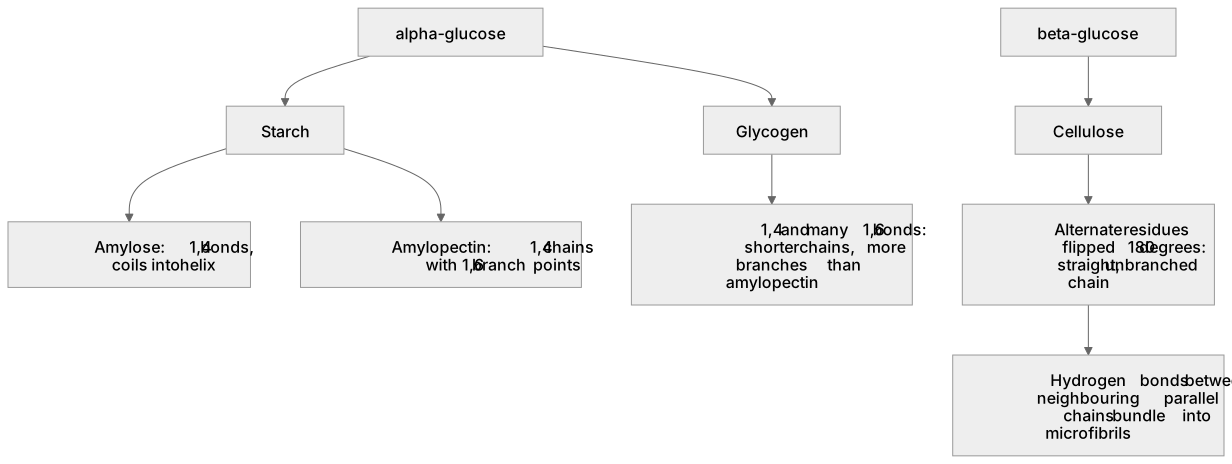
Starch and glycogen are condensation polymers of alpha-glucose; cellulose is a condensation polymer of beta-glucose. Starch is a mixture of two polysaccharides, not a single molecule: amylose, a long unbranched chain of 1,4 glycosidic bonds that coils into a helix, and amylopectin, which has 1,4 chains with 1,6 branch points. Glycogen is the animal and fungal store, also alpha-glucose with 1,4 and many 1,6 bonds, so it has shorter chains and more branches than amylopectin. Cellulose is built from beta-glucose, so alternate residues are flipped through 180 degrees, the chain is straight and unbranched, and hydrogen bonds form between the hydroxyl groups of neighbouring parallel chains, bundling them into microfibrils.
What earns the marks
- Stating that starch is formed from alpha-glucose but cellulose is formed from beta-glucose, written as a comparison.
- Identifying the inverted positions of the hydrogen and hydroxyl groups on carbon 1 as the origin of that difference.
- A shared feature, such as both being polysaccharides, both being glucose polymers or both containing glycosidic bonds.
- Starch being helical or branched while cellulose is straight and unbranched.
- Starch containing 1,6 glycosidic bonds while cellulose does not, or for starch being a mixture of two polysaccharides while cellulose is one.
Common mistakes and how to put them right
Stating that cellulose is made from alpha-glucose.
Writing separate paragraphs about starch and cellulose without linking them, so the points are not comparative.
Treating starch as a single molecule and never mentioning amylose and amylopectin.
Saying glycogen is found in plants or that starch is found in animals.
Claiming cellulose contains 1,6 branch points.
Exam tips
- In compare and contrast questions, write each point as one linked sentence - 'starch has alpha-glucose whereas cellulose has beta-glucose' - because separate statements may not be credited as a comparison.
- Include at least one similarity; full marks on a six-mark compare and contrast usually require one of the 'both' points.
- Use branching as your structural marker: glycogen most branched, amylopectin branched, amylose and cellulose unbranched.
Try the lesson
The start of the Carbohydrates: Glycogen and starch are formed by the condensation of α- glucose. Cellulose is formed by the condensation of β-glucose. lesson, made from checked teaching notes for this specification point.
Have a go first
Which monosaccharide is the monomer used to build cellulose?
Listen
Starch and glycogen are condensation polymers of alpha-glucose; cellulose is a condensation polymer of beta-glucose. Starch is a mixture of two polysaccharides, not a single molecule: amylose, a long unbranched chain of 1,4 glycosidic bonds that coils into a helix, and amylopectin, which has 1,4 chains with 1,6 branch points. Glycogen is the animal and fungal store, also alpha-glucose with 1,4 and many 1,6 bonds, so it has shorter chains and more branches than amylopectin. Cellulose is built from beta-glucose, so alternate residues are flipped through 180 degrees, the chain is straight and unbranched, and hydrogen bonds form between the hydroxyl groups of neighbouring parallel chains, bundling them into microfibrils. A strong answer earns marks for these points. stating that starch is formed from alpha-glucose but cellulose is formed from beta-glucose, written as a comparison. identifying the inverted positions of the hydrogen and hydroxyl groups on carbon 1 as the origin of that difference. a shared feature, such as both being polysaccharides, both being glucose polymers or both containing glycosidic bonds. starch being helical or branched while cellulose is straight and unbranched. Exam tip: In compare and contrast questions, write each point as one linked sentence - 'starch has alpha-glucose whereas cellulose has beta-glucose' - because separate statements may not be credited as a comparison.
See it
Key words
Say what each word means before you turn the card.
amylose and amylopectin
Try answering aloud or in your head before turning the card.
branching and 1,6 bonds
Try answering aloud or in your head before turning the card.
beta-glucose polymer
Try answering aloud or in your head before turning the card.
alpha-glucose polymers
Try answering aloud or in your head before turning the card.
See every definition
- amylose and amylopectin
- Starch is a mixture of two polysaccharides, not a single molecule: amylose, a long unbranched chain of 1,4 glycosidic bonds that coils into a helix, and amylopectin, which has 1,4 chains with 1,6 branch points.
- branching and 1,6 bonds
- Glycogen is alpha-glucose with 1,4 and many 1,6 bonds, so it has shorter chains and more branches than amylopectin.
- beta-glucose polymer
- Cellulose is formed by the condensation of beta-glucose, so alternate residues are flipped through 180 degrees and the chain is straight and unbranched.
- alpha-glucose polymers
- Glycogen and starch are formed by the condensation of alpha-glucose.
Label the diagram
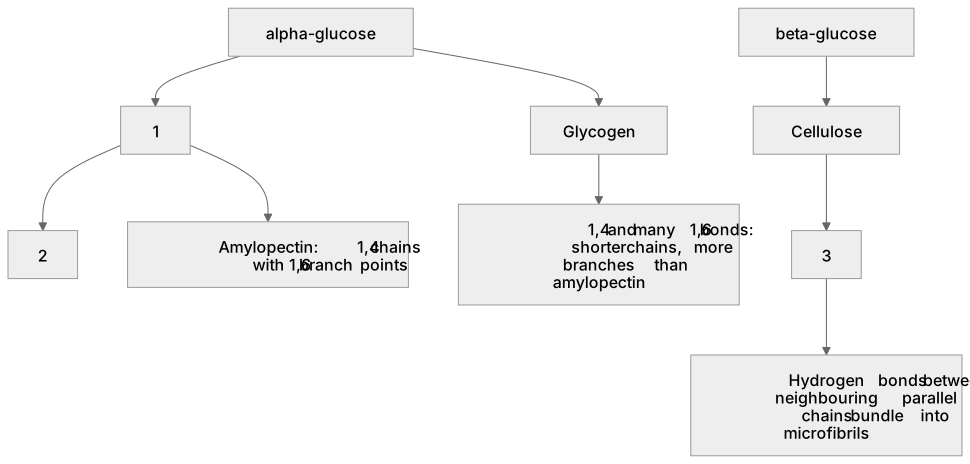
Some boxes have lost their names. Pick the right name for each number.
1Box 1
2Box 2
3Box 3
There is more to this lesson
The full lesson goes on to check your understanding and help you earn the marks. Create a free account to carry on, with your progress saved.
A week of Premium from your first lesson · Then the free plan continues · No card, no charge
Test your understanding of Carbohydrates: Glycogen and starch are formed by the condensation of α- glucose. Cellulose is formed by the condensation of β-glucose.
Active recall beats re-reading. Take an instant quiz now to test what you’ve learned and lock it into long-term memory.
A week of Premium from your first lesson · Then the free plan continues · No card, no charge