AQA · A-Level · Biology
Course version: 7402 · Version from Sept 2016
Osmoregulation as control of the water potential of the blood.
Full specification wording
Control of blood water potential (A-level only): Osmoregulation as control of the water potential of the blood.
Osmoregulation is the homeostatic control of the water potential of blood plasma, which matters because body cells are bathed in tissue fluid derived from plasma, and water moves between these…
Checked against the AQA 7402 specification (opens in a new tab) on .
- Point 1 of 3
- 4 key terms
Study notes
From the checked teaching notes for this specification point.
The idea
Osmoregulation is the homeostatic control of the water potential of blood plasma, which matters because body cells are bathed in tissue fluid derived from plasma, and water moves between these compartments by osmosis. If blood becomes too concentrated, water leaves cells by osmosis and they shrink; if too dilute, water enters and animal cells may burst. The controlled variable is water potential, measured in kPa; pure water is 0 kPa and any solution is negative, so more concentrated plasma has a lower, more negative water potential. Osmoreceptors in the hypothalamus monitor this. Sweating, a salty meal or not drinking makes blood water potential fall; water leaves osmoreceptor cells by osmosis and they shrink, triggering ADH release, so the kidney reabsorbs more water and a small volume of concentrated urine is produced.
What earns the marks
- Identifying the water potential of the blood or plasma as the factor being controlled, rather than simply the water content.
- Osmoreceptors in the hypothalamus detecting the change in water potential.
- Water leaving or entering the osmoreceptor cells by osmosis so that they shrink or swell.
- Linking the response to the volume and the concentration of urine produced.
- Naming the mechanism as negative feedback, with the response returning water potential to normal.
- Stating that body cells are bathed in tissue fluid, not directly in blood plasma, and that water moves between plasma and tissue fluid by osmosis.
Common mistakes and how to put them right
Writing that water potential increases when the blood becomes more concentrated.
Put it right: Adding solute makes water potential more negative, so it falls.
Saying the hypothalamus detects the amount of water in the blood rather than the water potential of the blood.
Put it right: Osmoreceptors respond to water potential changes, detected via osmosis.
Describing osmoreceptors as detecting sodium ions directly, instead of responding to water moving in or out by osmosis.
Put it right: The receptor cells shrink or swell as water moves by osmosis.
Calling the control positive feedback, or leaving out that the response is switched off once normal water potential is restored.
Put it right: This is negative feedback; the response reverses the initial change.
Confusing osmoregulation with excretion.
Put it right: Removing urea is excretion; controlling water potential is osmoregulation.
Stating that every cell sits directly in blood plasma.
Put it right: Most body cells are bathed in tissue fluid, which is derived from plasma.
Exam tips
- Always give the direction of change: a fall in blood water potential means more ADH, more water reabsorbed and less urine.
- Use kPa and remember pure water is 0, so every solution is negative and lower always means more negative.
- This topic appears in synoptic essays, so practise linking water potential, osmosis, receptor proteins and negative feedback in one paragraph.
Try the lesson
The start of the Control of blood water potential (A-level only): Osmoregulation as control of the water potential of the blood. lesson, made from checked teaching notes for this specification point.
Have a go first
Which structure detects changes in the water potential of the blood and is involved in osmoregulation?
Listen
Osmoregulation is the homeostatic control of the water potential of blood plasma, which matters because body cells are bathed in tissue fluid derived from plasma, and water moves between these compartments by osmosis. If blood becomes too concentrated, water leaves cells by osmosis and they shrink; if too dilute, water enters and animal cells may burst. The controlled variable is water potential, measured in kPa; pure water is 0 kPa and any solution is negative, so more concentrated plasma has a lower, more negative water potential. Osmoreceptors in the hypothalamus monitor this. Sweating, a salty meal or not drinking makes blood water potential fall; water leaves osmoreceptor cells by osmosis and they shrink, triggering ADH release, so the kidney reabsorbs more water and a small volume of concentrated urine is produced. A strong answer earns marks for these points. Identifying the water potential of the blood or plasma as the factor being controlled, rather than simply the water content. Osmoreceptors in the hypothalamus detecting the change in water potential. Water leaving or entering the osmoreceptor cells by osmosis so that they shrink or swell. Linking the response to the volume and the concentration of urine produced. A common slip: Writing that water potential increases when the blood becomes more concentrated. Instead, adding solute makes water potential more negative, so it falls. Exam tip: Always give the direction of change: a fall in blood water potential means more ADH, more water reabsorbed and less urine.
See it
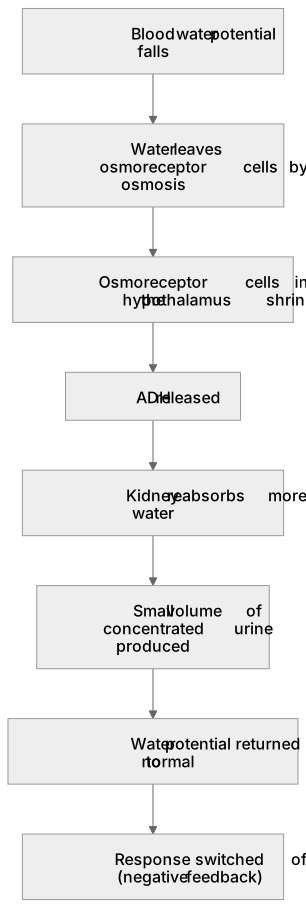
Put it in order
Put these steps in the order they happen.
- 1. Kidney reabsorbs more water
- 2. Response switched off (negative feedback)
- 3. Small volume of concentrated urine produced
- 4. Blood water potential falls
- 5. Water leaves osmoreceptor cells by osmosis
- 6. Water potential returned to normal
- 7. Osmoreceptor cells in the hypothalamus shrink
- 8. ADH released
Key words
Say what each word means before you turn the card.
water potential of blood
Try answering aloud or in your head before turning the card.
osmoreceptors
Try answering aloud or in your head before turning the card.
hypothalamus
Try answering aloud or in your head before turning the card.
negative feedback
Try answering aloud or in your head before turning the card.
See every definition
- water potential of blood
- The factor being controlled in osmoregulation, measured in kPa, where pure water is 0 kPa and any solution is negative, so more concentrated plasma has a lower, more negative water potential.
- osmoreceptors
- Cells in the hypothalamus that monitor water potential; when blood water potential falls, water leaves them by osmosis and they shrink, triggering ADH release.
- hypothalamus
- The location of the osmoreceptors that monitor the water potential of the blood.
- negative feedback
- The mechanism by which the response returns water potential to normal, reversing the initial change.
Label the diagram
Some boxes have lost their names. Pick the right name for each number.
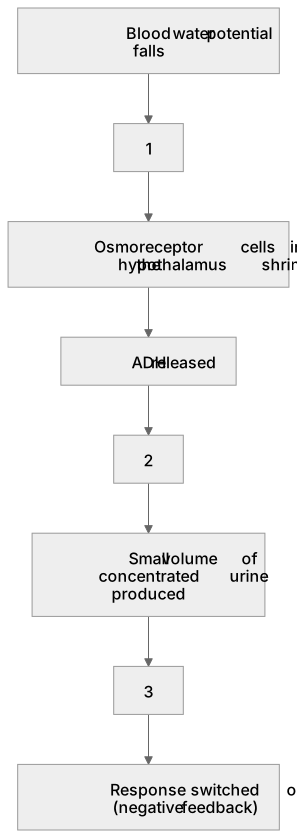
1Box 1
2Box 2
3Box 3
There is more to this lesson
The full lesson goes on to check your understanding and help you earn the marks. Create a free account to carry on, with your progress saved.
A week of Premium from your first lesson · Then the free plan continues · No card, no charge
Test your understanding of Control of blood water potential (A-level only): Osmoregulation as control of the water potential of the blood.
Active recall beats re-reading. Take an instant quiz now to test what you’ve learned and lock it into long-term memory.
A week of Premium from your first lesson · Then the free plan continues · No card, no charge