AQA · A-Level · Biology
Course version: 7402 · Version from Sept 2016
Myogenic stimulation of the heart and transmission of a subsequent wave of…
Full specification wording
Control of heart rate (A-level only): Myogenic stimulation of the heart and transmission of a subsequent wave of electrical activity.
Cardiac muscle is myogenic: it contracts rhythmically without nerve impulses.
Checked against the AQA 7402 specification (opens in a new tab) on .
- Point 1 of 3
- 3 key terms
Study notes
From the checked teaching notes for this specification point.
The idea
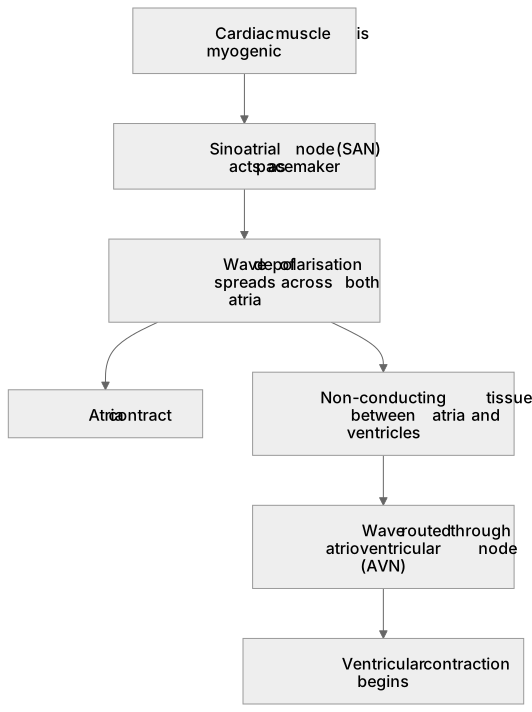
Cardiac muscle is myogenic: it contracts rhythmically without nerve impulses. The intrinsic rhythm originates in the sinoatrial node (SAN) in the right atrium, which depolarises spontaneously to set the basic heart rate. A wave of depolarisation spreads across both atria, causing atrial systole. Cardiac muscle cells are electrically coupled via gap junctions, allowing ions to pass directly. A band of non-conducting connective tissue between the atria and ventricles prevents the wave passing straight down. Consequently, ventricular contraction only begins after the wave is routed through the atrioventricular node (AVN).
What earns the marks
- Cardiac muscle is myogenic, contracting without stimulation by nerve impulses.
- The sinoatrial node acts as the pacemaker, originating the wave of electrical activity.
- A wave of depolarisation spreads across both atria, stimulating them to contract.
- Non-conducting tissue between atria and ventricles prevents the wave passing directly downwards.
- The autonomic nervous system alters the rate of the heartbeat rather than initiating it.
Common mistakes and how to put them right
Using vague terms like 'message' or 'signal' instead of 'wave of depolarisation' or 'impulses'.
Saying the brain initiates each heartbeat, rather than modifying the baseline myogenic rate.
Describing the wave as travelling along nerves inside the heart rather than passing between muscle cells.
Exam tips
- Define myogenic clearly as contracting without nerve stimulation to secure foundational marks.
- Use precise terminology such as 'wave of depolarisation' and avoid vague terms like 'signal'.
Try the lesson
The start of the Control of heart rate (A-level only): Myogenic stimulation of the heart and transmission of a subsequent wave of electrical activity. lesson, made from checked teaching notes for this specification point.
Have a go first
What is meant by the term myogenic, when used to describe the heart?
Listen
Cardiac muscle is myogenic: it contracts rhythmically without nerve impulses. The intrinsic rhythm originates in the sinoatrial node (SAN) in the right atrium, which depolarises spontaneously to set the basic heart rate. A wave of depolarisation spreads across both atria, causing atrial systole. Cardiac muscle cells are electrically coupled via gap junctions, allowing ions to pass directly. A band of non-conducting connective tissue between the atria and ventricles prevents the wave passing straight down. Consequently, ventricular contraction only begins after the wave is routed through the atrioventricular node (AVN). A strong answer earns marks for these points. Cardiac muscle is myogenic, contracting without stimulation by nerve impulses. The sinoatrial node acts as the pacemaker, originating the wave of electrical activity. A wave of depolarisation spreads across both atria, stimulating them to contract. Non-conducting tissue between atria and ventricles prevents the wave passing directly downwards. Exam tip: Define myogenic clearly as contracting without nerve stimulation to secure foundational marks.
See it
Key words
Say what each word means before you turn the card.
myogenic contraction
Try answering aloud or in your head before turning the card.
sinoatrial node as pacemaker
Try answering aloud or in your head before turning the card.
wave of depolarisation
Try answering aloud or in your head before turning the card.
See every definition
- myogenic contraction
- Cardiac muscle contracts rhythmically without stimulation by nerve impulses.
- sinoatrial node as pacemaker
- The sinoatrial node acts as the pacemaker, originating the wave of electrical activity.
- wave of depolarisation
- A wave of depolarisation spreads across both atria, stimulating them to contract.
Label the diagram
Some boxes have lost their names. Pick the right name for each number.
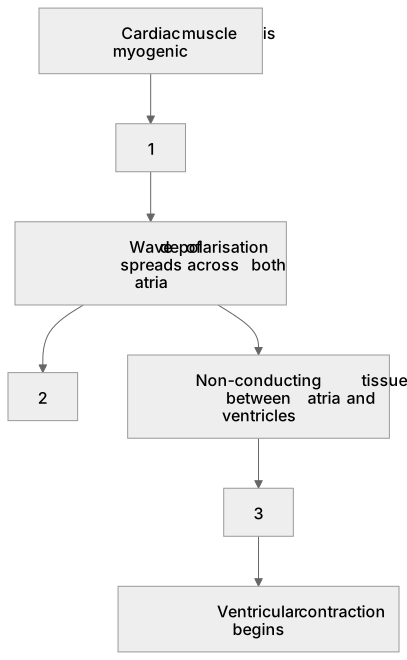
1Box 1
2Box 2
3Box 3
There is more to this lesson
The full lesson goes on to check your understanding and help you earn the marks. Create a free account to carry on, with your progress saved.
A week of Premium from your first lesson · Then the free plan continues · No card, no charge
Test your understanding of Control of heart rate (A-level only): Myogenic stimulation of the heart and transmission of a subsequent wave of electrical activity.
Active recall beats re-reading. Take an instant quiz now to test what you’ve learned and lock it into long-term memory.
A week of Premium from your first lesson · Then the free plan continues · No card, no charge