AQA · A-Level · Biology
Course version: 7402 · Version from Sept 2016
The use of labelled DNA probes and DNA hybridisation to locate specific…
Full specification wording
Differences in DNA between individuals of the same species can be exploited: The use of labelled DNA probes and DNA hybridisation to locate specific alleles of genes.
A DNA probe is a short, single-stranded DNA fragment with a base sequence complementary to the target allele.
Checked against the AQA 7402 specification (opens in a new tab) on .
- Point 1 of 4
- 4 key terms
Study notes
From the checked teaching notes for this specification point.
The idea
A DNA probe is a short, single-stranded DNA fragment with a base sequence complementary to the target allele. It carries a label, such as a radioactive phosphorus-32 tag detected on X-ray film, or a fluorescent tag visible under UV light. To locate an allele, the sample DNA is first amplified by PCR. It is then heated to break hydrogen bonds, making it single-stranded. The labelled probe is added and the mixture cooled. If the target allele is present, the probe binds to its complementary sequence via hydrogen bonding—this is DNA hybridisation. Finally, unbound probes are washed away, and the label's presence is detected to locate the specific allele.
What earns the marks
- Using PCR to amplify the DNA sample before testing.
- Heating the DNA to break hydrogen bonds and make it single-stranded.
- Adding a labelled DNA probe that binds to the target allele by complementary base pairing.
- Washing away unbound probes so only hybridised probes remain.
- Detecting the allele using fluorescence under UV light or radioactivity on X-ray film.
Common mistakes and how to put them right
Stating the probe is just 'complementary' without explicitly saying it binds or hybridises to the DNA.
Forgetting that the sample DNA must be heated to become single-stranded before the probe can bind.
Leaving the probe unlabelled in descriptions, meaning there is no way to detect where it has bound.
Exam tips
- Always name the label and how it is detected: fluorescence under UV light or radioactivity on X-ray film.
- Use the term 'hybridisation' explicitly when describing the probe binding to the target DNA.
Try the lesson
The start of the Differences in DNA between individuals of the same species can be exploited: The use of labelled DNA probes and DNA hybridisation to locate specific alleles of genes. lesson, made from checked teaching notes for this specification point.
Have a go first
What is a DNA probe? Select the correct answer.
Listen
A DNA probe is a short, single-stranded DNA fragment with a base sequence complementary to the target allele. It carries a label, such as a radioactive phosphorus-32 tag detected on X-ray film, or a fluorescent tag visible under UV light. To locate an allele, the sample DNA is first amplified by PCR. It is then heated to break hydrogen bonds, making it single-stranded. The labelled probe is added and the mixture cooled. If the target allele is present, the probe binds to its complementary sequence via hydrogen bonding—this is DNA hybridisation. Finally, unbound probes are washed away, and the label's presence is detected to locate the specific allele. A strong answer earns marks for these points. using PCR to amplify the DNA sample before testing. heating the DNA to break hydrogen bonds and make it single-stranded. adding a labelled DNA probe that binds to the target allele by complementary base pairing. washing away unbound probes so only hybridised probes remain. Exam tip: Always name the label and how it is detected: fluorescence under UV light or radioactivity on X-ray film.
See it
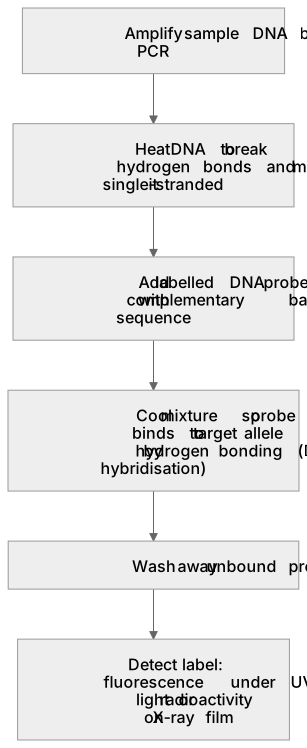
Put it in order
Put these steps in the order they happen.
- 1. Add labelled DNA probe with complementary base sequence
- 2. Heat DNA to break hydrogen bonds and make it single-stranded
- 3. Amplify sample DNA by PCR
- 4. Detect label: fluorescence under UV light or radioactivity on X-ray film
- 5. Wash away unbound probes
- 6. Cool mixture so probe binds to target allele by hydrogen bonding (DNA hybridisation)
Key words
Say what each word means before you turn the card.
DNA probes
Try answering aloud or in your head before turning the card.
DNA hybridisation
Try answering aloud or in your head before turning the card.
labelling
Try answering aloud or in your head before turning the card.
locating alleles
Try answering aloud or in your head before turning the card.
See every definition
- DNA probes
- A short, single-stranded DNA fragment with a base sequence complementary to the target allele, carrying a label.
- DNA hybridisation
- The probe binds to the complementary sequence of the target allele via hydrogen bonding.
- labelling
- The probe carries a radioactive phosphorus-32 tag detected on X-ray film, or a fluorescent tag visible under UV light.
- locating alleles
- The sample DNA is amplified by PCR, heated to break hydrogen bonds, the labelled probe added and cooled, unbound probes washed away, and the label's presence detected.
Label the diagram
Some boxes have lost their names. Pick the right name for each number.
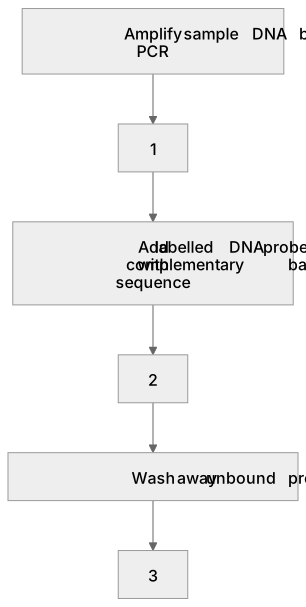
1Box 1
2Box 2
3Box 3
There is more to this lesson
The full lesson goes on to check your understanding and help you earn the marks. Create a free account to carry on, with your progress saved.
A week of Premium from your first lesson · Then the free plan continues · No card, no charge
Test your understanding of Differences in DNA between individuals of the same species can be exploited: The use of labelled DNA probes and DNA hybridisation to locate specific alleles of genes.
Active recall beats re-reading. Take an instant quiz now to test what you’ve learned and lock it into long-term memory.
A week of Premium from your first lesson · Then the free plan continues · No card, no charge