AQA · A-Level · Biology
Course version: 7402 · Version from Sept 2016
Digestion in mammals of: carbohydrates by amylases and membrane-bound…
Full specification wording
Digestion and absorption: Digestion in mammals of: carbohydrates by amylases and membrane-bound disaccharidases lipids by lipase, including the action of bile salts proteins by endopeptidases, exopeptidases and membrane- bound dipeptidases.
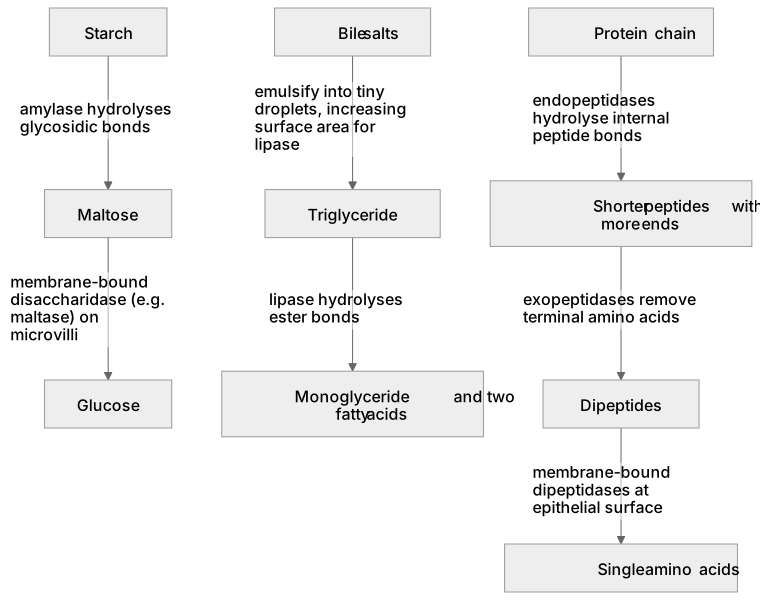
Salivary and pancreatic amylase hydrolyse the glycosidic bonds in starch to maltose.
Checked against the AQA 7402 specification (opens in a new tab) on .
- Point 2 of 3
- 4 key terms
Study notes
From the checked teaching notes for this specification point.
The idea
Salivary and pancreatic amylase hydrolyse the glycosidic bonds in starch to maltose. Membrane-bound disaccharidases such as maltase, sucrase and lactase sit in the cell-surface membrane of the epithelial cells on the microvilli of the ileum, completing digestion to monosaccharides at the site of absorption. Pancreatic lipase hydrolyses the ester bonds of a triglyceride to a monoglyceride and two fatty acids. Bile salts, made in the liver, do not hydrolyse anything: they emulsify lipid droplets into many tiny droplets, greatly increasing the surface area on which lipase can act, raising the rate of digestion. Proteins are hydrolysed in stages: endopeptidases hydrolyse peptide bonds inside the chain, creating shorter peptides with more ends; exopeptidases remove terminal amino acids; membrane-bound dipeptidases hydrolyse dipeptides to single amino acids at the epithelial surface.
What earns the marks
- Amylase hydrolyses glycosidic bonds in starch to produce maltose; a membrane-bound disaccharidase such as maltase then hydrolyses maltose to glucose.
- State that the disaccharidase is membrane-bound on the microvilli of the epithelial cells, not secreted into the lumen.
- Lipase hydrolyses the ester bonds of a triglyceride to produce a monoglyceride and two fatty acids.
- Bile salts emulsify lipids into smaller droplets, increasing the surface area on which lipase can act and so raising the rate of hydrolysis; they do not hydrolyse bonds themselves.
- Endopeptidases hydrolyse internal peptide bonds, creating shorter peptides with more ends; exopeptidases remove terminal amino acids; membrane-bound dipeptidases hydrolyse dipeptides to single amino acids.
- For each enzyme, link bond hydrolysed to product formed, e.g. peptide bond to amino acids, ester bond to monoglyceride and fatty acids.
Common mistakes and how to put them right
Saying bile salts digest or hydrolyse lipids.
Put it right: Bile salts emulsify lipids, increasing surface area for lipase; they hydrolyse nothing.
Writing that amylase breaks starch straight into glucose.
Put it right: Amylase gives maltose, then a membrane-bound disaccharidase gives glucose.
Saying disaccharidases are secreted into the lumen.
Put it right: They are membrane-bound on the microvilli of epithelial cells.
Swapping endopeptidase and exopeptidase.
Put it right: Endopeptidases cut internal peptide bonds; exopeptidases remove terminal amino acids.
Writing 'protease' throughout when the question names specific enzyme groups.
Put it right: Name endopeptidases, exopeptidases and dipeptidases as appropriate.
Exam tips
- Build each digestion point from bond plus enzyme plus product, so write all three each time.
- Place membrane-bound enzymes (disaccharidases, dipeptidases) in the cell-surface membrane of the epithelial cells, not in the lumen.
- For proteins, sequence endopeptidases, exopeptidases and dipeptidases, stating the bond each hydrolyses and why the order speeds digestion.
Try the lesson
The start of the Digestion and absorption: Digestion in mammals of: carbohydrates by amylases and membrane-bound disaccharidases lipids by lipase, including the action of bile salts proteins by endopeptidases, exopeptidases and membrane- bound dipeptidases. lesson, made from checked teaching notes for this specification point.
Have a go first
Which enzyme hydrolyses starch into maltose during digestion in mammals?
Listen
Salivary and pancreatic amylase hydrolyse the glycosidic bonds in starch to maltose. Membrane-bound disaccharidases such as maltase, sucrase and lactase sit in the cell-surface membrane of the epithelial cells on the microvilli of the ileum, completing digestion to monosaccharides at the site of absorption. Pancreatic lipase hydrolyses the ester bonds of a triglyceride to a monoglyceride and two fatty acids. Bile salts, made in the liver, do not hydrolyse anything: they emulsify lipid droplets into many tiny droplets, greatly increasing the surface area on which lipase can act, raising the rate of digestion. Proteins are hydrolysed in stages: endopeptidases hydrolyse peptide bonds inside the chain, creating shorter peptides with more ends; exopeptidases remove terminal amino acids; membrane-bound dipeptidases hydrolyse dipeptides to single amino acids at the epithelial surface. A strong answer earns marks for these points. Amylase hydrolyses glycosidic bonds in starch to produce maltose; a membrane-bound disaccharidase such as maltase then hydrolyses maltose to glucose. State that the disaccharidase is membrane-bound on the microvilli of the epithelial cells, not secreted into the lumen. Lipase hydrolyses the ester bonds of a triglyceride to produce a monoglyceride and two fatty acids. Bile salts emulsify lipids into smaller droplets, increasing the surface area on which lipase can act and so raising the rate of hydrolysis; they do not hydrolyse bonds themselves. A common slip: Saying bile salts digest or hydrolyse lipids. Instead, bile salts emulsify lipids, increasing surface area for lipase; they hydrolyse nothing. Exam tip: Build each digestion point from bond plus enzyme plus product, so write all three each time.
See it
Key words
Say what each word means before you turn the card.
amylase and maltose
Try answering aloud or in your head before turning the card.
membrane-bound disaccharidases
Try answering aloud or in your head before turning the card.
bile salts and emulsification
Try answering aloud or in your head before turning the card.
endopeptidases and exopeptidases
Try answering aloud or in your head before turning the card.
See every definition
- amylase and maltose
- Amylase hydrolyses glycosidic bonds in starch to produce maltose, which a membrane-bound disaccharidase such as maltase then hydrolyses to glucose.
- membrane-bound disaccharidases
- These sit in the cell-surface membrane of the epithelial cells on the microvilli of the ileum, completing digestion to monosaccharides at the site of absorption.
- bile salts and emulsification
- Made in the liver, they do not hydrolyse anything but emulsify lipid droplets into many tiny droplets, greatly increasing the surface area on which lipase can act.
- endopeptidases and exopeptidases
- The former hydrolyse peptide bonds inside the chain, creating shorter peptides with more ends, while the latter remove terminal amino acids.
Label the diagram
Some boxes have lost their names. Pick the right name for each number.
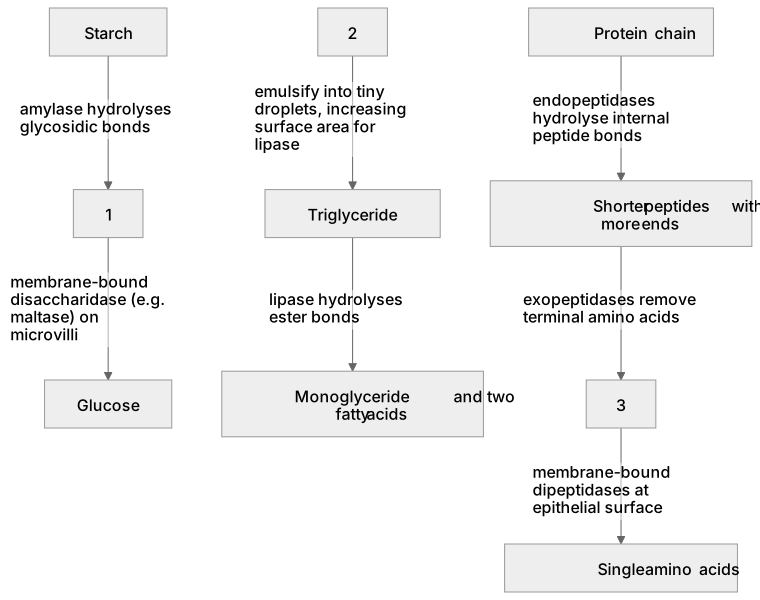
1Box 1
2Box 2
3Box 3
There is more to this lesson
The full lesson goes on to check your understanding and help you earn the marks. Create a free account to carry on, with your progress saved.
A week of Premium from your first lesson · Then the free plan continues · No card, no charge
Test your understanding of Digestion and absorption: Digestion in mammals of: carbohydrates by amylases and membrane-bound disaccharidases lipids by lipase, including the action of bile salts proteins by endopeptidases, exopeptidases and membrane- bound dipeptidases.
Active recall beats re-reading. Take an instant quiz now to test what you’ve learned and lock it into long-term memory.
A week of Premium from your first lesson · Then the free plan continues · No card, no charge