AQA · A-Level · Biology
Course version: 7402 · Version from Sept 2016
In eukaryotes, transcription results in the production of pre- mRNA; this…
Full specification wording
DNA and protein synthesis: In eukaryotes, transcription results in the production of pre- mRNA; this is then spliced to form mRNA.
A eukaryotic gene is split: coding sequences called exons are interrupted by non-coding sequences called introns.
Checked against the AQA 7402 specification (opens in a new tab) on .
- Point 5 of 7
- 4 key terms
Study notes
From the checked teaching notes for this specification point.
The idea
A eukaryotic gene is split: coding sequences called exons are interrupted by non-coding sequences called introns. Transcription copies the whole gene, introns and exons alike, producing pre-mRNA. Before it can be translated, spliceosomes cut the pre-mRNA at the intron-exon boundaries, remove the introns and join the exons together, forming mature mRNA. This then leaves the nucleus through a nuclear pore and attaches to a ribosome. Splicing matters for two reasons. First, if the introns remained, the ribosome would read them in triplets and build a completely wrong polypeptide. Second, the exons from one pre-mRNA can be joined in different combinations, so a single gene can yield several different mRNAs and therefore several different polypeptides, which is part of the reason the proteome is larger than the genome.
What earns the marks
- Transcription produces pre-mRNA containing both introns and exons.
- Splicing removes the introns and joins the exons together.
- The mature mRNA leaves the nucleus through a nuclear pore and attaches to a ribosome.
- Bacteria have no spliceosomes, so they cannot splice pre-mRNA or remove introns.
- Different combinations of exons produce different mRNAs, and so different polypeptides, from one gene.
Common mistakes and how to put them right
Saying exons are removed and introns are joined.
Put it right: This is the wrong way round.
Claiming introns are cut out of the DNA rather than out of the pre-mRNA.
Placing splicing in the cytoplasm.
Put it right: It happens in the nucleus before the mRNA leaves.
Writing that pre-mRNA is translated and the product trimmed afterwards.
Dismissing introns as useless.
Put it right: Some contain sequences that regulate transcription.
Exam tips
- Remember exons EXit the nucleus to be expressed; introns stay IN.
- In eukaryotic transcription answers, include a splicing line to show the full process.
- In genetic engineering questions, explain that cDNA produced from mature mRNA by reverse transcriptase contains no introns.
Try the lesson
The start of the DNA and protein synthesis: In eukaryotes, transcription results in the production of pre- mRNA; this is then spliced to form mRNA. lesson, made from checked teaching notes for this specification point.
Have a go first
In eukaryotes, what is the direct product of the transcription of a protein-coding gene?
Listen
A eukaryotic gene is split: coding sequences called exons are interrupted by non-coding sequences called introns. Transcription copies the whole gene, introns and exons alike, producing pre-mRNA. Before it can be translated, spliceosomes cut the pre-mRNA at the intron-exon boundaries, remove the introns and join the exons together, forming mature mRNA. This then leaves the nucleus through a nuclear pore and attaches to a ribosome. Splicing matters for two reasons. First, if the introns remained, the ribosome would read them in triplets and build a completely wrong polypeptide. Second, the exons from one pre-mRNA can be joined in different combinations, so a single gene can yield several different mRNAs and therefore several different polypeptides, which is part of the reason the proteome is larger than the genome. A strong answer earns marks for these points. Transcription produces pre-mRNA containing both introns and exons. Splicing removes the introns and joins the exons together. The mature mRNA leaves the nucleus through a nuclear pore and attaches to a ribosome. Bacteria have no spliceosomes, so they cannot splice pre-mRNA or remove introns. Exam tip: Remember exons EXit the nucleus to be expressed; introns stay IN.
See it
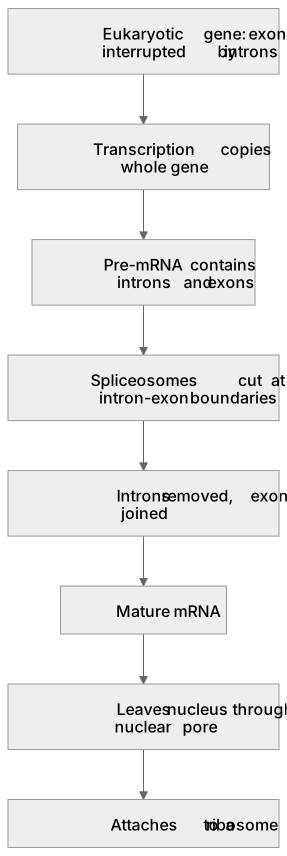
Put it in order
Put these steps in the order they happen.
- 1. Introns removed, exons joined
- 2. Attaches to a ribosome
- 3. Mature mRNA
- 4. Eukaryotic gene: exons interrupted by introns
- 5. Transcription copies whole gene
- 6. Leaves nucleus through nuclear pore
- 7. Pre-mRNA contains introns and exons
- 8. Spliceosomes cut at intron-exon boundaries
Key words
Say what each word means before you turn the card.
introns and exons
Try answering aloud or in your head before turning the card.
pre-mRNA
Try answering aloud or in your head before turning the card.
splicing
Try answering aloud or in your head before turning the card.
nuclear pore
Try answering aloud or in your head before turning the card.
See every definition
- introns and exons
- Coding sequences called exons are interrupted by non-coding sequences called introns.
- pre-mRNA
- Transcription copies the whole gene, introns and exons alike, producing this.
- splicing
- Spliceosomes cut the pre-mRNA at the intron-exon boundaries, remove the introns and join the exons together, forming mature mRNA.
- nuclear pore
- The mature mRNA leaves the nucleus through this and attaches to a ribosome.
Label the diagram
Some boxes have lost their names. Pick the right name for each number.
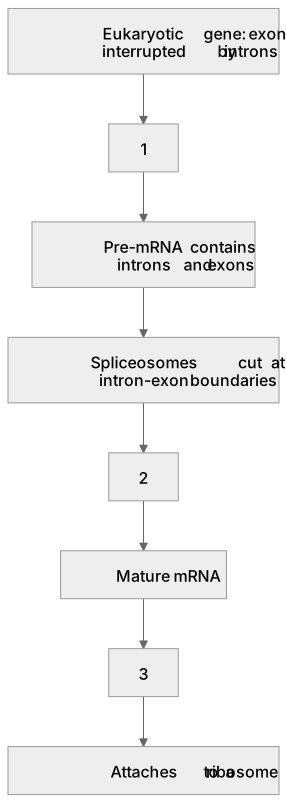
1Box 1
2Box 2
3Box 3
There is more to this lesson
The full lesson goes on to check your understanding and help you earn the marks. Create a free account to carry on, with your progress saved.
A week of Premium from your first lesson · Then the free plan continues · No card, no charge
Test your understanding of DNA and protein synthesis: In eukaryotes, transcription results in the production of pre- mRNA; this is then spliced to form mRNA.
Active recall beats re-reading. Take an instant quiz now to test what you’ve learned and lock it into long-term memory.
A week of Premium from your first lesson · Then the free plan continues · No card, no charge