AQA · A-Level · Biology
Course version: 7402 · Version from Sept 2016
A gene occupies a fixed position, called a locus, on a particular DNA…
Full specification wording
DNA, genes and chromosomes: A gene occupies a fixed position, called a locus, on a particular DNA molecule.
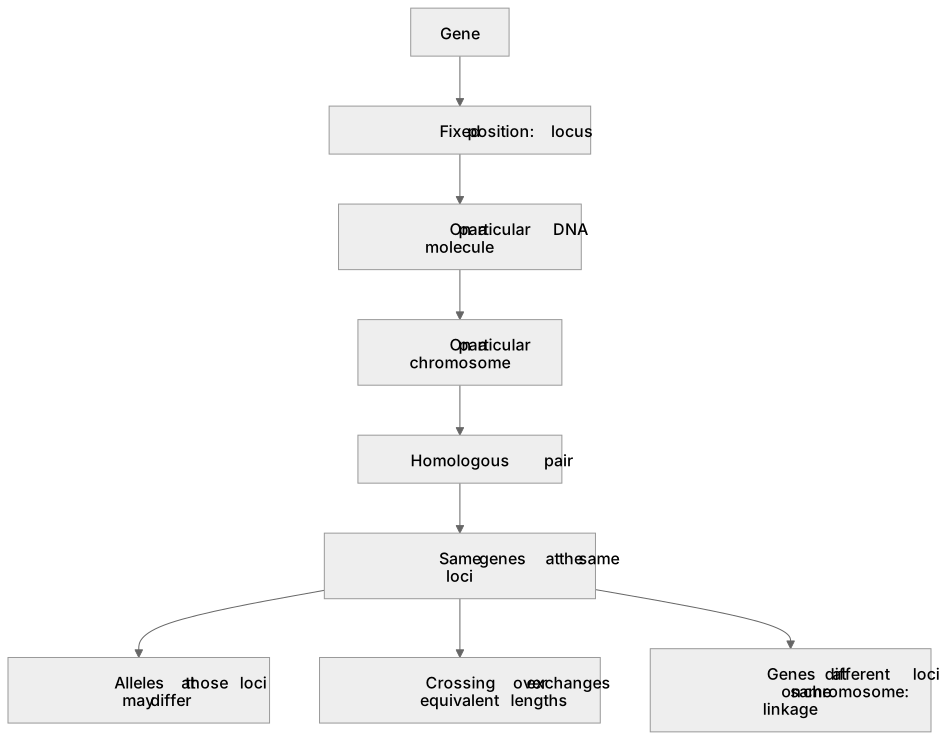
The locus of a gene is its fixed position on a particular DNA molecule, and therefore on a particular chromosome.
Checked against the AQA 7402 specification (opens in a new tab) on .
- Point 6 of 11
- 4 key terms
Study notes
From the checked teaching notes for this specification point.
The idea
The locus of a gene is its fixed position on a particular DNA molecule, and therefore on a particular chromosome. Because that position is fixed and is the same in every member of a species, the two chromosomes of a homologous pair carry the same genes in the same order, which is what makes them homologous, even though the alleles at those loci may differ. Fixed loci explain several later ideas. Crossing over in prophase one exchanges equivalent lengths of chromatid between homologous chromosomes, so no gene is lost or duplicated in the process. Genes at different loci on the same chromosome tend to be inherited together rather than assorting independently, which is linkage, and the closer their loci the stronger the linkage. Mapping loci is what genome projects do.
What earns the marks
- A locus being the fixed position of a gene on a DNA molecule or chromosome.
- Homologous chromosomes carrying the same genes at the same loci but possibly different alleles.
- Explaining that crossing over exchanges equivalent lengths because the loci on the two chromosomes correspond.
- Linked genes being at different loci on the same chromosome and so not assorting independently.
- Using the term allele correctly as one version of a gene at a given locus.
Common mistakes and how to put them right
Using locus and allele as though they meant the same thing.
Saying homologous chromosomes are identical, when the alleles at their loci can differ.
Claiming that genes can move to new positions during ordinary inheritance.
Describing two genes on different chromosomes as linked.
Saying crossing over swaps whole chromosomes rather than equivalent sections of chromatids.
Exam tips
- Answer a definition question in one clean sentence: position, gene, chromosome.
- If a question tells you two genes are on the same chromosome, it is asking about linkage.
- Write alleles as upper and lower case of the same letter so their shared locus is obvious.
Try the lesson
The start of the DNA, genes and chromosomes: A gene occupies a fixed position, called a locus, on a particular DNA molecule. lesson, made from checked teaching notes for this specification point.
Have a go first
What is the name given to the fixed position that a gene occupies on a DNA molecule?
Listen
The locus of a gene is its fixed position on a particular DNA molecule, and therefore on a particular chromosome. Because that position is fixed and is the same in every member of a species, the two chromosomes of a homologous pair carry the same genes in the same order, which is what makes them homologous, even though the alleles at those loci may differ. Fixed loci explain several later ideas. Crossing over in prophase one exchanges equivalent lengths of chromatid between homologous chromosomes, so no gene is lost or duplicated in the process. Genes at different loci on the same chromosome tend to be inherited together rather than assorting independently, which is linkage, and the closer their loci the stronger the linkage. Mapping loci is what genome projects do. A strong answer earns marks for these points. a locus being the fixed position of a gene on a DNA molecule or chromosome. homologous chromosomes carrying the same genes at the same loci but possibly different alleles. explaining that crossing over exchanges equivalent lengths because the loci on the two chromosomes correspond. linked genes being at different loci on the same chromosome and so not assorting independently. Exam tip: Answer a definition question in one clean sentence: position, gene, chromosome.
See it
Key words
Say what each word means before you turn the card.
locus
Try answering aloud or in your head before turning the card.
homologous chromosomes
Try answering aloud or in your head before turning the card.
linkage
Try answering aloud or in your head before turning the card.
crossing over
Try answering aloud or in your head before turning the card.
See every definition
- locus
- The fixed position that a gene occupies on a particular DNA molecule, and therefore on a particular chromosome.
- homologous chromosomes
- The two chromosomes of a pair that carry the same genes in the same order at the same loci, even though the alleles at those loci may differ.
- linkage
- Genes at different loci on the same chromosome tending to be inherited together rather than assorting independently, with closer loci giving stronger linkage.
- crossing over
- A process in prophase one that exchanges equivalent lengths of chromatid between homologous chromosomes, so no gene is lost or duplicated.
Label the diagram
Some boxes have lost their names. Pick the right name for each number.
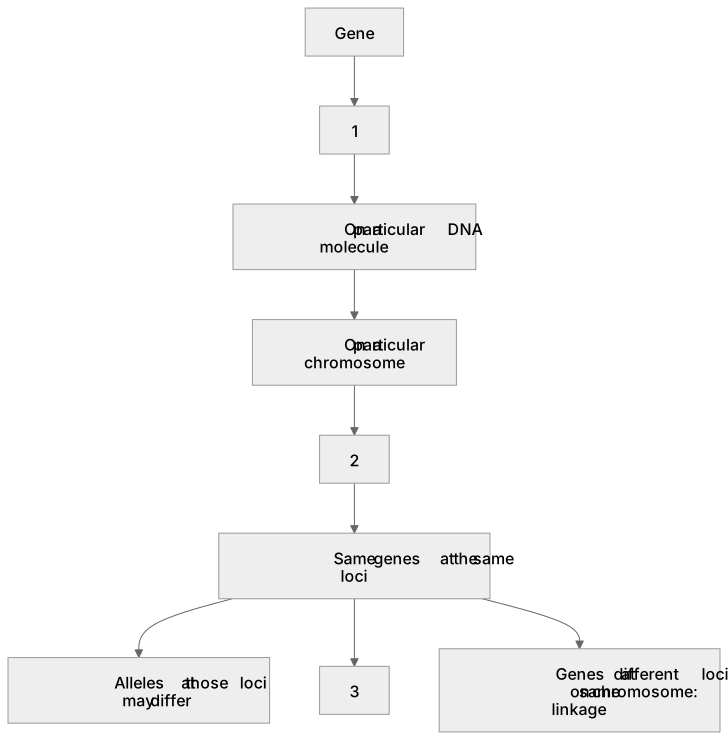
1Box 1
2Box 2
3Box 3
There is more to this lesson
The full lesson goes on to check your understanding and help you earn the marks. Create a free account to carry on, with your progress saved.
A week of Premium from your first lesson · Then the free plan continues · No card, no charge
Test your understanding of DNA, genes and chromosomes: A gene occupies a fixed position, called a locus, on a particular DNA molecule.
Active recall beats re-reading. Take an instant quiz now to test what you’ve learned and lock it into long-term memory.
A week of Premium from your first lesson · Then the free plan continues · No card, no charge