AQA · A-Level · Biology
Course version: 7402 · Version from Sept 2016
Students should be able to evaluate the work of scientists in validating…
Full specification wording
DNA replication: Students should be able to evaluate the work of scientists in validating the Watson–Crick model of DNA replication.
Meselson and Stahl tested DNA replication models by growing bacteria in a medium with the heavy isotope nitrogen-15, so all DNA bases contained it.
Checked against the AQA 7402 specification (opens in a new tab) on .
- Point 3 of 3
- 4 key terms
Study notes
From the checked teaching notes for this specification point.
The idea
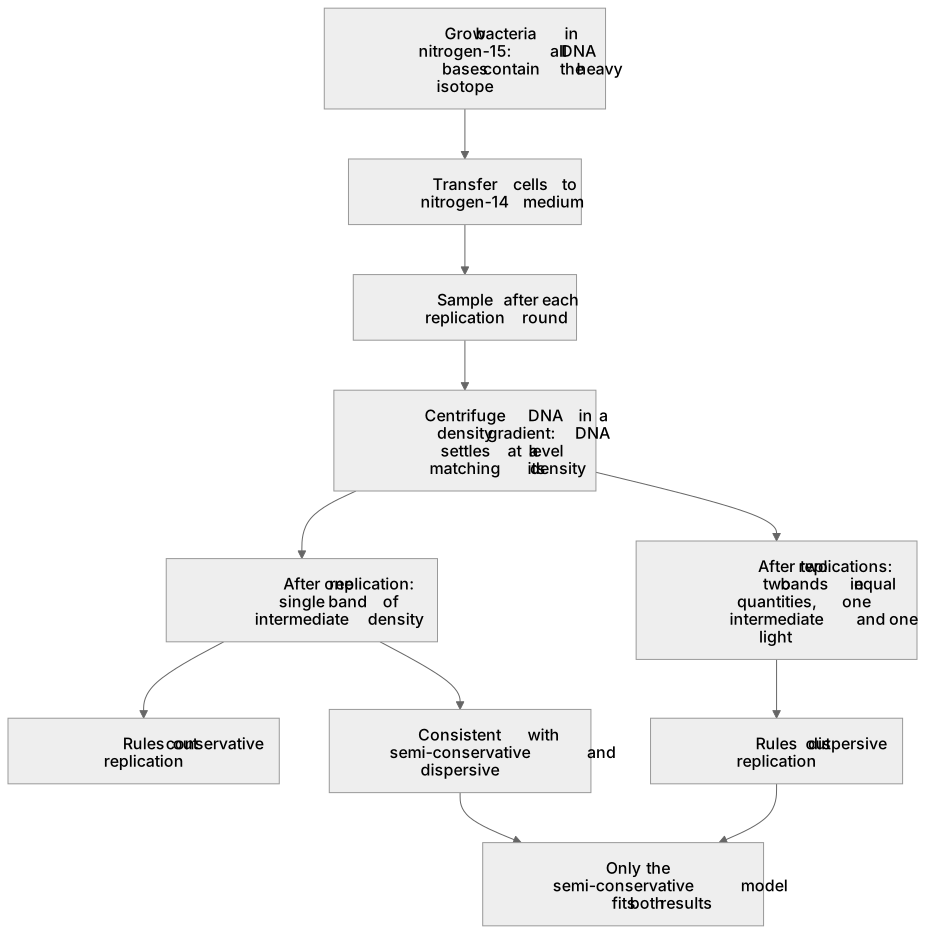
Meselson and Stahl tested DNA replication models by growing bacteria in a medium with the heavy isotope nitrogen-15, so all DNA bases contained it. They then transferred cells to a medium with ordinary nitrogen-14 and sampled after each replication round. DNA was centrifuged in a density gradient, settling at a level matching its density. After one replication, all DNA formed a single band of intermediate density. This rules out conservative replication, which predicts one heavy and one light band, but is consistent with both semi-conservative and dispersive models. After two replications, there were two bands in equal quantities: one intermediate and one light. This rules out dispersive replication, which predicts a single band becoming steadily lighter. Only the semi-conservative model fits both results.
What earns the marks
- Growing cells in nitrogen-15 so that all their DNA contains the heavy isotope, then transferring them to nitrogen-14.
- Separating DNA according to density, with heavier DNA settling lower in the tube.
- Stating the single band of intermediate density after one replication rules out the conservative model, as it shows the DNA contains both heavy and light isotopes.
- Using the second generation result, equal amounts of intermediate and light DNA, to rule out the dispersive model.
- Stating that repetition by other scientists and peer review are needed before a model is accepted.
Common mistakes and how to put them right
Describing nitrogen-15 as radioactive, when it is a stable heavy isotope and the bands are separated by density.
Put it right by referring to it as a heavy isotope.
Treating the first generation result as proof of the semi-conservative model, when it only eliminates the conservative one.
Put it right by stating it is consistent with both semi-conservative and dispersive models.
Saying the experiment proves the model true, rather than that it supports it and fails to disprove it.
Put it right by using terms like 'supports' or 'provides evidence for'.
Forgetting that nitrogen is in the bases, and explaining the labelling as being in the sugar or the phosphate.
Put it right by specifying the nitrogenous bases.
Evaluating with vague statements such as 'they did lots of repeats' with no reference to the actual data.
Put it right by referring to specific band positions and generations.
Exam tips
- Sketch the three predicted band patterns for generation one and generation two before you write; the answer then almost writes itself.
- An 'evaluate' command needs both what the evidence shows and a limitation or a reason for confidence, so include both.
- Refer to the data given in the question by value or by band position rather than describing it in general terms.
Try the lesson
The start of the DNA replication: Students should be able to evaluate the work of scientists in validating the Watson–Crick model of DNA replication. lesson, made from checked teaching notes for this specification point.
Have a go first
Meselson and Stahl grew bacteria in a medium containing heavy nitrogen (¹⁵N) and then transferred them to a medium containing light nitrogen (¹⁴N). They extracted DNA after one round of replication and after two rounds. Which observation best supports the semi-conservative model of DNA replication?
Listen
Meselson and Stahl tested DNA replication models by growing bacteria in a medium with the heavy isotope nitrogen-15, so all DNA bases contained it. They then transferred cells to a medium with ordinary nitrogen-14 and sampled after each replication round. DNA was centrifuged in a density gradient, settling at a level matching its density. After one replication, all DNA formed a single band of intermediate density. This rules out conservative replication, which predicts one heavy and one light band, but is consistent with both semi-conservative and dispersive models. After two replications, there were two bands in equal quantities: one intermediate and one light. This rules out dispersive replication, which predicts a single band becoming steadily lighter. Only the semi-conservative model fits both results. A strong answer earns marks for these points. growing cells in nitrogen-15 so that all their DNA contains the heavy isotope, then transferring them to nitrogen-14. separating DNA according to density, with heavier DNA settling lower in the tube. stating the single band of intermediate density after one replication rules out the conservative model, as it shows the DNA contains both heavy and light isotopes. using the second generation result, equal amounts of intermediate and light DNA, to rule out the dispersive model. A common slip: describing nitrogen-15 as radioactive, when it is a stable heavy isotope and the bands are separated by density. Instead, referring to it as a heavy isotope. Exam tip: Sketch the three predicted band patterns for generation one and generation two before you write; the answer then almost writes itself.
See it
Key words
Say what each word means before you turn the card.
Meselson and Stahl
Try answering aloud or in your head before turning the card.
heavy isotope labelling
Try answering aloud or in your head before turning the card.
density gradient centrifugation
Try answering aloud or in your head before turning the card.
peer review
Try answering aloud or in your head before turning the card.
See every definition
- Meselson and Stahl
- Scientists who tested DNA replication models by growing bacteria in a medium with the heavy isotope nitrogen-15, then transferring cells to a medium with ordinary nitrogen-14 and sampling after each replication round.
- heavy isotope labelling
- Growing bacteria in a medium with nitrogen-15, so all DNA bases contained it, before transferring cells to a medium with ordinary nitrogen-14.
- density gradient centrifugation
- A method in which DNA is centrifuged in a density gradient, settling at a level matching its density, with heavier DNA settling lower in the tube.
- peer review
- Along with repetition by other scientists, needed before a model is accepted.
Label the diagram
Some boxes have lost their names. Pick the right name for each number.
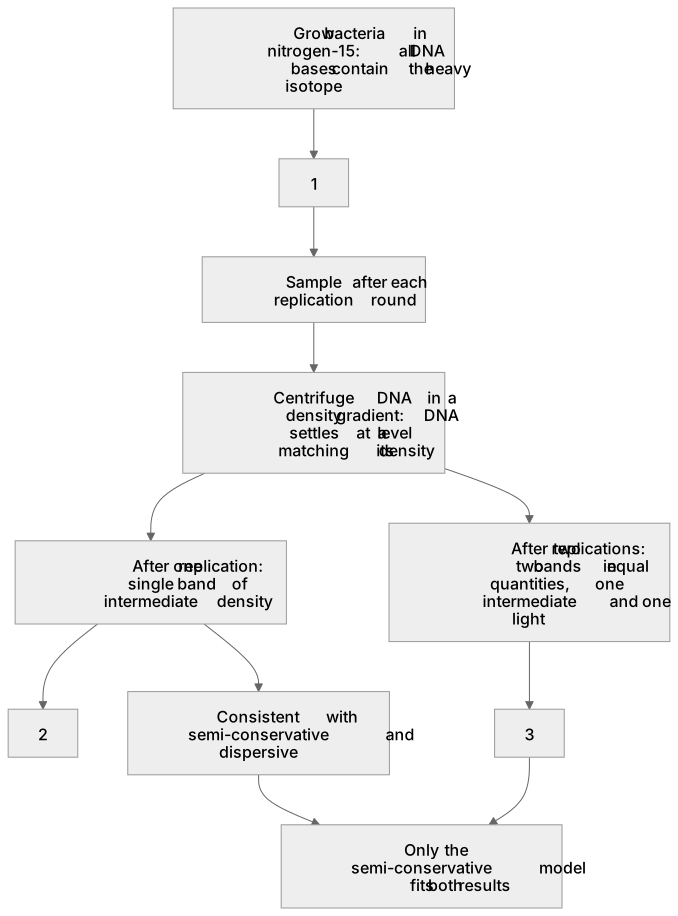
1Box 1
2Box 2
3Box 3
There is more to this lesson
The full lesson goes on to check your understanding and help you earn the marks. Create a free account to carry on, with your progress saved.
A week of Premium from your first lesson · Then the free plan continues · No card, no charge
Test your understanding of DNA replication: Students should be able to evaluate the work of scientists in validating the Watson–Crick model of DNA replication.
Active recall beats re-reading. Take an instant quiz now to test what you’ve learned and lock it into long-term memory.
A week of Premium from your first lesson · Then the free plan continues · No card, no charge