AQA · A-Level · Biology
Course version: 7402 · Version from Sept 2016
Biomass can be measured in terms of mass of carbon or dry mass of tissue…
Full specification wording
Energy and ecosystems (A-level only): Biomass can be measured in terms of mass of carbon or dry mass of tissue per given area.
Biomass is measured as dry mass of tissue or mass of carbon per given area.
Checked against the AQA 7402 specification (opens in a new tab) on .
- Point 5 of 11
- 4 key terms
Study notes
From the checked teaching notes for this specification point.
The idea
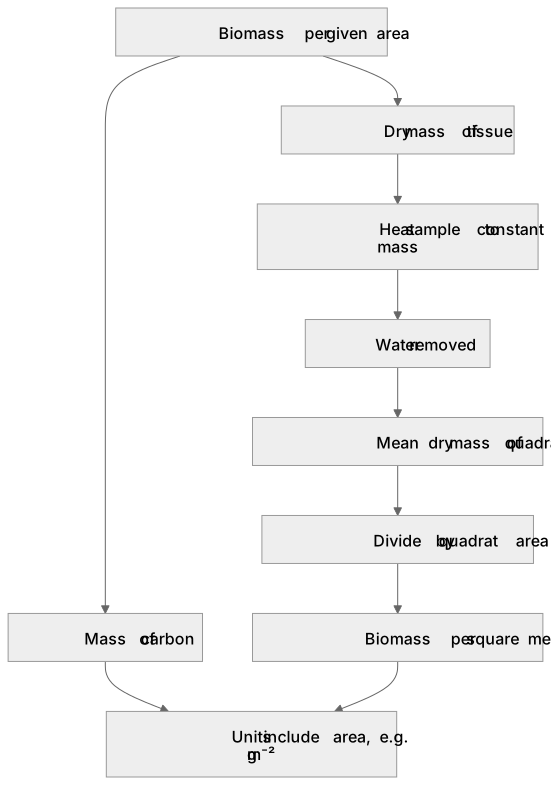
Biomass is measured as dry mass of tissue or mass of carbon per given area. Dry mass is found by heating a sample to constant mass at a low temperature, removing variable water content. Carbon mass is useful as carbon forms the backbone of organic molecules, removing variation from differing mineral contents. Both use units like g m⁻². To calculate biomass per square metre, divide the mean dry mass of a quadrat by its area. For example, a 20 g dry mass in a 0.25 m² quadrat gives 80 g m⁻² (20 / 0.25). Because drying kills the tissue, small random samples are taken; calculating a mean from these ensures a reliable estimate when scaling up.
What earns the marks
- State carbon as the element whose mass per given area can express biomass.
- Identify dry mass of tissue per given area as the alternative measure.
- Explain that water is removed by heating to constant mass because water content varies.
- Calculate biomass per square metre by dividing the mean dry mass of a quadrat by the quadrat area (e.g., 20 g / 0.25 m² = 80 g m⁻²).
- Provide a correct unit that includes area, such as g m⁻² or kg C m⁻².
- Describe using random sampling and a mean when scaling a quadrat measurement up to a whole area.
Common mistakes and how to put them right
Answering 'biomass' or 'organic matter' when asked what specific element is measured per given area.
Put it right: The required answer is carbon.
Quoting a mass with no area in the unit.
Put it right: Include area (e.g., m⁻²) so values can be compared between sites of different sizes.
Assuming carbon mass and dry mass are the same figure.
Put it right: Carbon is only a fraction (roughly half) of dry mass.
Sampling a single quadrat and scaling it up without repeats.
Put it right: Use multiple random quadrats and calculate a mean for reliability.
Exam tips
- Check that a rate unit for productivity has three parts: mass, area, and time (e.g., g m⁻² yr⁻¹), whereas biomass just has mass and area.
- When describing how to estimate dry mass, always specify heating the sample to constant mass to ensure all water is removed.
- Use random coordinates and a mean of several quadrats when scaling dry mass up to a field or pond.
Try the lesson
The start of the Energy and ecosystems (A-level only): Biomass can be measured in terms of mass of carbon or dry mass of tissue per given area. lesson, made from checked teaching notes for this specification point.
Have a go first
Which measurement of plant biomass avoids the variable water content of living tissue?
Listen
Biomass is measured as dry mass of tissue or mass of carbon per given area. Dry mass is found by heating a sample to constant mass at a low temperature, removing variable water content. Carbon mass is useful as carbon forms the backbone of organic molecules, removing variation from differing mineral contents. Both use units like g m⁻². To calculate biomass per square metre, divide the mean dry mass of a quadrat by its area. For example, a 20 g dry mass in a 0.25 m² quadrat gives 80 g m⁻² (20 / 0.25). Because drying kills the tissue, small random samples are taken; calculating a mean from these ensures a reliable estimate when scaling up. A strong answer earns marks for these points. State carbon as the element whose mass per given area can express biomass. Identify dry mass of tissue per given area as the alternative measure. Explain that water is removed by heating to constant mass because water content varies. Calculate biomass per square metre by dividing the mean dry mass of a quadrat by the quadrat area (e.g., 20 g / 0.25 m² = 80 g m⁻²). A common slip: Answering 'biomass' or 'organic matter' when asked what specific element is measured per given area. Instead, the required answer is carbon. Exam tip: Check that a rate unit for productivity has three parts: mass, area, and time (e.g., g m⁻² yr⁻¹), whereas biomass just has mass and area.
See it
Key words
Say what each word means before you turn the card.
mass of carbon
Try answering aloud or in your head before turning the card.
dry mass per unit area
Try answering aloud or in your head before turning the card.
units of biomass
Try answering aloud or in your head before turning the card.
random sampling
Try answering aloud or in your head before turning the card.
See every definition
- mass of carbon
- One way biomass can be measured, per given area, useful as carbon forms the backbone of organic molecules and removes variation from differing mineral contents.
- dry mass per unit area
- The other measure of biomass, found by heating a sample to constant mass at a low temperature to remove variable water content.
- units of biomass
- Units that include area, such as g m⁻² or kg C m⁻², so values can be compared between sites of different sizes.
- random sampling
- Small random samples are taken because drying kills the tissue, and calculating a mean from these ensures a reliable estimate when scaling up.
Label the diagram
Some boxes have lost their names. Pick the right name for each number.
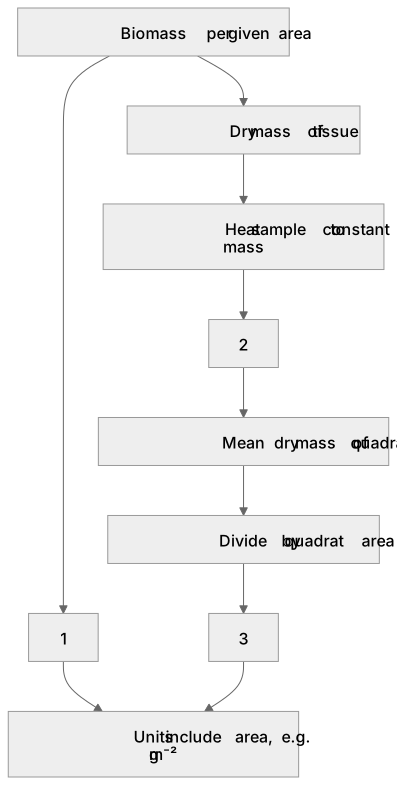
1Box 1
2Box 2
3Box 3
There is more to this lesson
The full lesson goes on to check your understanding and help you earn the marks. Create a free account to carry on, with your progress saved.
A week of Premium from your first lesson · Then the free plan continues · No card, no charge
Test your understanding of Energy and ecosystems (A-level only): Biomass can be measured in terms of mass of carbon or dry mass of tissue per given area.
Active recall beats re-reading. Take an instant quiz now to test what you’ve learned and lock it into long-term memory.
A week of Premium from your first lesson · Then the free plan continues · No card, no charge