AQA · A-Level · Biology
Course version: 7402 · Version from Sept 2016
Most of the sugars synthesised by plants are used by the plant as…
Full specification wording
Energy and ecosystems (A-level only): Most of the sugars synthesised by plants are used by the plant as respiratory substrates.
Photosynthesis makes far more sugar than a plant stores.
Checked against the AQA 7402 specification (opens in a new tab) on .
- Point 2 of 11
Study notes
From the checked teaching notes for this specification point.
The idea
Photosynthesis makes far more sugar than a plant stores. Most of the hexose produced is oxidised again in respiration, because every plant cell, in roots, stems, storage organs and leaves, needs ATP for active transport, phloem loading, protein synthesis and cell division. Glucose enters glycolysis in the cytoplasm to give pyruvate, reduced NAD and a small net yield of ATP; the link reaction and Krebs cycle in the mitochondrial matrix remove carbon as carbon dioxide and load the electron carriers; oxidative phosphorylation on the inner membrane then produces the bulk of the ATP. The carbon leaving as carbon dioxide is lost from the plant's store, and that loss is exactly the respiratory term R that turns gross primary production into net primary production. Respiratory loss is why net primary production is typically only around half of gross primary production.
What earns the marks
- Naming respiration as the process that uses the sugars, with aerobic or anaerobic ignored.
- More sugars being produced and used in respiration when photosynthesis is faster.
- Linking faster respiration to more ATP or energy being available for growth.
- The resulting faster synthesis of new organic materials.
- Identifying respiratory loss as the reason gross primary production exceeds net primary production.
Common mistakes and how to put them right
Writing that energy is 'used in respiration', which examiners reject.
Put it right: Energy is released from glucose and transferred to ATP.
Saying respiration produces or generates energy rather than transferring it.
Assuming plants respire only at night and photosynthesise only in the day.
Treating all the sugar made as biomass, which ignores the respiratory losses separating GPP from NPP.
Naming glucose as the respiratory substrate but never linking ATP to a named use in the plant.
Exam tips
- If asked what happens to sugars made in photosynthesis, respiration is the expected one-word answer; adding aerobic or anaerobic neither gains nor loses the mark.
- Whenever energy and respiration appear in the same sentence, check the direction: ATP is made, energy is released, never used in respiration.
- Link faster photosynthesis to growth in three steps: more sugar, more ATP, more synthesis of new organic material.
Try the lesson
The start of the Energy and ecosystems (A-level only): Most of the sugars synthesised by plants are used by the plant as respiratory substrates. lesson, made from checked teaching notes for this specification point.
Have a go first
What is the main use of most of the sugars synthesised by a plant?
Listen
Photosynthesis makes far more sugar than a plant stores. Most of the hexose produced is oxidised again in respiration, because every plant cell, in roots, stems, storage organs and leaves, needs ATP for active transport, phloem loading, protein synthesis and cell division. Glucose enters glycolysis in the cytoplasm to give pyruvate, reduced NAD and a small net yield of ATP; the link reaction and Krebs cycle in the mitochondrial matrix remove carbon as carbon dioxide and load the electron carriers; oxidative phosphorylation on the inner membrane then produces the bulk of the ATP. The carbon leaving as carbon dioxide is lost from the plant's store, and that loss is exactly the respiratory term R that turns gross primary production into net primary production. Respiratory loss is why net primary production is typically only around half of gross primary production. A strong answer earns marks for these points. naming respiration as the process that uses the sugars, with aerobic or anaerobic ignored. more sugars being produced and used in respiration when photosynthesis is faster. linking faster respiration to more ATP or energy being available for growth. the resulting faster synthesis of new organic materials. Exam tip: If asked what happens to sugars made in photosynthesis, respiration is the expected one-word answer; adding aerobic or anaerobic neither gains nor loses the mark.
See it
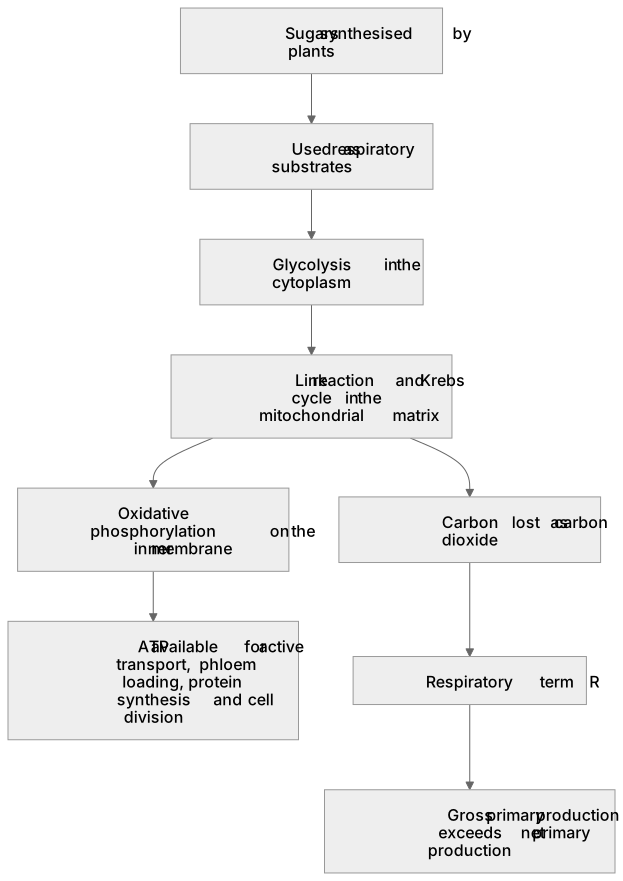
Label the diagram
Some boxes have lost their names. Pick the right name for each number.
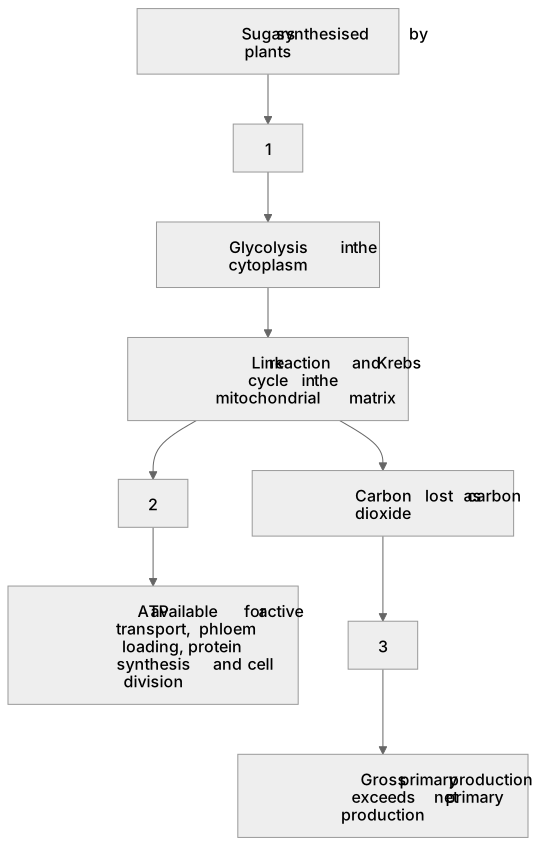
1Box 1
2Box 2
3Box 3
There is more to this lesson
The full lesson goes on to check your understanding and help you earn the marks. Create a free account to carry on, with your progress saved.
A week of Premium from your first lesson · Then the free plan continues · No card, no charge
Test your understanding of Energy and ecosystems (A-level only): Most of the sugars synthesised by plants are used by the plant as respiratory substrates.
Active recall beats re-reading. Take an instant quiz now to test what you’ve learned and lock it into long-term memory.
A week of Premium from your first lesson · Then the free plan continues · No card, no charge