AQA · A-Level · Biology
Course version: 7402 · Version from Sept 2016
Primary and secondary productivity is the rate of primary or secondary…
Full specification wording
Energy and ecosystems (A-level only): Primary and secondary productivity is the rate of primary or secondary production, respectively.
Production and productivity are distinct concepts.
Checked against the AQA 7402 specification (opens in a new tab) on .
- Point 11 of 11
- 4 key terms
Study notes
From the checked teaching notes for this specification point.
The idea
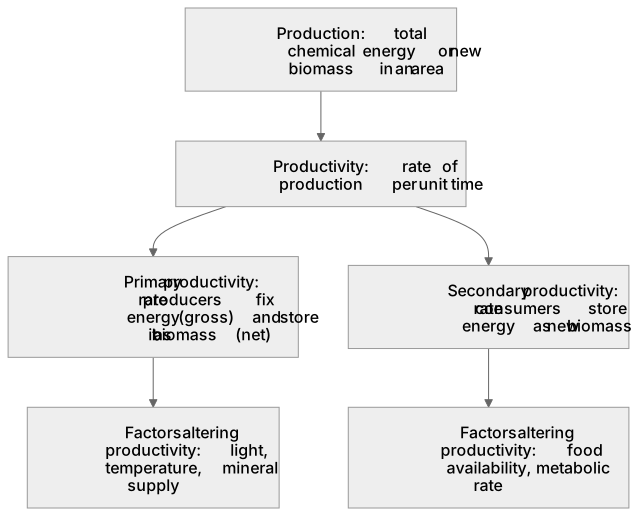
Production and productivity are distinct concepts. Production is the total quantity of chemical energy or new biomass generated in a given area, measured in units like kJ m-2. Productivity is the rate of this production, measured per unit time, such as kJ m-2 year-1. Primary productivity is the rate producers fix energy (gross) and store it as biomass (net). Secondary productivity is the rate consumers store energy as new biomass (the rate of N). Because productivity is a rate, it is influenced by factors altering the underlying processes: light, temperature and mineral supply for producers, and food availability or metabolic rate for consumers.
What earns the marks
- Productivity being a rate, that is production per unit time.
- A unit including both area and time, such as kJ m-2 year-1.
- Primary productivity referring to producers and secondary productivity to consumers.
- A named factor that changes productivity, with the direction of the effect stated.
Common mistakes and how to put them right
Using production and productivity interchangeably, so the rate mark is not awarded.
Quoting kJ m-2 for a productivity value, leaving the time out of the unit.
Defining production as standing biomass, rather than the new biomass or energy generated.
Exam tips
- Look at the unit before naming the quantity: if it contains 'per year', the answer is a productivity.
- Use the word rate explicitly when defining productivity.
Try the lesson
The start of the Energy and ecosystems (A-level only): Primary and secondary productivity is the rate of primary or secondary production, respectively. lesson, made from checked teaching notes for this specification point.
Have a go first
A grassland producer population transfers 4 500 kJ of chemical energy into new biomass over 30 days. What is the primary productivity of this population?
Listen
Production and productivity are distinct concepts. Production is the total quantity of chemical energy or new biomass generated in a given area, measured in units like kJ m-2. Productivity is the rate of this production, measured per unit time, such as kJ m-2 year-1. Primary productivity is the rate producers fix energy (gross) and store it as biomass (net). Secondary productivity is the rate consumers store energy as new biomass (the rate of N). Because productivity is a rate, it is influenced by factors altering the underlying processes: light, temperature and mineral supply for producers, and food availability or metabolic rate for consumers. A strong answer earns marks for these points. productivity being a rate, that is production per unit time. a unit including both area and time, such as kJ m-2 year-1. primary productivity referring to producers and secondary productivity to consumers. a named factor that changes productivity, with the direction of the effect stated. Exam tip: Look at the unit before naming the quantity: if it contains 'per year', the answer is a productivity.
See it
Key words
Say what each word means before you turn the card.
production versus productivity
Try answering aloud or in your head before turning the card.
rate per unit time
Try answering aloud or in your head before turning the card.
primary productivity
Try answering aloud or in your head before turning the card.
secondary productivity
Try answering aloud or in your head before turning the card.
See every definition
- production versus productivity
- Production is the total quantity of chemical energy or new biomass generated in a given area, whereas productivity is the rate of this production.
- rate per unit time
- Productivity is measured per unit time, such as kJ m-2 year-1, because it is a rate.
- primary productivity
- The rate at which producers fix energy (gross) and store it as biomass (net).
- secondary productivity
- The rate at which consumers store energy as new biomass.
Label the diagram
Some boxes have lost their names. Pick the right name for each number.
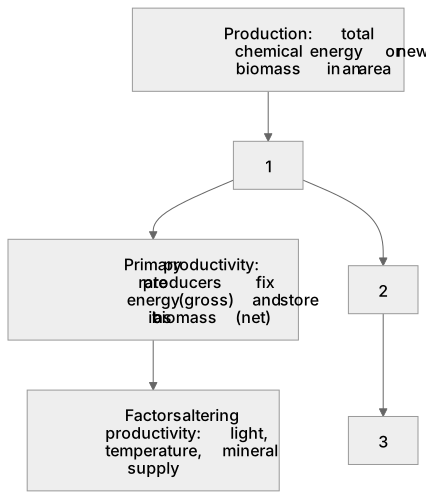
1Box 1
2Box 2
3Box 3
There is more to this lesson
The full lesson goes on to check your understanding and help you earn the marks. Create a free account to carry on, with your progress saved.
A week of Premium from your first lesson · Then the free plan continues · No card, no charge
Test your understanding of Energy and ecosystems (A-level only): Primary and secondary productivity is the rate of primary or secondary production, respectively.
Active recall beats re-reading. Take an instant quiz now to test what you’ve learned and lock it into long-term memory.
A week of Premium from your first lesson · Then the free plan continues · No card, no charge