AQA · A-Level · Biology
Course version: 7402 · Version from Sept 2016
In this way, new species arise from existing species.
Full specification wording
Evolution may lead to speciation (A-level only): In this way, new species arise from existing species.
Every species alive today descends from an earlier species, so speciation is always a lineage splitting rather than a species appearing from nothing.
Checked against the AQA 7402 specification (opens in a new tab) on .
- Point 12 of 14
- 3 key terms
Study notes
From the checked teaching notes for this specification point.
The idea
Every species alive today descends from an earlier species, so speciation is always a lineage splitting rather than a species appearing from nothing. Put the whole sequence together: variation exists in a population because of mutation, meiosis and random fertilisation; the population becomes reproductively separated into two; the two gene pools stop exchanging alleles; new mutations arise separately in each and different selection pressures favour different phenotypes; the allele frequencies change in different directions; and the accumulated differences eventually make interbreeding to produce fertile offspring impossible, so there are now two species where there was one.
What earns the marks
- A sequence that begins with variation in the original population caused by mutation.
- Reproductive separation separating the gene pools.
- Different selection pressures changing allele frequencies differently in each population.
- The end point, two populations that cannot interbreed to produce fertile offspring.
- Relating the split to common ancestry, as shown by a phylogenetic tree.
Common mistakes and how to put them right
Describing speciation as a single event rather than a sequence taking many generations.
Beginning the account with the new species rather than with variation in the original population.
Implying that an individual organism becomes a new species.
Reading a phylogenetic tree as a ladder of improvement rather than as a record of branching.
Leaving out the original population, so the new species appears from nowhere.
Exam tips
- Learn the sequence as a chain of six linked statements, because extended speciation questions are marked point by point.
- Begin with the original population, so the examiner can see the new species arising from an existing one.
- Where a tree or a timeline is given, use it to say which species share the most recent common ancestor.
Try the lesson
The start of the Evolution may lead to speciation (A-level only): In this way, new species arise from existing species. lesson, made from checked teaching notes for this specification point.
Have a go first
A population of a mammal species is split into two by a newly formed mountain range. After millions of years, the two populations can no longer interbreed to produce fertile offspring. Which statement best explains how the new species arose from the existing species?
Listen
Every species alive today descends from an earlier species, so speciation is always a lineage splitting rather than a species appearing from nothing. Put the whole sequence together: variation exists in a population because of mutation, meiosis and random fertilisation; the population becomes reproductively separated into two; the two gene pools stop exchanging alleles; new mutations arise separately in each and different selection pressures favour different phenotypes; the allele frequencies change in different directions; and the accumulated differences eventually make interbreeding to produce fertile offspring impossible, so there are now two species where there was one. A strong answer earns marks for these points. a sequence that begins with variation in the original population caused by mutation. reproductive separation separating the gene pools. different selection pressures changing allele frequencies differently in each population. the end point, two populations that cannot interbreed to produce fertile offspring. Exam tip: Learn the sequence as a chain of six linked statements, because extended speciation questions are marked point by point.
See it
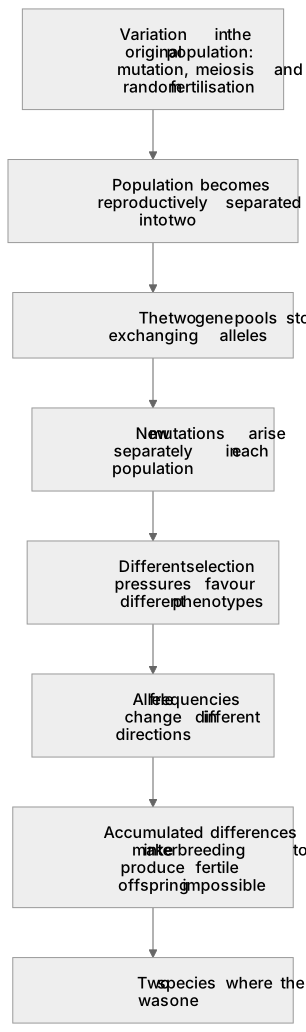
Put it in order
Put these steps in the order they happen.
- 1. Different selection pressures favour different phenotypes
- 2. Two species where there was one
- 3. Allele frequencies change in different directions
- 4. Variation in the original population: mutation, meiosis and random fertilisation
- 5. Population becomes reproductively separated into two
- 6. Accumulated differences make interbreeding to produce fertile offspring impossible
- 7. The two gene pools stop exchanging alleles
- 8. New mutations arise separately in each population
Key words
Say what each word means before you turn the card.
lineage splitting
Try answering aloud or in your head before turning the card.
phylogenetic tree
Try answering aloud or in your head before turning the card.
common ancestry
Try answering aloud or in your head before turning the card.
See every definition
- lineage splitting
- Speciation is always this rather than a species appearing from nothing, because every species alive today descends from an earlier species.
- phylogenetic tree
- A record of branching that shows the split related to common ancestry, not a ladder of improvement.
- common ancestry
- The relationship shown by a phylogenetic tree, to which the split is related.
Label the diagram
Some boxes have lost their names. Pick the right name for each number.
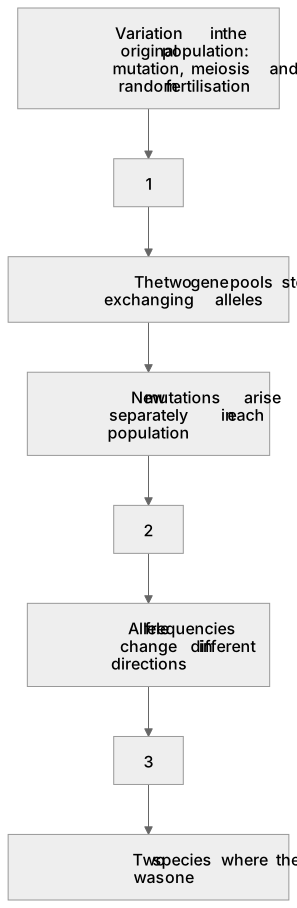
1Box 1
2Box 2
3Box 3
There is more to this lesson
The full lesson goes on to check your understanding and help you earn the marks. Create a free account to carry on, with your progress saved.
A week of Premium from your first lesson · Then the free plan continues · No card, no charge
Test your understanding of Evolution may lead to speciation (A-level only): In this way, new species arise from existing species.
Active recall beats re-reading. Take an instant quiz now to test what you’ve learned and lock it into long-term memory.
A week of Premium from your first lesson · Then the free plan continues · No card, no charge