AQA · A-Level · Biology
Course version: 7402 · Version from Sept 2016
The effect of this differential reproductive success on the allele…
Full specification wording
Evolution may lead to speciation (A-level only): The effect of this differential reproductive success on the allele frequencies within a gene pool.
Differential reproductive success translates an individual advantage into a population-level change.
Checked against the AQA 7402 specification (opens in a new tab) on .
- Point 7 of 14
- 2 key terms
Study notes
From the checked teaching notes for this specification point.
The idea
Differential reproductive success translates an individual advantage into a population-level change. Organisms that survive and breed contribute their alleles to the next generation's gene pool. Because breeders are not a random sample, allele proportions shift. For example, if a resistance allele provides a survival advantage during an antibiotic course, its frequency in the bacterial gene pool increases rapidly over successive generations. This process occurs much slower in mammals due to longer generation times. When two separated populations face different selection pressures, their allele frequencies change in different directions, causing their gene pools to diverge.
What earns the marks
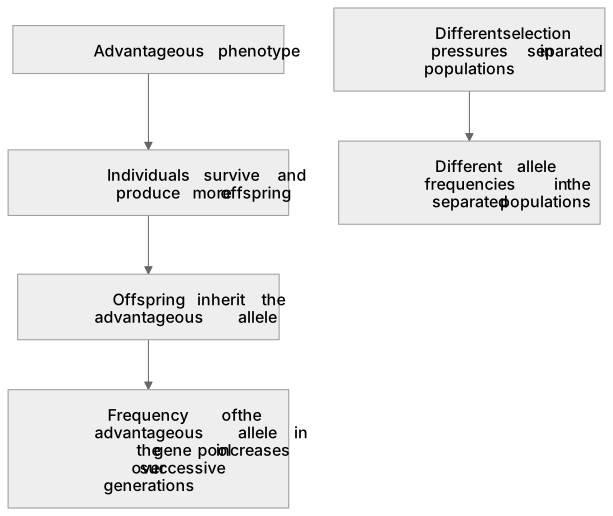
- Individuals with the advantageous phenotype survive and produce more offspring.
- The frequency of the advantageous allele in the gene pool increases over successive generations.
- Different selection pressures produce different allele frequencies in separated populations.
Common mistakes and how to put them right
Describing the change as an increase in the number of organisms rather than in the frequency of an allele.
Stating selection acts directly on alleles, when it acts on the phenotypes those alleles help to produce.
Ignoring heterozygotes, incorrectly predicting that a recessive allele disappears entirely within one generation.
Exam tips
- Specify the direction of change and the population, for example, 'the frequency of the resistance allele in the hospital population increased'.
- When comparing two populations, state that their allele frequencies now differ, not merely that they changed.
Try the lesson
The start of the Evolution may lead to speciation (A-level only): The effect of this differential reproductive success on the allele frequencies within a gene pool. lesson, made from checked teaching notes for this specification point.
Have a go first
Within a gene pool, individuals with a particular allele produce more surviving offspring than individuals without it. What is the effect of this differential reproductive success on the frequency of that allele?
Listen
Differential reproductive success translates an individual advantage into a population-level change. Organisms that survive and breed contribute their alleles to the next generation's gene pool. Because breeders are not a random sample, allele proportions shift. For example, if a resistance allele provides a survival advantage during an antibiotic course, its frequency in the bacterial gene pool increases rapidly over successive generations. This process occurs much slower in mammals due to longer generation times. When two separated populations face different selection pressures, their allele frequencies change in different directions, causing their gene pools to diverge. A strong answer earns marks for these points. Individuals with the advantageous phenotype survive and produce more offspring. The frequency of the advantageous allele in the gene pool increases over successive generations. Different selection pressures produce different allele frequencies in separated populations. Exam tip: Specify the direction of change and the population, for example, 'the frequency of the resistance allele in the hospital population increased'.
See it
Key words
Say what each word means before you turn the card.
allele frequency change
Try answering aloud or in your head before turning the card.
selection acts on phenotype
Try answering aloud or in your head before turning the card.
See every definition
- allele frequency change
- The shift in allele proportions because breeders are not a random sample, with the advantageous allele increasing over successive generations.
- selection acts on phenotype
- Selection acts on the phenotypes those alleles help to produce, not directly on alleles.
Label the diagram
Some boxes have lost their names. Pick the right name for each number.
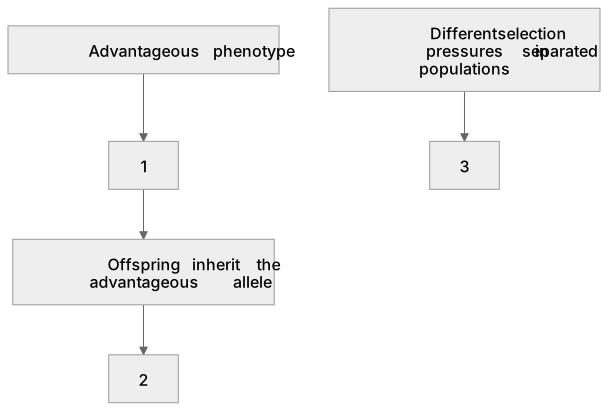
1Box 1
2Box 2
3Box 3
There is more to this lesson
The full lesson goes on to check your understanding and help you earn the marks. Create a free account to carry on, with your progress saved.
A week of Premium from your first lesson · Then the free plan continues · No card, no charge
Test your understanding of Evolution may lead to speciation (A-level only): The effect of this differential reproductive success on the allele frequencies within a gene pool.
Active recall beats re-reading. Take an instant quiz now to test what you’ve learned and lock it into long-term memory.
A week of Premium from your first lesson · Then the free plan continues · No card, no charge