AQA · A-Level · Biology
Course version: 7402 · Version from Sept 2016
Students should be able to: interpret information relating to the effects…
Full specification wording
Gas exchange: Students should be able to: interpret information relating to the effects of lung disease on gas exchange and/or ventilation interpret data relating to the effects of pollution and smoking on the incidence of lung disease analyse and interpret data associated with specific risk factors and the incidence of lung disease evaluate the way in which experimental data led to statutory restrictions on the sources of risk factors recognise correlations and causal relationships.
Lung disease impairs gas exchange by altering alveolar structure.
Checked against the AQA 7402 specification (opens in a new tab) on .
- Point 7 of 7
- 4 key terms
Study notes
From the checked teaching notes for this specification point.
The idea
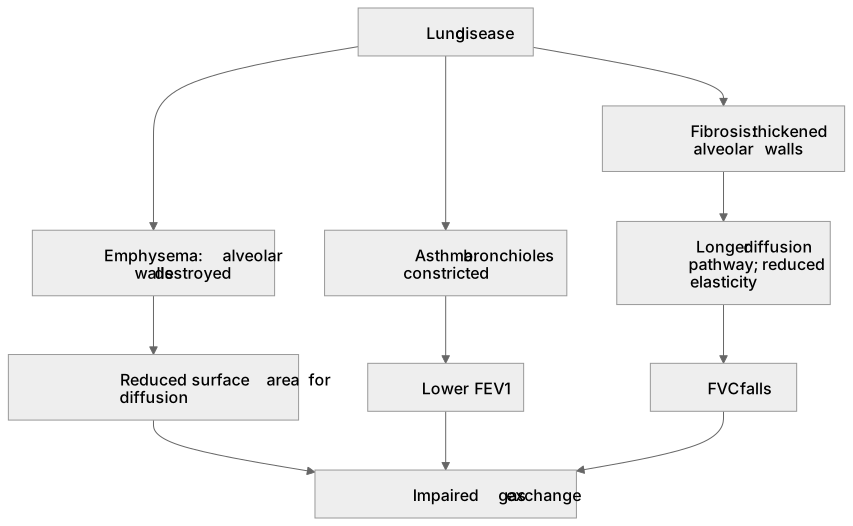
Lung disease impairs gas exchange by altering alveolar structure. Fibrosis thickens alveolar walls, lengthening the diffusion pathway and reducing elasticity, so forced vital capacity (FVC) falls. Emphysema destroys alveolar walls, reducing surface area for diffusion. Asthma constricts bronchioles, lowering forced expiratory volume in one second (FEV1). When interpreting incidence data for smoking or pollution, distinguish correlation from causation: a correlation shows variables changing together, but causation requires a plausible mechanism and control of confounding variables. Evaluate how experimental data led to statutory restrictions (e.g. smoking bans, emission limits) by assessing study design, sample size and whether findings generalise. Note that animal-model evidence is experimental, not epidemiological, and supports mechanisms rather than population incidence.
What earns the marks
- Interpret spirometer data by quoting FEV1 and FVC values and comparing them with predicted or control values, linking a reduced FEV1 to airway constriction in asthma and a reduced FVC to reduced elasticity in fibrosis.
- Evaluate the strength of evidence linking a risk factor to statutory restrictions, considering study design, sample size, whether the study population generalises, and whether a biological mechanism is demonstrated.
- Recognise that animal-model experiments provide mechanistic evidence rather than epidemiological incidence data, and that both types of evidence may be needed to justify a statutory restriction.
Common mistakes and how to put them right
Assuming a correlation between a risk factor (such as pollution or smoking) and lung disease incidence proves causation, without considering confounding variables or a biological mechanism.
Put it right: State that the data show a correlation and identify at least one confounding variable or the mechanism needed to infer causation.
Describing a change in FEV1 or FVC without explaining the underlying structural reason, such as loss of elasticity in fibrosis or airway constriction in asthma.
Put it right: Link the spirometer value to the structural change that causes it.
Stating that overlapping standard deviations prove results are not significant.
Put it right: Overlap suggests the results might not differ significantly, but a statistical test is required to confirm significance.
Listing reliance on animal models as a limitation of epidemiological data.
Put it right: Animal models are experimental evidence, not epidemiological; a limitation of epidemiological data would be, for example, small sample size or uncontrolled confounding.
Exam tips
- Always quote specific figures from the provided graphs or tables when evaluating data on smoking or pollution incidence, and state the direction of the relationship.
- When evaluating statutory restrictions, explicitly state the limits of the evidence, such as whether the study applied only to a specific demographic or relied on animal models, and whether a mechanism has been demonstrated.
Try the lesson
The start of the Gas exchange: Students should be able to: interpret information relating to the effects of lung disease on gas exchange and/or ventilation interpret data relating to the effects of pollution and smoking on the incidence of lung disease analyse and interpret data associated with specific risk factors and the incidence of lung disease evaluate the way in which experimental data led to statutory restrictions on the sources of risk factors recognise correlations and causal relationships. lesson, made from checked teaching notes for this specification point.
Have a go first
Emphysema reduces the surface area of the alveoli. Which effect does this have on gas exchange?
Listen
Lung disease impairs gas exchange by altering alveolar structure. Fibrosis thickens alveolar walls, lengthening the diffusion pathway and reducing elasticity, so forced vital capacity (FVC) falls. Emphysema destroys alveolar walls, reducing surface area for diffusion. Asthma constricts bronchioles, lowering forced expiratory volume in one second (FEV1). When interpreting incidence data for smoking or pollution, distinguish correlation from causation: a correlation shows variables changing together, but causation requires a plausible mechanism and control of confounding variables. Evaluate how experimental data led to statutory restrictions (e.g. smoking bans, emission limits) by assessing study design, sample size and whether findings generalise. Note that animal-model evidence is experimental, not epidemiological, and supports mechanisms rather than population incidence. A strong answer earns marks for these points. Describe the structural change caused by a named disease, such as thickened alveolar walls in fibrosis or fewer, larger alveoli in emphysema, and link it to a gas-exchange effect such as a longer diffusion pathway or reduced surface area. Interpret spirometer data by quoting FEV1 and FVC values and comparing them with predicted or control values, linking a reduced FEV1 to airway constriction in asthma and a reduced FVC to reduced elasticity in fibrosis. Distinguish correlation from causation in incidence data: state that a correlation alone does not establish cause, and identify a confounding variable (e.g. age, occupation or deprivation) that could explain the association. Evaluate the strength of evidence linking a risk factor to statutory restrictions, considering study design, sample size, whether the study population generalises, and whether a biological mechanism is demonstrated. A common slip: Assuming a correlation between a risk factor (such as pollution or smoking) and lung disease incidence proves causation, without considering confounding variables or a biological mechanism. Instead, state that the data show a correlation and identify at least one confounding variable or the mechanism needed to infer causation. Exam tip: Always quote specific figures from the provided graphs or tables when evaluating data on smoking or pollution incidence, and state the direction of the relationship.
See it
Key words
Say what each word means before you turn the card.
Fibrosis
Try answering aloud or in your head before turning the card.
Emphysema
Try answering aloud or in your head before turning the card.
Asthma
Try answering aloud or in your head before turning the card.
Correlation
Try answering aloud or in your head before turning the card.
See every definition
- Fibrosis
- Thickens alveolar walls, lengthening the diffusion pathway and reducing elasticity, so forced vital capacity falls.
- Emphysema
- Destroys alveolar walls, reducing surface area for diffusion.
- Asthma
- Constricts bronchioles, lowering forced expiratory volume in one second.
- Correlation
- Shows variables changing together, but causation requires a plausible mechanism and control of confounding variables.
Label the diagram
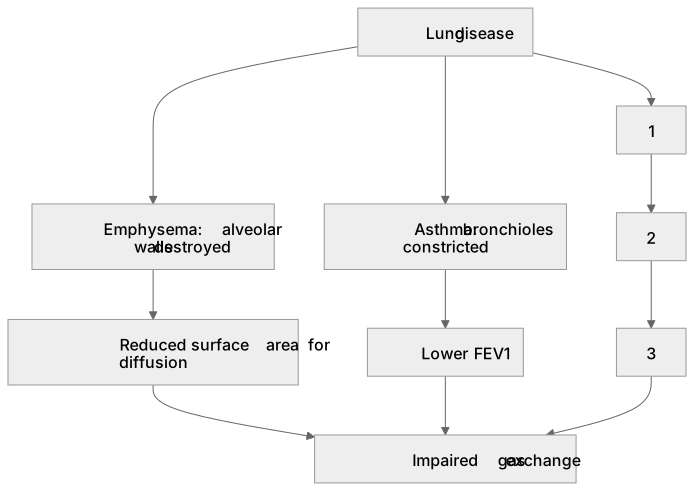
Some boxes have lost their names. Pick the right name for each number.
1Box 1
2Box 2
3Box 3
There is more to this lesson
The full lesson goes on to check your understanding and help you earn the marks. Create a free account to carry on, with your progress saved.
A week of Premium from your first lesson · Then the free plan continues · No card, no charge
Test your understanding of Gas exchange: Students should be able to: interpret information relating to the effects of lung disease on gas exchange and/or ventilation interpret data relating to the effects of pollution and smoking on the incidence of lung disease analyse and interpret data associated with specific risk factors and the incidence of lung disease evaluate the way in which experimental data led to statutory restrictions on the sources of risk factors recognise correlations and causal relationships.
Active recall beats re-reading. Take an instant quiz now to test what you’ve learned and lock it into long-term memory.
A week of Premium from your first lesson · Then the free plan continues · No card, no charge