AQA · A-Level · Biology
Course version: 7402 · Version from Sept 2016
Proteins have a variety of functions within all living organisms.
Full specification wording
General properties of proteins: Proteins have a variety of functions within all living organisms.
Proteins carry out more different jobs than any other group of biological molecules, and every job is a consequence of one specific three-dimensional shape.
Checked against the AQA 7402 specification (opens in a new tab) on .
- Point 6 of 9
- 4 key terms
Study notes
From the checked teaching notes for this specification point.
The idea
Proteins carry out more different jobs than any other group of biological molecules, and every job is a consequence of one specific three-dimensional shape. Enzymes such as amylase are catalysts with active sites complementary to a substrate. Structural proteins such as collagen provide tensile strength. Transport proteins include haemoglobin, which carries oxygen, and the channel and carrier proteins that move ions across membranes. Antibodies have variable regions complementary to a specific antigen. Some hormones are proteins, notably insulin, and target cells carry protein receptors that those hormones bind to. Actin and myosin are contractile proteins in muscle, and transcription factors regulate transcription, switching genes on or off.
What earns the marks
- Each named function with a correct example, such as enzymes as catalysts or antibodies binding antigens.
- Identifying a structural role with a named protein such as collagen or keratin.
- A transport role, naming haemoglobin or channel and carrier proteins.
- Linking each function to the specific three-dimensional shape of the protein.
- Identifying a regulatory role, such as hormones binding to receptors or transcription factors regulating gene expression.
Common mistakes and how to put them right
Writing that proteins are needed 'for growth and repair', which is not an A-level answer.
Assuming all proteins are enzymes, ignoring structural or transport roles.
Giving energy storage as a primary function of proteins, which is a role for carbohydrates and lipids.
Exam tips
- Always attach a named example to a named function; a bare list of functions rarely scores.
- Where a question asks about a protein you have not met, work from its shape and its binding site rather than trying to recall it.
Try the lesson
The start of the General properties of proteins: Proteins have a variety of functions within all living organisms. lesson, made from checked teaching notes for this specification point.
Have a go first
Which of the following is a function of proteins in living organisms?
Listen
Proteins carry out more different jobs than any other group of biological molecules, and every job is a consequence of one specific three-dimensional shape. Enzymes such as amylase are catalysts with active sites complementary to a substrate. Structural proteins such as collagen provide tensile strength. Transport proteins include haemoglobin, which carries oxygen, and the channel and carrier proteins that move ions across membranes. Antibodies have variable regions complementary to a specific antigen. Some hormones are proteins, notably insulin, and target cells carry protein receptors that those hormones bind to. Actin and myosin are contractile proteins in muscle, and transcription factors regulate transcription, switching genes on or off. A strong answer earns marks for these points. each named function with a correct example, such as enzymes as catalysts or antibodies binding antigens. identifying a structural role with a named protein such as collagen or keratin. a transport role, naming haemoglobin or channel and carrier proteins. linking each function to the specific three-dimensional shape of the protein. Exam tip: Always attach a named example to a named function; a bare list of functions rarely scores.
See it

Key words
Say what each word means before you turn the card.
enzymes
Try answering aloud or in your head before turning the card.
structural proteins
Try answering aloud or in your head before turning the card.
transport proteins
Try answering aloud or in your head before turning the card.
antibodies
Try answering aloud or in your head before turning the card.
See every definition
- enzymes
- Catalysts with active sites complementary to a substrate, such as amylase.
- structural proteins
- Proteins such as collagen that provide tensile strength.
- transport proteins
- Include haemoglobin, which carries oxygen, and the channel and carrier proteins that move ions across membranes.
- antibodies
- Have variable regions complementary to a specific antigen.
Label the diagram
Some boxes have lost their names. Pick the right name for each number.
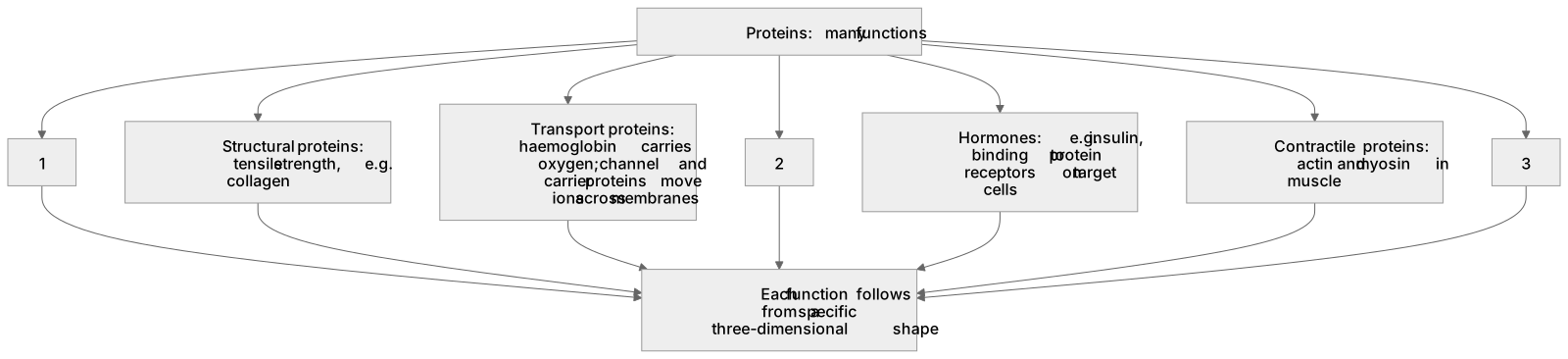
1Box 1
2Box 2
3Box 3
There is more to this lesson
The full lesson goes on to check your understanding and help you earn the marks. Create a free account to carry on, with your progress saved.
A week of Premium from your first lesson · Then the free plan continues · No card, no charge
Test your understanding of General properties of proteins: Proteins have a variety of functions within all living organisms.
Active recall beats re-reading. Take an instant quiz now to test what you’ve learned and lock it into long-term memory.
A week of Premium from your first lesson · Then the free plan continues · No card, no charge