AQA · A-Level · Biology
Course version: 7402 · Version from Sept 2016
Gene mutations involve a change in the base sequence of chromosomes.
Full specification wording
Genetic diversity can arise as a result of mutation or during: Gene mutations involve a change in the base sequence of chromosomes.
A gene mutation is a change to the base sequence of the DNA in a chromosome, producing a new allele of that gene.
Checked against the AQA 7402 specification (opens in a new tab) on .
- Point 1 of 8
- 4 key terms
Study notes
From the checked teaching notes for this specification point.
The idea
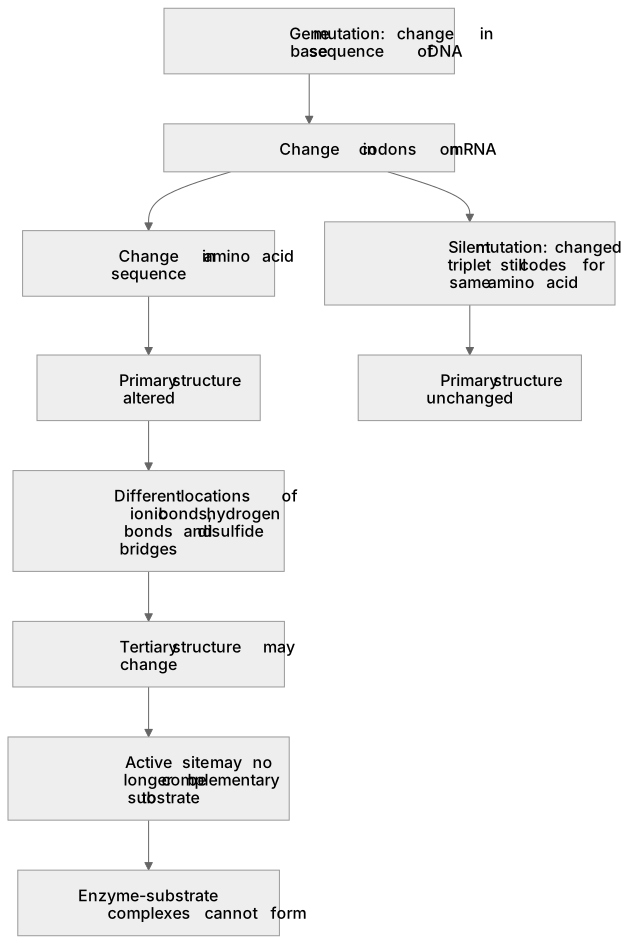
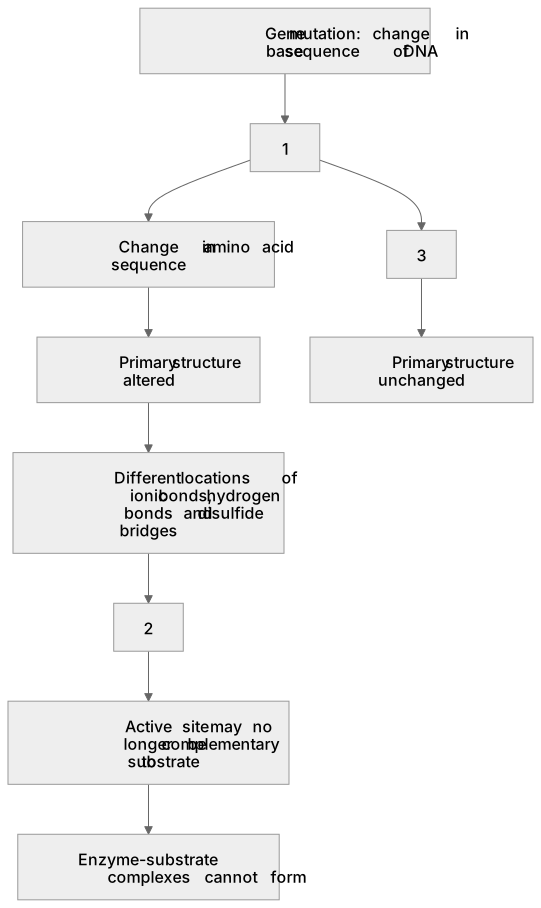
A gene mutation is a change to the base sequence of the DNA in a chromosome, producing a new allele of that gene. Because the base sequence determines the sequence of codons on mRNA, a change can alter which amino acid is inserted at that point in the polypeptide. A different amino acid sequence changes the primary structure. Since the R groups of the amino acids determine where ionic bonds, hydrogen bonds and disulfide bridges form, the tertiary structure may also change. For an enzyme, this altered 3D shape means the active site may no longer be complementary to its substrate, preventing enzyme-substrate complexes from forming. Some mutations are silent: because the genetic code is degenerate, a changed triplet may still code for the same amino acid, so the primary structure is unchanged.
What earns the marks
- A gene mutation involves a change in the base sequence of the DNA or a change in a DNA triplet.
- A change in primary structure can lead to a consequent change in the tertiary structure of the protein due to different bond locations.
- The altered tertiary structure can affect protein function, such as an active site no longer being complementary to the substrate.
- Some mutations are silent because the genetic code is degenerate, so a changed triplet may still code for the same amino acid and the primary structure is unchanged.
Common mistakes and how to put them right
Writing that 'different amino acids are formed'.
Put it right: The mutation changes the sequence in which existing amino acids are joined.
Writing '3D structure' or 'shape' instead of the specific term 'tertiary structure' when describing protein folding.
Saying the mutation makes a different gene rather than a different allele of the same gene.
Saying a mutation is 'degenerate'.
Put it right: Degeneracy is a property of the genetic code, so the correct phrasing is that a mutation is silent because the code is degenerate.
Exam tips
- Logically sequence your answers: state the change in base sequence, then amino acid sequence, then tertiary structure, and finally the effect on function.
- Say allele, not gene, whenever you mean one version of a gene.
- When explaining why a mutation has no effect, attribute this to the degeneracy of the genetic code, not to the mutation itself.
Try the lesson
The start of the Genetic diversity can arise as a result of mutation or during: Gene mutations involve a change in the base sequence of chromosomes. lesson, made from checked teaching notes for this specification point.
Have a go first
What is a gene mutation? Select the correct answer.
Listen
A gene mutation is a change to the base sequence of the DNA in a chromosome, producing a new allele of that gene. Because the base sequence determines the sequence of codons on mRNA, a change can alter which amino acid is inserted at that point in the polypeptide. A different amino acid sequence changes the primary structure. Since the R groups of the amino acids determine where ionic bonds, hydrogen bonds and disulfide bridges form, the tertiary structure may also change. For an enzyme, this altered 3D shape means the active site may no longer be complementary to its substrate, preventing enzyme-substrate complexes from forming. Some mutations are silent: because the genetic code is degenerate, a changed triplet may still code for the same amino acid, so the primary structure is unchanged. A strong answer earns marks for these points. A gene mutation involves a change in the base sequence of the DNA or a change in a DNA triplet. A change in primary structure can lead to a consequent change in the tertiary structure of the protein due to different bond locations. The altered tertiary structure can affect protein function, such as an active site no longer being complementary to the substrate. Some mutations are silent because the genetic code is degenerate, so a changed triplet may still code for the same amino acid and the primary structure is unchanged. Exam tip: Logically sequence your answers: state the change in base sequence, then amino acid sequence, then tertiary structure, and finally the effect on function.
See it
Key words
Say what each word means before you turn the card.
gene mutation
Try answering aloud or in your head before turning the card.
primary structure
Try answering aloud or in your head before turning the card.
tertiary structure
Try answering aloud or in your head before turning the card.
alleles
Try answering aloud or in your head before turning the card.
See every definition
- gene mutation
- A change in the base sequence of the DNA in a chromosome, producing a new allele of that gene.
- primary structure
- The sequence of amino acids in a polypeptide, which a change in the base sequence can alter.
- tertiary structure
- The 3D shape of a protein, determined by where ionic bonds, hydrogen bonds and disulfide bridges form between the R groups of the amino acids.
- alleles
- Versions of a gene, of which a gene mutation produces a new one.
Label the diagram
Some boxes have lost their names. Pick the right name for each number.
1Box 1
2Box 2
3Box 3
There is more to this lesson
The full lesson goes on to check your understanding and help you earn the marks. Create a free account to carry on, with your progress saved.
A week of Premium from your first lesson · Then the free plan continues · No card, no charge
Test your understanding of Genetic diversity can arise as a result of mutation or during: Gene mutations involve a change in the base sequence of chromosomes.
Active recall beats re-reading. Take an instant quiz now to test what you’ve learned and lock it into long-term memory.
A week of Premium from your first lesson · Then the free plan continues · No card, no charge