AQA · A-Level · Biology
Course version: 7402 · Version from Sept 2016
The process of meiosis only in sufficient detail to show how: two nuclear…
Full specification wording
Genetic diversity can arise as a result of mutation or during: The process of meiosis only in sufficient detail to show how: two nuclear divisions result usually in the formation of four haploid daughter cells from a single diploid parent cell genetically different daughter cells result from the independent segregation of homologous chromosomes crossing over between homologous chromosomes results in further genetic variation among daughter cells.
Meiosis begins with a diploid cell whose DNA has already replicated, so each chromosome exists as two identical sister chromatids joined at a centromere.
Checked against the AQA 7402 specification (opens in a new tab) on .
- Point 7 of 8
Study notes
From the checked teaching notes for this specification point.
The idea
Meiosis begins with a diploid cell whose DNA has already replicated, so each chromosome exists as two identical sister chromatids joined at a centromere. In meiosis I, homologous chromosomes pair up as bivalents, crossing over occurs at chiasmata, and the pairs are then pulled apart, one whole chromosome from each pair going to each pole. This is the reduction division: the two cells produced are haploid, carrying one chromosome from each homologous pair, though each chromosome is still two chromatids. Meiosis II resembles mitosis: the chromatids of each chromosome are separated, giving four haploid daughter cells in total from one diploid parent. Which homologue of each pair goes to which pole in meiosis I is independent of every other pair, so the combinations of maternal and paternal chromosomes differ between cells, and crossing over has already exchanged alleles between them.
What earns the marks
- Two nuclear divisions producing four haploid daughter cells from one diploid parent cell.
- Homologous chromosomes separating in the first division and chromatids separating in the second.
- Independent segregation of homologous chromosomes producing different combinations of maternal and paternal chromosomes.
- Crossing over between homologous chromosomes producing new combinations of alleles.
- Stating that the daughter cells are genetically different from one another.
Common mistakes and how to put them right
Saying the chromosome number halves during meiosis II rather than meiosis I.
Describing homologous chromosomes as identical, when they carry the same genes but may carry different alleles.
Placing crossing over in meiosis II instead of prophase I.
Writing that four daughter cells are produced by each division rather than four in total.
Forgetting that each haploid cell after meiosis I still has two chromatids per chromosome.
Exam tips
- Keep chromosome and chromatid strictly separate in every sentence; most lost marks here are vocabulary, not understanding.
- Name meiosis I as the reduction division explicitly.
- Learn the sequence as two lines: I - pair up, cross over, separate homologues; II - separate chromatids.
Try the lesson
The start of the Genetic diversity can arise as a result of mutation or during: The process of meiosis only in sufficient detail to show how: two nuclear divisions result usually in the formation of four haploid daughter cells from a single diploid parent cell genetically different daughter cells result from the independent segregation of homologous chromosomes crossing over between homologous chromosomes results in further genetic variation among daughter cells. lesson, made from checked teaching notes for this specification point.
Have a go first
What is the chromosome number of the daughter cells usually produced by meiosis from a diploid parent cell?
Listen
Meiosis begins with a diploid cell whose DNA has already replicated, so each chromosome exists as two identical sister chromatids joined at a centromere. In meiosis I, homologous chromosomes pair up as bivalents, crossing over occurs at chiasmata, and the pairs are then pulled apart, one whole chromosome from each pair going to each pole. This is the reduction division: the two cells produced are haploid, carrying one chromosome from each homologous pair, though each chromosome is still two chromatids. Meiosis II resembles mitosis: the chromatids of each chromosome are separated, giving four haploid daughter cells in total from one diploid parent. Which homologue of each pair goes to which pole in meiosis I is independent of every other pair, so the combinations of maternal and paternal chromosomes differ between cells, and crossing over has already exchanged alleles between them. A strong answer earns marks for these points. two nuclear divisions producing four haploid daughter cells from one diploid parent cell. homologous chromosomes separating in the first division and chromatids separating in the second. independent segregation of homologous chromosomes producing different combinations of maternal and paternal chromosomes. crossing over between homologous chromosomes producing new combinations of alleles. Exam tip: Keep chromosome and chromatid strictly separate in every sentence; most lost marks here are vocabulary, not understanding.
See it
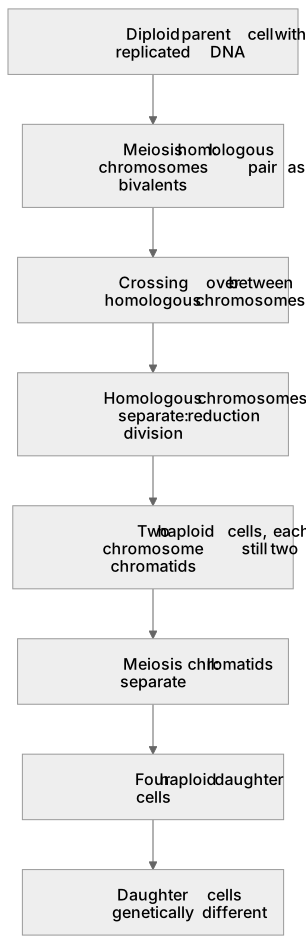
Put it in order
Put these steps in the order they happen.
- 1. Two haploid cells, each chromosome still two chromatids
- 2. Daughter cells genetically different
- 3. Meiosis II: chromatids separate
- 4. Diploid parent cell with replicated DNA
- 5. Meiosis I: homologous chromosomes pair as bivalents
- 6. Four haploid daughter cells
- 7. Crossing over between homologous chromosomes
- 8. Homologous chromosomes separate: reduction division
Label the diagram
Some boxes have lost their names. Pick the right name for each number.
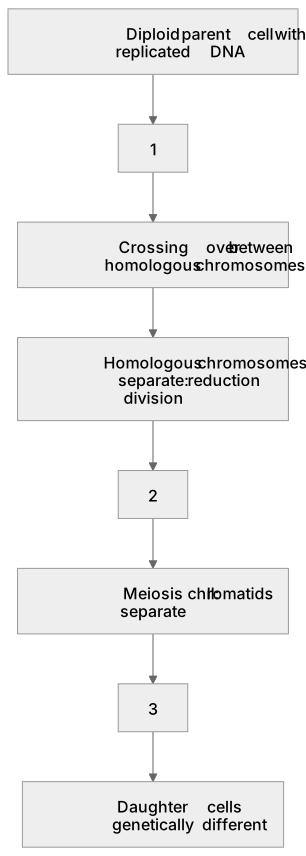
1Box 1
2Box 2
3Box 3
There is more to this lesson
The full lesson goes on to check your understanding and help you earn the marks. Create a free account to carry on, with your progress saved.
A week of Premium from your first lesson · Then the free plan continues · No card, no charge
Test your understanding of Genetic diversity can arise as a result of mutation or during: The process of meiosis only in sufficient detail to show how: two nuclear divisions result usually in the formation of four haploid daughter cells from a single diploid parent cell genetically different daughter cells result from the independent segregation of homologous chromosomes crossing over between homologous chromosomes results in further genetic variation among daughter cells.
Active recall beats re-reading. Take an instant quiz now to test what you’ve learned and lock it into long-term memory.
A week of Premium from your first lesson · Then the free plan continues · No card, no charge