AQA · A-Level · Biology
Course version: 7402 · Version from Sept 2016
Lipids: The emulsion test for lipids.
The emulsion test uses the fact that lipids dissolve in ethanol but not in water.
Checked against the AQA 7402 specification (opens in a new tab) on .
- Point 7 of 8
- 4 key terms
Study notes
From the checked teaching notes for this specification point.
The idea
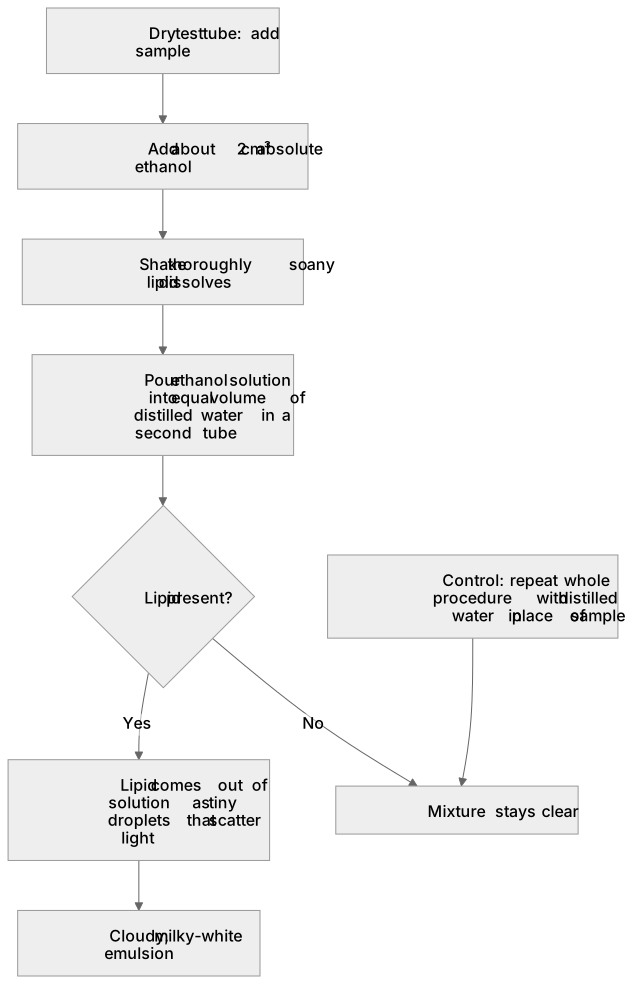
The emulsion test uses the fact that lipids dissolve in ethanol but not in water. Take a completely dry test tube, add the sample, add about two centimetres cubed of absolute ethanol and shake thoroughly so that any lipid present dissolves. Then pour the ethanol solution into an equal volume of distilled water in a second tube. If lipid is present it comes out of solution as it meets the water, forming millions of tiny droplets suspended through the liquid; these scatter light, so the mixture turns a cloudy, milky-white emulsion. If no lipid is present the mixture stays clear. The order matters: ethanol first, water second. The obvious control is to repeat the whole procedure with distilled water in place of the sample and show that it stays clear.
What earns the marks
- Adding ethanol to the sample and shaking to dissolve any lipid present.
- Then adding or pouring the mixture into an equal volume of water.
- A positive result described as a cloudy, milky-white emulsion rather than simply 'it turns white'.
- Explaining that the lipid is insoluble in water so comes out of solution as droplets that scatter light.
- A negative control using distilled water in place of the sample, which remains clear.
Common mistakes and how to put them right
Adding water before ethanol, so the lipid never dissolves and no emulsion forms.
Explaining the dry-tube rule as ethanol and water turning cloudy together, when they mix clear - the real problem is diluted ethanol leaving lipid undissolved.
Describing the positive result as a colour change rather than the formation of an emulsion.
Stating that the degree of cloudiness measures the lipid concentration, when the test is qualitative.
Confusing this test with the biuret test and adding copper sulfate.
Exam tips
- Write the method as numbered steps in the correct order; sequence marks are commonly lost here.
- Always name the solvent as ethanol, and state that the tube and the sample must be clean and dry.
- Include a control for any practical description - distilled water in place of the sample is the simple, creditable one.
Try the lesson
The start of the Lipids: The emulsion test for lipids. lesson, made from checked teaching notes for this specification point.
Have a go first
Which reagent is added to a sample when carrying out the emulsion test for lipids?
Listen
The emulsion test uses the fact that lipids dissolve in ethanol but not in water. Take a completely dry test tube, add the sample, add about two centimetres cubed of absolute ethanol and shake thoroughly so that any lipid present dissolves. Then pour the ethanol solution into an equal volume of distilled water in a second tube. If lipid is present it comes out of solution as it meets the water, forming millions of tiny droplets suspended through the liquid; these scatter light, so the mixture turns a cloudy, milky-white emulsion. If no lipid is present the mixture stays clear. The order matters: ethanol first, water second. The obvious control is to repeat the whole procedure with distilled water in place of the sample and show that it stays clear. A strong answer earns marks for these points. adding ethanol to the sample and shaking to dissolve any lipid present. then adding or pouring the mixture into an equal volume of water. a positive result described as a cloudy, milky-white emulsion rather than simply 'it turns white'. explaining that the lipid is insoluble in water so comes out of solution as droplets that scatter light. Exam tip: Write the method as numbered steps in the correct order; sequence marks are commonly lost here.
See it
Key words
Say what each word means before you turn the card.
emulsion test
Try answering aloud or in your head before turning the card.
solubility in ethanol
Try answering aloud or in your head before turning the card.
milky-white emulsion
Try answering aloud or in your head before turning the card.
order of reagents
Try answering aloud or in your head before turning the card.
See every definition
- emulsion test
- A test for lipids that uses the fact that lipids dissolve in ethanol but not in water.
- solubility in ethanol
- Lipids dissolve in ethanol but not in water, so they come out of solution as droplets when the ethanol solution meets water.
- milky-white emulsion
- Millions of tiny droplets suspended through the liquid that scatter light, so the mixture turns cloudy.
- order of reagents
- Ethanol is added to the sample first and shaken, then the mixture is poured into an equal volume of water.
There is more to this lesson
The full lesson goes on to check your understanding and help you earn the marks. Create a free account to carry on, with your progress saved.
A week of Premium from your first lesson · Then the free plan continues · No card, no charge
Test your understanding of Lipids: The emulsion test for lipids.
Active recall beats re-reading. Take an instant quiz now to test what you’ve learned and lock it into long-term memory.
A week of Premium from your first lesson · Then the free plan continues · No card, no charge