AQA · A-Level · Biology
Course version: 7402 · Version from Sept 2016
Lipids: Triglycerides and phospholipids are two groups of lipid.
Lipids contain carbon, hydrogen and oxygen, but with proportionally less oxygen than carbohydrates.
Checked against the AQA 7402 specification (opens in a new tab) on .
- Point 1 of 8
- 3 key terms
Study notes
From the checked teaching notes for this specification point.
The idea
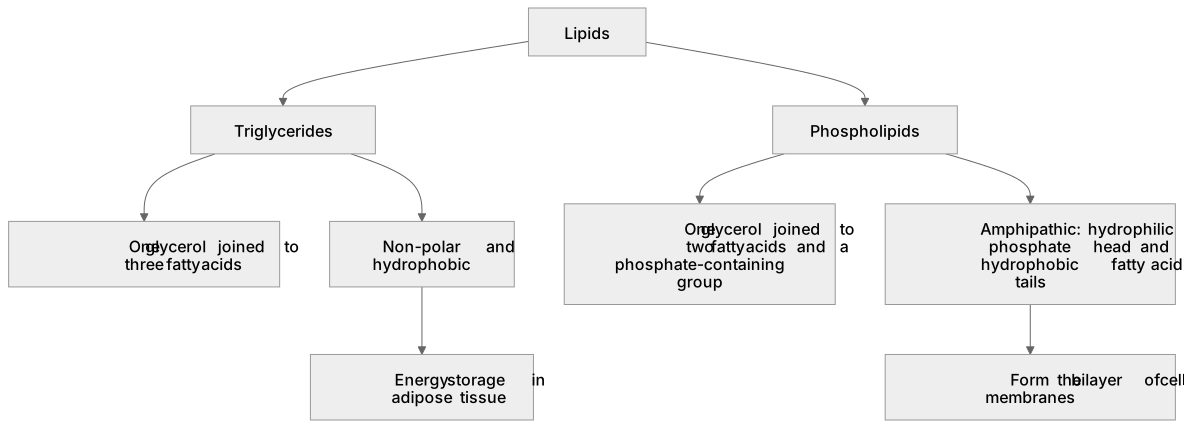
Lipids contain carbon, hydrogen and oxygen, but with proportionally less oxygen than carbohydrates. They are insoluble in water but soluble in organic solvents like ethanol. The specification names two groups: triglycerides and phospholipids. Triglycerides consist of one glycerol joined to three fatty acids. They are non-polar, hydrophobic molecules, making them ideal energy storage lipids in adipose tissue. Phospholipids consist of one glycerol joined to two fatty acids and a phosphate-containing group. This structure makes them amphipathic: they have a hydrophilic phosphate head and hydrophobic fatty acid tails. This property is essential for forming the bilayer of cell membranes.
What earns the marks
- State that triglycerides consist of one glycerol joined to three fatty acids.
- State that phospholipids consist of one glycerol joined to two fatty acids and a phosphate-containing group.
- Explain that triglycerides are non-polar and hydrophobic, acting as energy storage molecules.
- Explain that phospholipids are amphipathic, allowing them to form the bilayer of cell membranes.
- Identify that lipids contain carbon, hydrogen and oxygen, with proportionally less oxygen than carbohydrates.
Common mistakes and how to put them right
Describing a triglyceride as a polymer of fatty acids.
Put it right: Lipids are macromolecules but not polymers, as they are not made of repeating monomer units.
Stating that all lipids contain phosphorus.
Put it right: Only phospholipids contain a phosphate-containing group; triglycerides contain only C, H, and O.
Saying lipids are insoluble in all solvents.
Put it right: Lipids are insoluble in water but soluble in organic solvents such as ethanol.
Exam tips
- Fix the two structures by counting fatty acids: three means a triglyceride (storage), while two plus a phosphate-containing group means a phospholipid (membrane).
- Never use the words monomer or polymer when describing lipids, as examiners frequently penalise this error.
Try the lesson
The start of the Lipids: Triglycerides and phospholipids are two groups of lipid. lesson, made from checked teaching notes for this specification point.
Have a go first
A student is classifying different biological molecules. Which of the following pairs consists entirely of two groups of lipid?
Listen
Lipids contain carbon, hydrogen and oxygen, but with proportionally less oxygen than carbohydrates. They are insoluble in water but soluble in organic solvents like ethanol. The specification names two groups: triglycerides and phospholipids. Triglycerides consist of one glycerol joined to three fatty acids. They are non-polar, hydrophobic molecules, making them ideal energy storage lipids in adipose tissue. Phospholipids consist of one glycerol joined to two fatty acids and a phosphate-containing group. This structure makes them amphipathic: they have a hydrophilic phosphate head and hydrophobic fatty acid tails. This property is essential for forming the bilayer of cell membranes. A strong answer earns marks for these points. State that triglycerides consist of one glycerol joined to three fatty acids. State that phospholipids consist of one glycerol joined to two fatty acids and a phosphate-containing group. Explain that triglycerides are non-polar and hydrophobic, acting as energy storage molecules. Explain that phospholipids are amphipathic, allowing them to form the bilayer of cell membranes. A common slip: Describing a triglyceride as a polymer of fatty acids. Instead, Lipids are macromolecules but not polymers, as they are not made of repeating monomer units. Exam tip: Fix the two structures by counting fatty acids: three means a triglyceride (storage), while two plus a phosphate-containing group means a phospholipid (membrane).
See it
Key words
Say what each word means before you turn the card.
Triglyceride structure
Try answering aloud or in your head before turning the card.
Phospholipid structure
Try answering aloud or in your head before turning the card.
Hydrophobic and amphipathic properties
Try answering aloud or in your head before turning the card.
See every definition
- Triglyceride structure
- One glycerol joined to three fatty acids, forming a non-polar, hydrophobic molecule.
- Phospholipid structure
- One glycerol joined to two fatty acids and a phosphate-containing group.
- Hydrophobic and amphipathic properties
- Triglycerides are non-polar and hydrophobic, while phospholipids are amphipathic with a hydrophilic phosphate head and hydrophobic fatty acid tails.
Label the diagram
Some boxes have lost their names. Pick the right name for each number.
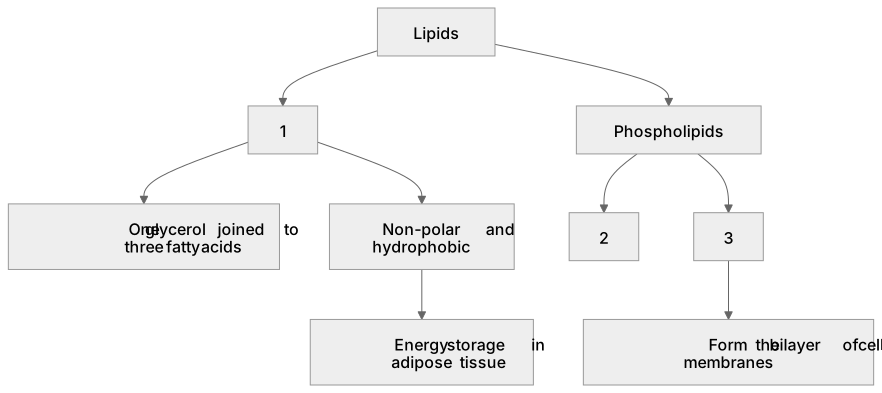
1Box 1
2Box 2
3Box 3
There is more to this lesson
The full lesson goes on to check your understanding and help you earn the marks. Create a free account to carry on, with your progress saved.
A week of Premium from your first lesson · Then the free plan continues · No card, no charge
Test your understanding of Lipids: Triglycerides and phospholipids are two groups of lipid.
Active recall beats re-reading. Take an instant quiz now to test what you’ve learned and lock it into long-term memory.
A week of Premium from your first lesson · Then the free plan continues · No card, no charge