AQA · A-Level · Biology
Course version: 7402 · Version from Sept 2016
Students should be able to: appreciate how models of enzyme action have…
Full specification wording
Many proteins are enzymes: Students should be able to: appreciate how models of enzyme action have changed over time appreciate that enzymes catalyse a wide range of intracellular and extracellular reactions that determine structures and functions from cellular to whole-organism level.
Enzyme models have evolved with new evidence.
Checked against the AQA 7402 specification (opens in a new tab) on .
- Point 5 of 6
- 3 key terms
Study notes
From the checked teaching notes for this specification point.
The idea
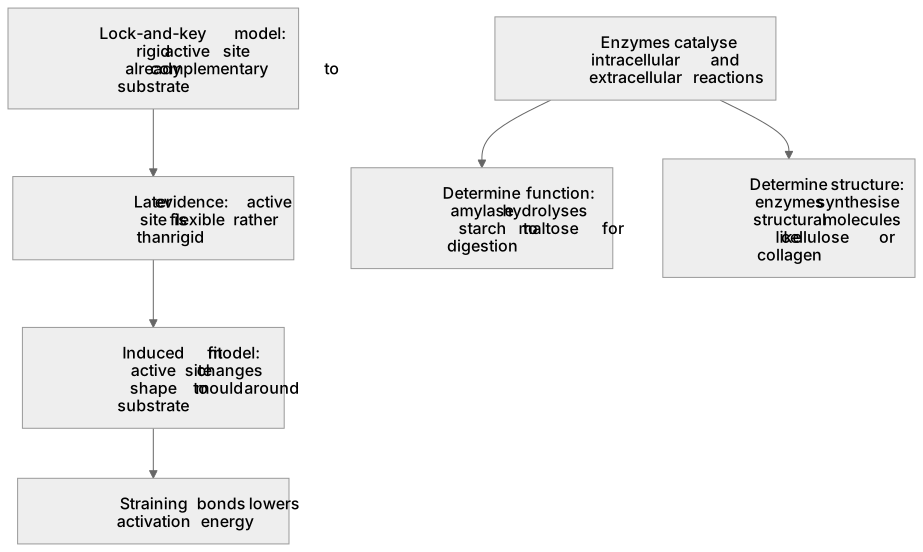
Enzyme models have evolved with new evidence. The lock-and-key model proposed a rigid active site perfectly complementary to the substrate. Later evidence supported the induced fit model, where the active site is flexible and moulds around the substrate, straining bonds to lower activation energy. Enzymes catalyse diverse reactions determining structure and function across all levels. Intracellularly, enzymes like DNA polymerase determine cellular structure and function by synthesising DNA. Extracellularly, amylase hydrolyses starch into maltose in the gut, aiding whole-organism digestive function. Other enzymes determine whole-organism structure, such as those synthesising structural proteins like collagen.
What earns the marks
- Describe the lock-and-key model as featuring a rigid active site that is already complementary to the substrate.
- Describe the induced fit model as the active site changing shape to mould around the substrate, straining bonds to lower activation energy.
- Explain that models changed because later evidence showed the active site is flexible rather than rigid.
- Provide an example of an enzyme determining function, such as extracellular amylase hydrolysing starch to maltose for digestion.
- Provide an example of an enzyme determining structure, such as intracellular enzymes synthesising structural molecules like cellulose or collagen.
Common mistakes and how to put them right
Stating amylase breaks starch directly into glucose.
Put it right: Amylase hydrolyses starch into the disaccharide maltose.
Describing the induced fit model as the substrate changing shape to fit the enzyme.
Put it right: It is the enzyme's active site that changes shape to mould around the substrate.
Overlooking the 'structure' aspect of enzyme function.
Put it right: Enzymes also synthesise structural components, such as cellulose for plant cell walls or collagen in animals.
Exam tips
- When comparing enzyme models, explicitly contrast the rigid active site of lock-and-key with the flexible active site of induced fit.
- Ensure you can provide specific examples of enzymes determining both structure (e.g., cellulose synthase) and function (e.g., amylase producing maltose).
Try the lesson
The start of the Many proteins are enzymes: Students should be able to: appreciate how models of enzyme action have changed over time appreciate that enzymes catalyse a wide range of intracellular and extracellular reactions that determine structures and functions from cellular to whole-organism level. lesson, made from checked teaching notes for this specification point.
Have a go first
Which statement describes an extracellular enzyme?
Listen
Enzyme models have evolved with new evidence. The lock-and-key model proposed a rigid active site perfectly complementary to the substrate. Later evidence supported the induced fit model, where the active site is flexible and moulds around the substrate, straining bonds to lower activation energy. Enzymes catalyse diverse reactions determining structure and function across all levels. Intracellularly, enzymes like DNA polymerase determine cellular structure and function by synthesising DNA. Extracellularly, amylase hydrolyses starch into maltose in the gut, aiding whole-organism digestive function. Other enzymes determine whole-organism structure, such as those synthesising structural proteins like collagen. A strong answer earns marks for these points. Describe the lock-and-key model as featuring a rigid active site that is already complementary to the substrate. Describe the induced fit model as the active site changing shape to mould around the substrate, straining bonds to lower activation energy. Explain that models changed because later evidence showed the active site is flexible rather than rigid. Provide an example of an enzyme determining function, such as extracellular amylase hydrolysing starch to maltose for digestion. A common slip: Stating amylase breaks starch directly into glucose. Instead, amylase hydrolyses starch into the disaccharide maltose. Exam tip: When comparing enzyme models, explicitly contrast the rigid active site of lock-and-key with the flexible active site of induced fit.
See it
Key words
Say what each word means before you turn the card.
induced fit
Try answering aloud or in your head before turning the card.
intracellular and extracellular enzymes
Try answering aloud or in your head before turning the card.
structural and functional roles
Try answering aloud or in your head before turning the card.
See every definition
- induced fit
- The active site is flexible and moulds around the substrate, straining bonds to lower activation energy.
- intracellular and extracellular enzymes
- Enzymes catalyse a wide range of reactions inside and outside cells that determine structures and functions from cellular to whole-organism level.
- structural and functional roles
- Enzymes determine structures and functions from cellular to whole-organism level through the reactions they catalyse.
Label the diagram
Some boxes have lost their names. Pick the right name for each number.
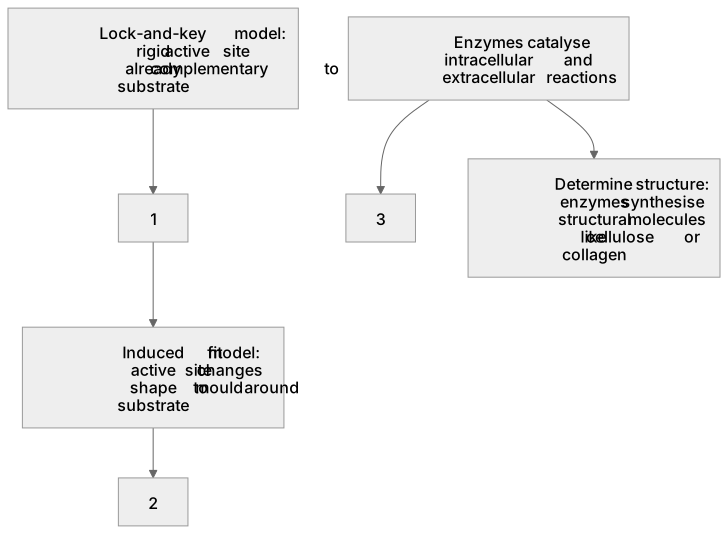
1Box 1
2Box 2
3Box 3
There is more to this lesson
The full lesson goes on to check your understanding and help you earn the marks. Create a free account to carry on, with your progress saved.
A week of Premium from your first lesson · Then the free plan continues · No card, no charge
Test your understanding of Many proteins are enzymes: Students should be able to: appreciate how models of enzyme action have changed over time appreciate that enzymes catalyse a wide range of intracellular and extracellular reactions that determine structures and functions from cellular to whole-organism level.
Active recall beats re-reading. Take an instant quiz now to test what you’ve learned and lock it into long-term memory.
A week of Premium from your first lesson · Then the free plan continues · No card, no charge