AQA · A-Level · Biology
Course version: 7402 · Version from Sept 2016
A hydrolysis reaction breaks a chemical bond between two molecules and…
Full specification wording
Monomers and polymers: A hydrolysis reaction breaks a chemical bond between two molecules and involves the use of a water molecule.
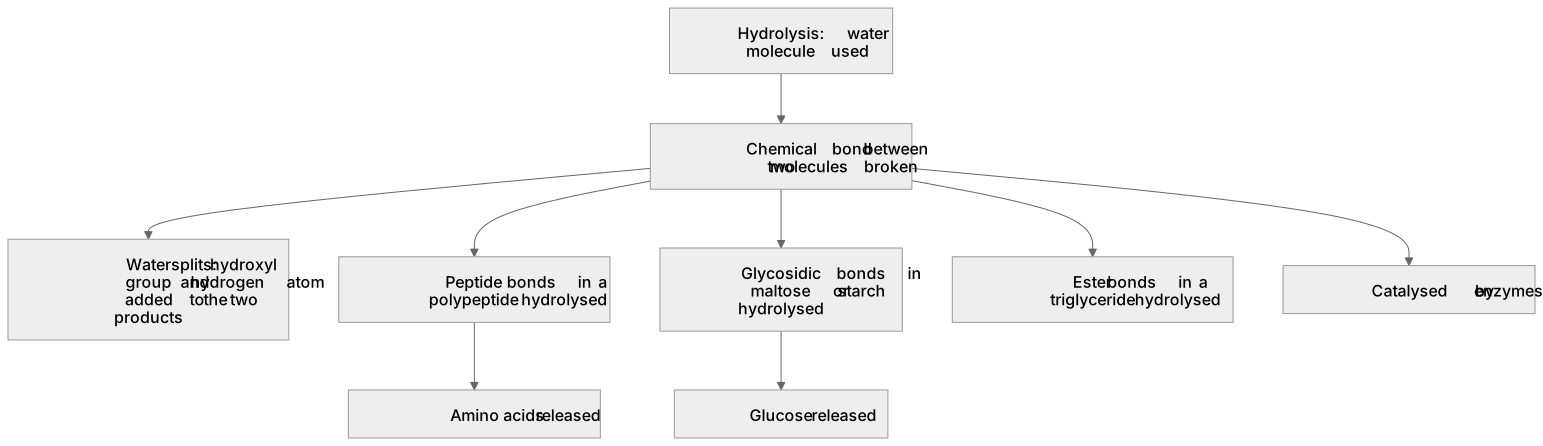
Hydrolysis breaks a chemical bond between two molecules using a molecule of water: the water splits and its hydroxyl group and hydrogen atom are added to the two products.
Checked against the AQA 7402 specification (opens in a new tab) on .
- Point 6 of 6
- 4 key terms
Study notes
From the checked teaching notes for this specification point.
The idea
Hydrolysis breaks a chemical bond between two molecules using a molecule of water: the water splits and its hydroxyl group and hydrogen atom are added to the two products. It is the exact reverse of condensation and uses one water molecule per bond broken. Digestion is the obvious example - peptide bonds in a polypeptide, glycosidic bonds in maltose or starch, and ester bonds in a triglyceride are all hydrolysed - but hydrolysis also happens continuously inside cells, when glycogen is mobilised or when ATP is hydrolysed to ADP and inorganic phosphate. Enzymes catalyse it. Enzyme names are not all derived from the bond acted on: endopeptidases and exopeptidases are named for their site of action (internal or terminal peptide bonds), dipeptidases for their substrate (dipeptides), and maltase for its substrate (maltose).
What earns the marks
- Stating that a water molecule is added or used to break the bond.
- Naming the bond hydrolysed, such as peptide bond or glycosidic bond.
- Naming the products released, for example amino acids from a dipeptide or glucose from maltose.
- Stating that the reaction is catalysed by a named enzyme, such as a peptidase or maltase.
- Explaining a delay or slower rate because the substrate must be hydrolysed before it can be used.
Common mistakes and how to put them right
Writing that hydrolysis releases water, which reverses the definition.
Put it right: Hydrolysis uses water, condensation releases it.
Saying the molecule is 'broken down' without naming the bond or mentioning water.
Put it right: Name the bond and state that water is used.
Stating that exopeptidases hydrolyse internal peptide bonds, when they act on the terminal bonds.
Put it right: Endopeptidases act internally, exopeptidases at the ends.
Forgetting that a disaccharide must be hydrolysed before it can enter respiration, and answering that maltose is simply 'harder to respire'.
Put it right: Maltose is a disaccharide that must first be hydrolysed to glucose.
Confusing hydrolysis with denaturation, which changes the folding of a protein rather than breaking peptide bonds.
Put it right: Denaturation disrupts bonds maintaining tertiary structure, hydrolysis breaks peptide bonds.
Exam tips
- Always include the water molecule; 'breaking the bond' with no reference to water does not describe hydrolysis.
- When a question compares maltose and glucose, the marks are for identifying maltose as a disaccharide and for the time taken to hydrolyse the glycosidic bond.
- Learn endopeptidase, exopeptidase and dipeptidase as a sequence, and describe where each acts on the chain.
Try the lesson
The start of the Monomers and polymers: A hydrolysis reaction breaks a chemical bond between two molecules and involves the use of a water molecule. lesson, made from checked teaching notes for this specification point.
Have a go first
What is used during a hydrolysis reaction to break a chemical bond between two molecules?
Listen
Hydrolysis breaks a chemical bond between two molecules using a molecule of water: the water splits and its hydroxyl group and hydrogen atom are added to the two products. It is the exact reverse of condensation and uses one water molecule per bond broken. Digestion is the obvious example - peptide bonds in a polypeptide, glycosidic bonds in maltose or starch, and ester bonds in a triglyceride are all hydrolysed - but hydrolysis also happens continuously inside cells, when glycogen is mobilised or when ATP is hydrolysed to ADP and inorganic phosphate. Enzymes catalyse it. Enzyme names are not all derived from the bond acted on: endopeptidases and exopeptidases are named for their site of action (internal or terminal peptide bonds), dipeptidases for their substrate (dipeptides), and maltase for its substrate (maltose). A strong answer earns marks for these points. stating that a water molecule is added or used to break the bond. naming the bond hydrolysed, such as peptide bond or glycosidic bond. naming the products released, for example amino acids from a dipeptide or glucose from maltose. stating that the reaction is catalysed by a named enzyme, such as a peptidase or maltase. A common slip: writing that hydrolysis releases water, which reverses the definition. Instead, hydrolysis uses water, condensation releases it. Exam tip: Always include the water molecule; 'breaking the bond' with no reference to water does not describe hydrolysis.
See it
Key words
Say what each word means before you turn the card.
hydrolysis reaction
Try answering aloud or in your head before turning the card.
condensation
Try answering aloud or in your head before turning the card.
endopeptidases
Try answering aloud or in your head before turning the card.
exopeptidases
Try answering aloud or in your head before turning the card.
See every definition
- hydrolysis reaction
- Breaks a chemical bond between two molecules and involves the use of a water molecule.
- condensation
- The reaction of which hydrolysis is the exact reverse, using one water molecule per bond broken in the other direction.
- endopeptidases
- Enzymes named for their site of action, acting on internal peptide bonds.
- exopeptidases
- Enzymes named for their site of action, acting on terminal peptide bonds.
Label the diagram
Some boxes have lost their names. Pick the right name for each number.
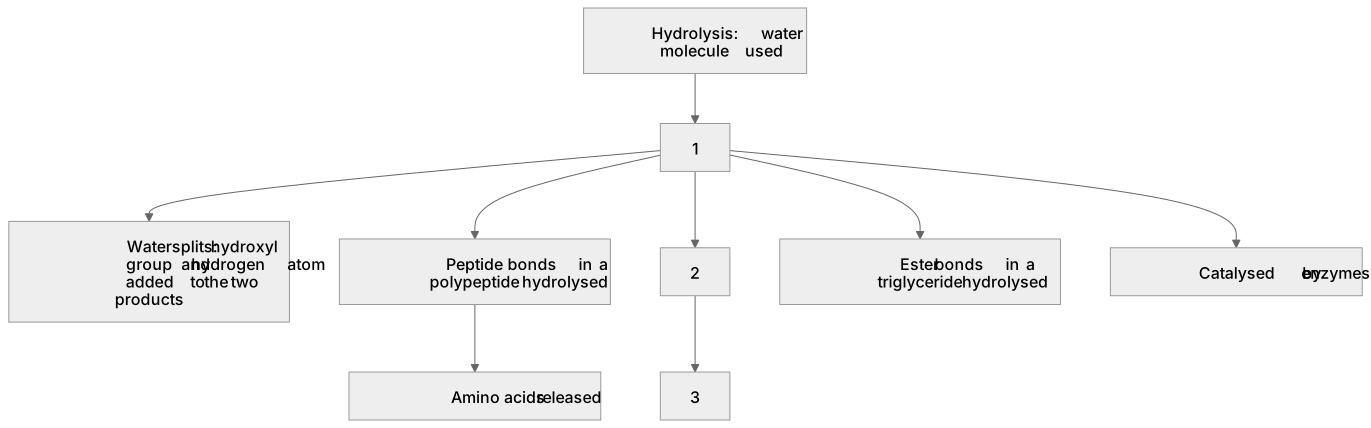
1Box 1
2Box 2
3Box 3
There is more to this lesson
The full lesson goes on to check your understanding and help you earn the marks. Create a free account to carry on, with your progress saved.
A week of Premium from your first lesson · Then the free plan continues · No card, no charge
Test your understanding of Monomers and polymers: A hydrolysis reaction breaks a chemical bond between two molecules and involves the use of a water molecule.
Active recall beats re-reading. Take an instant quiz now to test what you’ve learned and lock it into long-term memory.
A week of Premium from your first lesson · Then the free plan continues · No card, no charge