AQA · A-Level · Biology
Course version: 7402 · Version from Sept 2016
Totipotent cells can divide and produce any type of body cell.
Full specification wording
Most of a cell’s DNA is not translated (A-level only): Totipotent cells can divide and produce any type of body cell.
A stem cell is an undifferentiated cell that can keep dividing by mitosis and can differentiate into other cell types.
Checked against the AQA 7402 specification (opens in a new tab) on .
- Point 1 of 8
- 4 key terms
Study notes
From the checked teaching notes for this specification point.
The idea
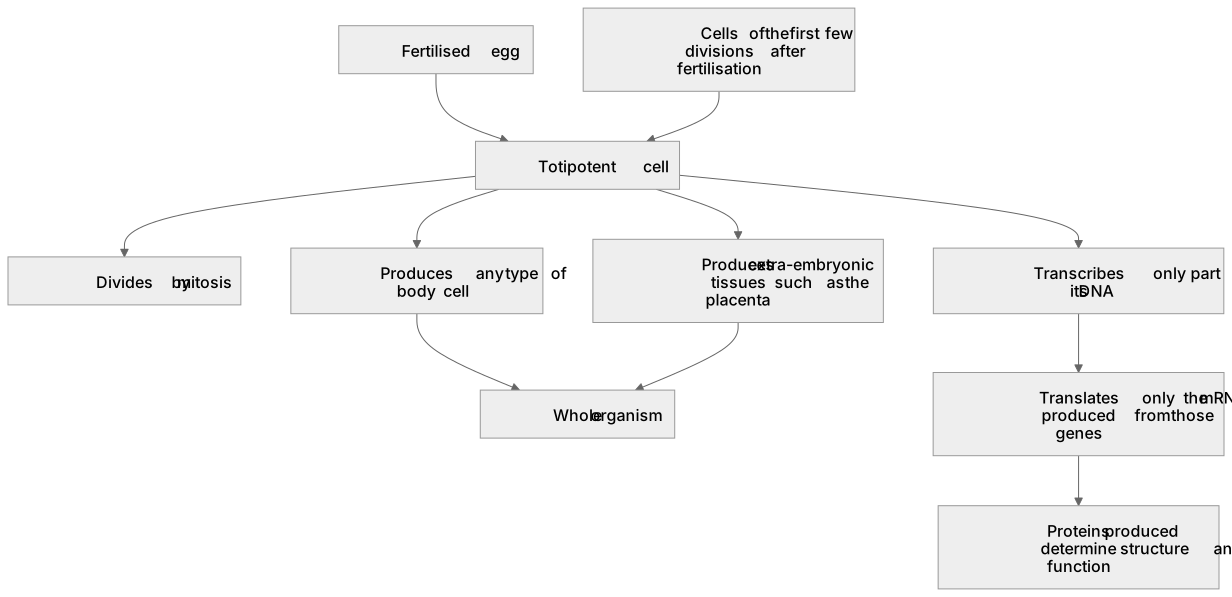
A stem cell is an undifferentiated cell that can keep dividing by mitosis and can differentiate into other cell types. Totipotent cells are the most versatile of all: they can divide and produce every type of body cell and, in mammals, the extra-embryonic tissues such as the placenta, so a single totipotent cell can give rise to a whole organism. The fertilised egg is totipotent, and so are the cells produced by the first few divisions after fertilisation. Every one of these cells contains exactly the same DNA as every other cell in the body; what makes a specialised cell different is not which genes it has but which genes it expresses. As development proceeds, a totipotent cell transcribes only part of its DNA and translates only the mRNA produced from those genes, and the proteins produced determine the structure and function it takes on.
What earns the marks
- Totipotent cells being able to divide and produce any type of body cell.
- Stating that they can also form extra-embryonic or placental tissue, and therefore a whole organism.
- Stating that all body cells of an organism contain the same genes or DNA.
- Specialisation arising because only some genes are expressed, not because genes are lost.
- A correct example, such as the zygote or the cells of the earliest embryo.
Common mistakes and how to put them right
Writing that specialised cells lose or destroy the genes they no longer need.
Using totipotent loosely for any stem cell, including bone marrow cells.
Saying totipotent cells can become any cell without distinguishing them from pluripotent cells, which cannot form placental tissue.
Describing stem cells as cells that have not been used yet, rather than undifferentiated cells able to divide and differentiate.
Confusing differentiation with cell division.
Exam tips
- Learn the four potency terms as a ladder, totipotent, pluripotent, multipotent, unipotent, with what each can and cannot form.
- Answer how does a cell become specialised with gene expression, never with gene loss.
- If asked what distinguishes totipotent from pluripotent, the placenta is the deciding point.
Try the lesson
The start of the Most of a cell’s DNA is not translated (A-level only): Totipotent cells can divide and produce any type of body cell. lesson, made from checked teaching notes for this specification point.
Have a go first
During early mammalian development, which type of stem cell can divide and differentiate into any type of body cell, as well as extra-embryonic cells?
Listen
A stem cell is an undifferentiated cell that can keep dividing by mitosis and can differentiate into other cell types. Totipotent cells are the most versatile of all: they can divide and produce every type of body cell and, in mammals, the extra-embryonic tissues such as the placenta, so a single totipotent cell can give rise to a whole organism. The fertilised egg is totipotent, and so are the cells produced by the first few divisions after fertilisation. Every one of these cells contains exactly the same DNA as every other cell in the body; what makes a specialised cell different is not which genes it has but which genes it expresses. As development proceeds, a totipotent cell transcribes only part of its DNA and translates only the mRNA produced from those genes, and the proteins produced determine the structure and function it takes on. A strong answer earns marks for these points. totipotent cells being able to divide and produce any type of body cell. stating that they can also form extra-embryonic or placental tissue, and therefore a whole organism. stating that all body cells of an organism contain the same genes or DNA. specialisation arising because only some genes are expressed, not because genes are lost. Exam tip: Learn the four potency terms as a ladder, totipotent, pluripotent, multipotent, unipotent, with what each can and cannot form.
See it
Key words
Say what each word means before you turn the card.
stem cell
Try answering aloud or in your head before turning the card.
totipotent cell
Try answering aloud or in your head before turning the card.
differentiation
Try answering aloud or in your head before turning the card.
same genes in all cells
Try answering aloud or in your head before turning the card.
See every definition
- stem cell
- An undifferentiated cell that can keep dividing by mitosis and can differentiate into other cell types.
- totipotent cell
- A cell that can divide and produce every type of body cell and, in mammals, the extra-embryonic tissues such as the placenta, so a single one can give rise to a whole organism.
- differentiation
- The process in which a cell transcribes only part of its DNA and translates only the mRNA produced from those genes, and the proteins produced determine the structure and function it takes on.
- same genes in all cells
- Every cell contains exactly the same DNA as every other cell in the body, and what makes a specialised cell different is not which genes it has but which genes it expresses.
Label the diagram
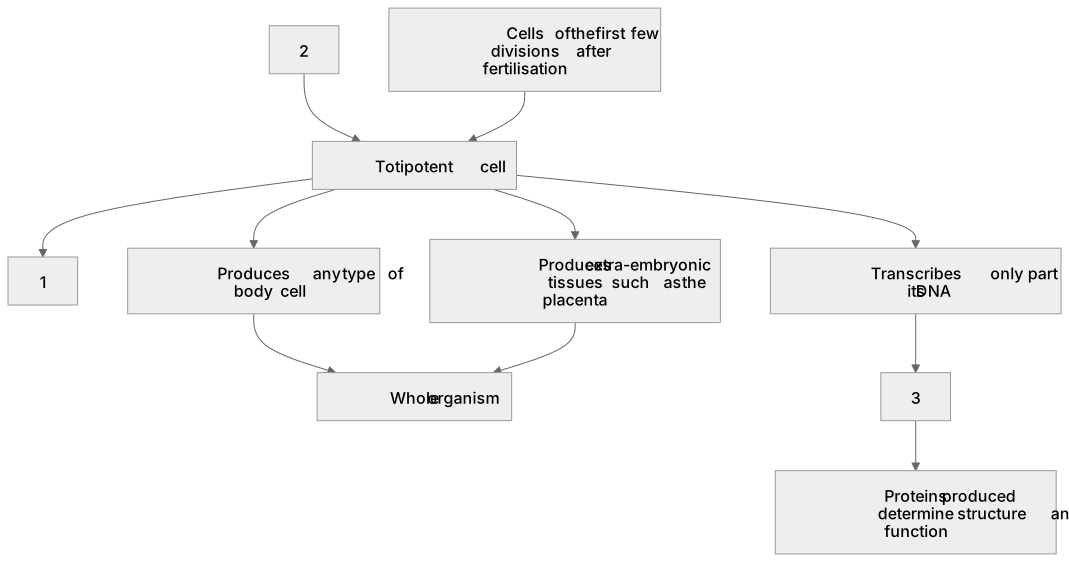
Some boxes have lost their names. Pick the right name for each number.
1Box 1
2Box 2
3Box 3
There is more to this lesson
The full lesson goes on to check your understanding and help you earn the marks. Create a free account to carry on, with your progress saved.
A week of Premium from your first lesson · Then the free plan continues · No card, no charge
Test your understanding of Most of a cell’s DNA is not translated (A-level only): Totipotent cells can divide and produce any type of body cell.
Active recall beats re-reading. Take an instant quiz now to test what you’ve learned and lock it into long-term memory.
A week of Premium from your first lesson · Then the free plan continues · No card, no charge