AQA · A-Level · Biology
Course version: 7402 · Version from Sept 2016
Totipotent cells occur only for a limited time in early mammalian embryos.
Full specification wording
Most of a cell’s DNA is not translated (A-level only): Totipotent cells occur only for a limited time in early mammalian embryos.
In mammals, totipotency is brief.
Checked against the AQA 7402 specification (opens in a new tab) on .
- Point 3 of 8
- 3 key terms
Study notes
From the checked teaching notes for this specification point.
The idea
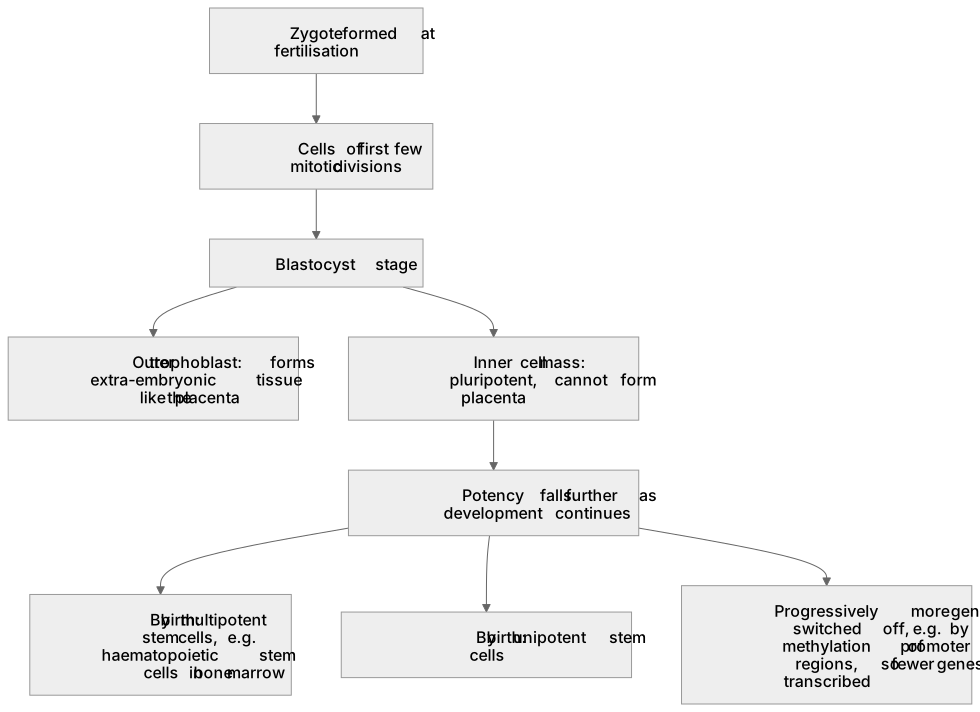
In mammals, totipotency is brief. The zygote formed at fertilisation and the cells of the first few mitotic divisions are totipotent. By the blastocyst stage, cells have begun to differ: the outer trophoblast forms extra-embryonic tissue like the placenta, while the inner cell mass retains the ability to form every body cell but not the placenta, making it pluripotent. As development continues, potency falls further. By birth, remaining stem cells are multipotent, such as haematopoietic stem cells in bone marrow, or unipotent. This narrowing of potential happens because progressively more genes are switched off, for example by methylation of promoter regions, so fewer genes can be transcribed.
What earns the marks
- The zygote and the cells of the first few divisions in early mammalian embryos are totipotent.
- Totipotency is lost early in development, for example by the blastocyst stage.
- The inner cell mass of the blastocyst is pluripotent because it cannot form extra-embryonic or placental tissue.
- Stem cells in a mature mammal are multipotent or unipotent rather than totipotent.
- The loss of potency is explained by genes being switched off and no longer transcribed.
Common mistakes and how to put them right
Describing embryonic stem cells taken from a blastocyst as totipotent when they are pluripotent.
Put it right: State that inner cell mass cells are pluripotent.
Claiming adults retain totipotent cells in their bone marrow.
Put it right: Adult bone marrow contains multipotent stem cells.
Explaining the loss of potency as cells using up or losing their DNA.
Put it right: Genes remain present but are switched off and not transcribed.
Exam tips
- Name the developmental stage whenever you claim a cell is totipotent, because the mark often depends on the stage.
- Link any statement about lost potency to genes no longer being transcribed.
Try the lesson
The start of the Most of a cell’s DNA is not translated (A-level only): Totipotent cells occur only for a limited time in early mammalian embryos. lesson, made from checked teaching notes for this specification point.
Have a go first
For how long do totipotent cells occur in mammals?
Listen
In mammals, totipotency is brief. The zygote formed at fertilisation and the cells of the first few mitotic divisions are totipotent. By the blastocyst stage, cells have begun to differ: the outer trophoblast forms extra-embryonic tissue like the placenta, while the inner cell mass retains the ability to form every body cell but not the placenta, making it pluripotent. As development continues, potency falls further. By birth, remaining stem cells are multipotent, such as haematopoietic stem cells in bone marrow, or unipotent. This narrowing of potential happens because progressively more genes are switched off, for example by methylation of promoter regions, so fewer genes can be transcribed. A strong answer earns marks for these points. The zygote and the cells of the first few divisions in early mammalian embryos are totipotent. Totipotency is lost early in development, for example by the blastocyst stage. The inner cell mass of the blastocyst is pluripotent because it cannot form extra-embryonic or placental tissue. Stem cells in a mature mammal are multipotent or unipotent rather than totipotent. A common slip: Describing embryonic stem cells taken from a blastocyst as totipotent when they are pluripotent. Instead, state that inner cell mass cells are pluripotent. Exam tip: Name the developmental stage whenever you claim a cell is totipotent, because the mark often depends on the stage.
See it
Key words
Say what each word means before you turn the card.
zygote
Try answering aloud or in your head before turning the card.
blastocyst
Try answering aloud or in your head before turning the card.
loss of potency
Try answering aloud or in your head before turning the card.
See every definition
- zygote
- The cell formed at fertilisation, which with the cells of the first few mitotic divisions is totipotent.
- blastocyst
- The developmental stage by which totipotency is lost, with an outer trophoblast and an inner cell mass.
- loss of potency
- The narrowing of potential as development continues, explained by progressively more genes being switched off and no longer transcribed.
Label the diagram
Some boxes have lost their names. Pick the right name for each number.
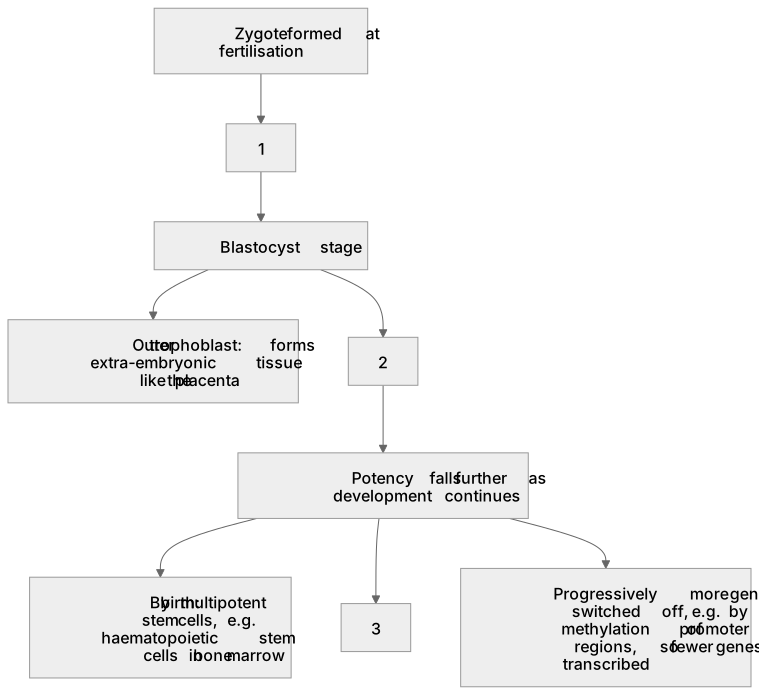
1Box 1
2Box 2
3Box 3
There is more to this lesson
The full lesson goes on to check your understanding and help you earn the marks. Create a free account to carry on, with your progress saved.
A week of Premium from your first lesson · Then the free plan continues · No card, no charge
Test your understanding of Most of a cell’s DNA is not translated (A-level only): Totipotent cells occur only for a limited time in early mammalian embryos.
Active recall beats re-reading. Take an instant quiz now to test what you’ve learned and lock it into long-term memory.
A week of Premium from your first lesson · Then the free plan continues · No card, no charge