AQA · A-Level · Biology
Course version: 7402 · Version from Sept 2016
Changes in membrane permeability lead to depolarisation and the generation…
Full specification wording
Nerve impulses (A-level only): Changes in membrane permeability lead to depolarisation and the generation of an action potential. The all-or-nothing principle.
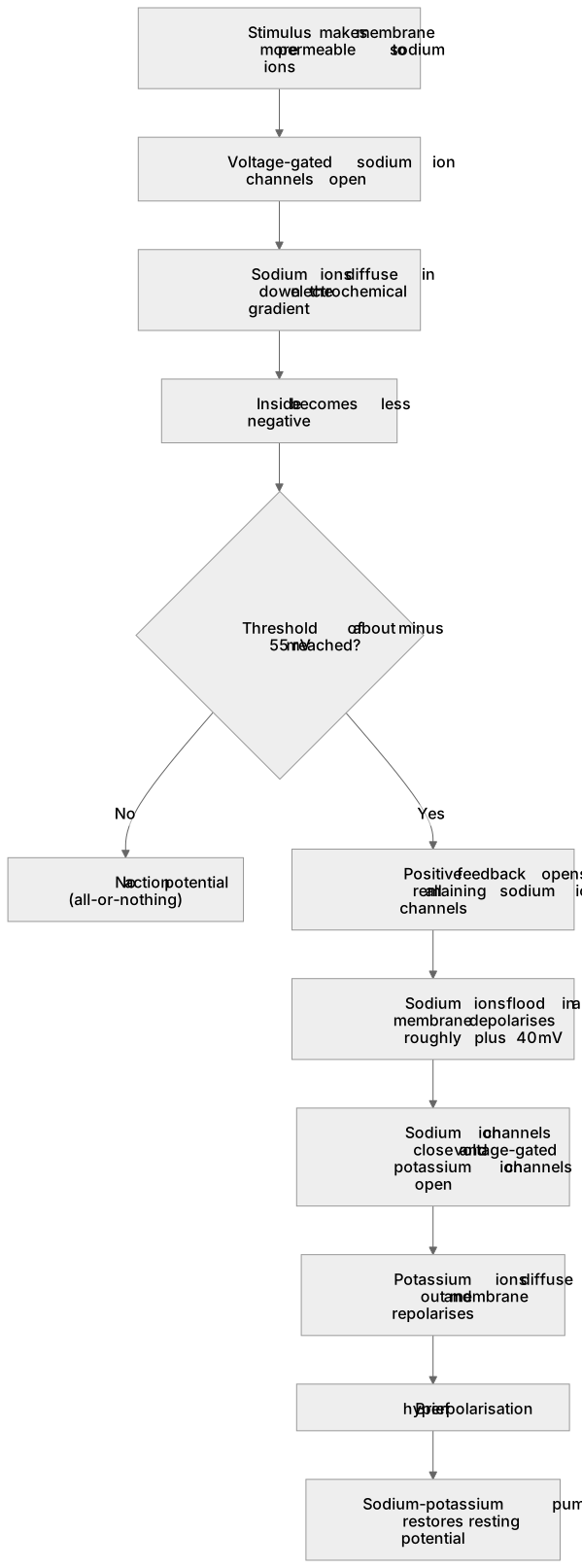
A stimulus makes the axon membrane more permeable to sodium ions: some voltage-gated sodium ion channels open, sodium ions diffuse in down the electrochemical gradient, and the inside becomes less…
Checked against the AQA 7402 specification (opens in a new tab) on .
- Point 3 of 6
- 4 key terms
Study notes
From the checked teaching notes for this specification point.
The idea
A stimulus makes the axon membrane more permeable to sodium ions: some voltage-gated sodium ion channels open, sodium ions diffuse in down the electrochemical gradient, and the inside becomes less negative. If enough sodium ions enter to lift the potential to the threshold of about minus 55 mV, positive feedback opens all the remaining voltage-gated sodium ion channels, sodium ions flood in and the membrane depolarises to roughly plus 40 mV, so the inside becomes positive. That is the action potential. At the peak the sodium ion channels close and voltage-gated potassium ion channels open, so potassium ions diffuse out and the membrane repolarises, overshooting briefly into hyperpolarisation before the sodium-potassium pump restores the resting potential.
What earns the marks
- Sodium ion channels opening so the membrane becomes more permeable to sodium ions.
- Sodium ions diffusing into the axon down the electrochemical gradient.
- Depolarisation, the inside becoming positive, once the threshold is reached.
- Potassium ion channels opening and potassium ions diffusing out, causing repolarisation.
- The all-or-nothing point, that below threshold no action potential is produced and above threshold every action potential is the same size.
Common mistakes and how to put them right
Describing a stronger stimulus as producing a bigger or stronger action potential, which examiners ignore because the size is fixed.
Writing sodium rather than sodium ions, which caps the marks available.
Saying sodium ions are actively transported into the axon during depolarisation, when they diffuse in through open channels.
Leaving threshold out altogether, so the all-or-nothing idea has nothing to hang on.
Confusing repolarisation with hyperpolarisation, or claiming the pump is what repolarises the membrane.
Exam tips
- Work from the graph: label minus 70 mV, the minus 55 mV threshold, the plus 40 mV peak and the return to rest, then attach an ion movement to each section.
- Code the intensity of a stimulus as the frequency of action potentials, never their amplitude.
- Say voltage-gated when writing about an axon, and stretch-mediated only when writing about a Pacinian corpuscle.
Try the lesson
The start of the Nerve impulses (A-level only): Changes in membrane permeability lead to depolarisation and the generation of an action potential. The all-or-nothing principle. lesson, made from checked teaching notes for this specification point.
Have a go first
Which change in membrane permeability causes depolarisation during an action potential?
Listen
A stimulus makes the axon membrane more permeable to sodium ions: some voltage-gated sodium ion channels open, sodium ions diffuse in down the electrochemical gradient, and the inside becomes less negative. If enough sodium ions enter to lift the potential to the threshold of about minus 55 mV, positive feedback opens all the remaining voltage-gated sodium ion channels, sodium ions flood in and the membrane depolarises to roughly plus 40 mV, so the inside becomes positive. That is the action potential. At the peak the sodium ion channels close and voltage-gated potassium ion channels open, so potassium ions diffuse out and the membrane repolarises, overshooting briefly into hyperpolarisation before the sodium-potassium pump restores the resting potential. A strong answer earns marks for these points. sodium ion channels opening so the membrane becomes more permeable to sodium ions. sodium ions diffusing into the axon down the electrochemical gradient. depolarisation, the inside becoming positive, once the threshold is reached. potassium ion channels opening and potassium ions diffusing out, causing repolarisation. Exam tip: Work from the graph: label minus 70 mV, the minus 55 mV threshold, the plus 40 mV peak and the return to rest, then attach an ion movement to each section.
See it
Key words
Say what each word means before you turn the card.
threshold
Try answering aloud or in your head before turning the card.
depolarisation
Try answering aloud or in your head before turning the card.
repolarisation
Try answering aloud or in your head before turning the card.
all-or-nothing principle
Try answering aloud or in your head before turning the card.
See every definition
- threshold
- The potential of about minus 55 mV that enough sodium ions must lift the inside to, so that positive feedback opens all the remaining voltage-gated sodium ion channels.
- depolarisation
- The membrane becoming depolarised to roughly plus 40 mV, so the inside becomes positive, once the threshold is reached.
- repolarisation
- The membrane repolarising when the sodium ion channels close at the peak and voltage-gated potassium ion channels open, so potassium ions diffuse out.
- all-or-nothing principle
- Below threshold no action potential is produced, and above threshold every action potential is the same size.
Label the diagram
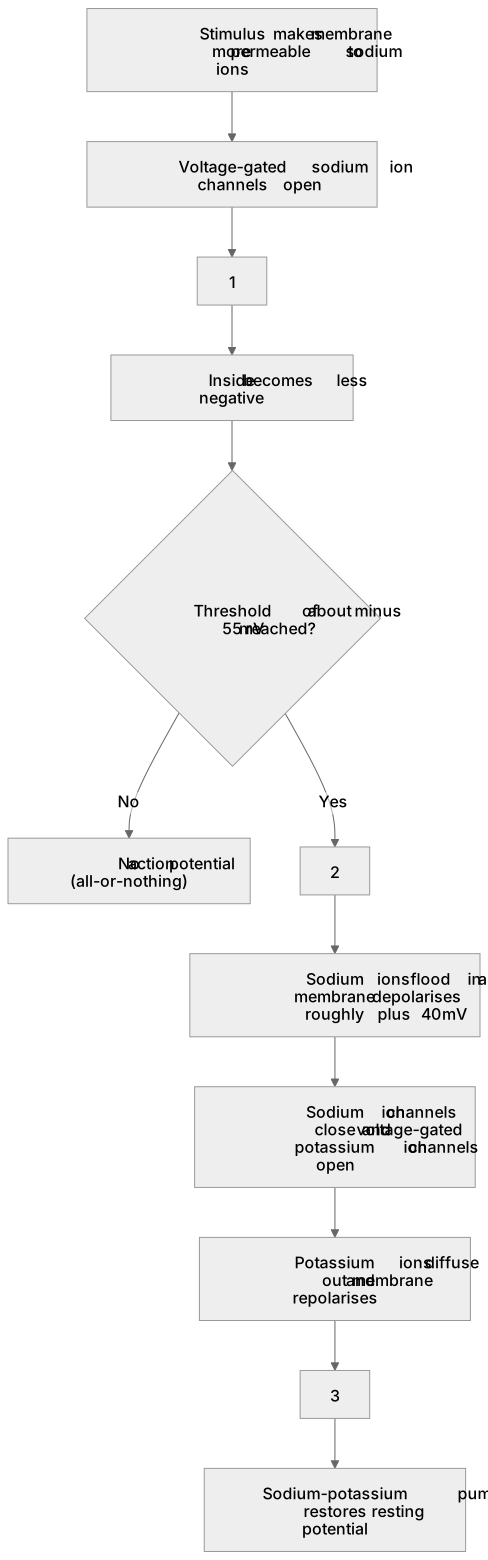
Some boxes have lost their names. Pick the right name for each number.
1Box 1
2Box 2
3Box 3
There is more to this lesson
The full lesson goes on to check your understanding and help you earn the marks. Create a free account to carry on, with your progress saved.
A week of Premium from your first lesson · Then the free plan continues · No card, no charge
Test your understanding of Nerve impulses (A-level only): Changes in membrane permeability lead to depolarisation and the generation of an action potential. The all-or-nothing principle.
Active recall beats re-reading. Take an instant quiz now to test what you’ve learned and lock it into long-term memory.
A week of Premium from your first lesson · Then the free plan continues · No card, no charge