AQA · A-Level · Biology
Course version: 7402 · Version from Sept 2016
Factors affecting the speed of conductance: myelination and saltatory…
Full specification wording
Nerve impulses (A-level only): Factors affecting the speed of conductance: myelination and saltatory conduction; axon diameter; temperature.
Three factors affect nerve impulse conductance speed.
Checked against the AQA 7402 specification (opens in a new tab) on .
- Point 6 of 6
- 4 key terms
Study notes
From the checked teaching notes for this specification point.
The idea
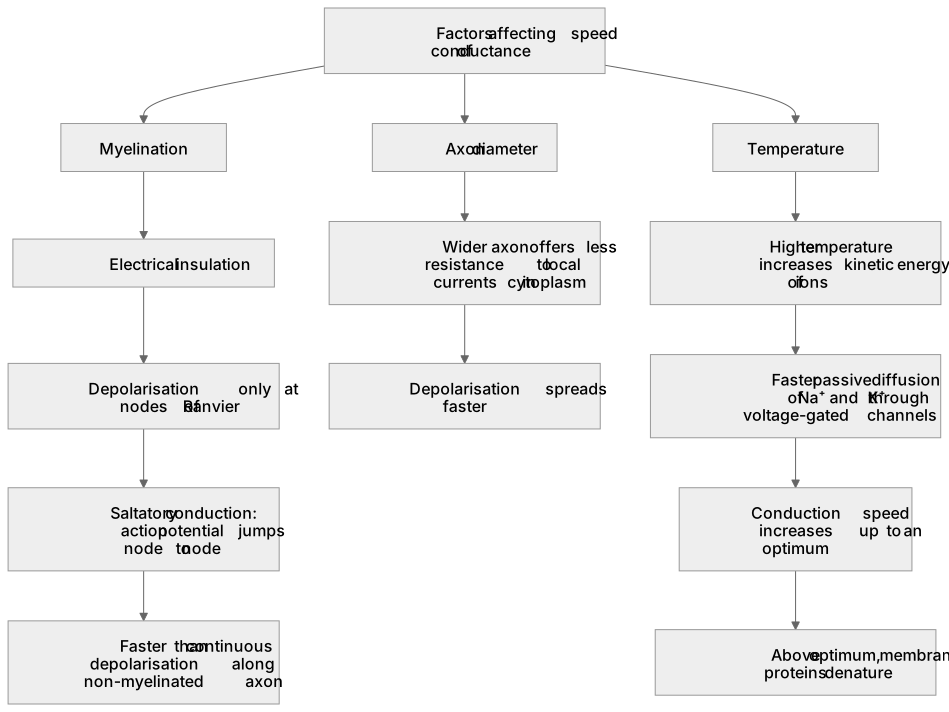
Three factors affect nerve impulse conductance speed. Myelination provides electrical insulation. In myelinated neurones, depolarisation only occurs at the nodes of Ranvier, allowing the action potential to jump from node to node via saltatory conduction. This is much faster than continuous depolarisation along a non-myelinated axon. Axon diameter also affects speed; a wider axon, like the squid giant axon, offers less resistance to the flow of local currents in the cytoplasm, so depolarisation spreads faster. Finally, higher temperatures increase the kinetic energy of ions. This leads to a faster rate of passive diffusion of Na⁺ and K⁺ through voltage-gated channels, increasing conduction speed up to an optimum before membrane proteins denature.
What earns the marks
- Myelination provides electrical insulation, allowing saltatory conduction where the action potential jumps between nodes of Ranvier.
- In non-myelinated axons, depolarisation must occur across the entire membrane length, resulting in slower conduction.
- A greater axon diameter reduces resistance to the flow of ions in the cytoplasm, increasing the speed of conduction.
- Higher temperatures increase the kinetic energy of ions, leading to a faster rate of passive diffusion of Na⁺ and K⁺ through voltage-gated channels.
- Temperatures above the optimum cause voltage-gated channel proteins to denature, preventing action potentials and stopping conduction.
Common mistakes and how to put them right
Stating myelin speeds up the impulse without explicitly naming saltatory conduction or the nodes of Ranvier.
Put it right: Specify that the impulse jumps between nodes of Ranvier via saltatory conduction.
Explaining demyelinating diseases (like multiple sclerosis) as the destruction of the axon itself.
Put it right: Explain that loss of myelin means depolarisation must now occur along the whole membrane, slowing the impulse.
Claiming higher temperatures speed up conduction because the sodium-potassium pump works faster.
Put it right: The pump maintains resting potential; faster conduction is due to increased kinetic energy and faster passive diffusion of Na⁺ and K⁺ through channels.
Exam tips
- In questions about multiple sclerosis or demyelination, explicitly state that saltatory conduction is lost and depolarisation must occur over the whole membrane.
- When evaluating data on conduction speeds, always make comparative statements (e.g., 'axon A has a wider diameter than axon B, so offers less resistance').
Try the lesson
The start of the Nerve impulses (A-level only): Factors affecting the speed of conductance: myelination and saltatory conduction; axon diameter; temperature. lesson, made from checked teaching notes for this specification point.
Have a go first
Which feature of a myelinated neurone allows saltatory conduction to occur?
Listen
Three factors affect nerve impulse conductance speed. Myelination provides electrical insulation. In myelinated neurones, depolarisation only occurs at the nodes of Ranvier, allowing the action potential to jump from node to node via saltatory conduction. This is much faster than continuous depolarisation along a non-myelinated axon. Axon diameter also affects speed; a wider axon, like the squid giant axon, offers less resistance to the flow of local currents in the cytoplasm, so depolarisation spreads faster. Finally, higher temperatures increase the kinetic energy of ions. This leads to a faster rate of passive diffusion of Na⁺ and K⁺ through voltage-gated channels, increasing conduction speed up to an optimum before membrane proteins denature. A strong answer earns marks for these points. Myelination provides electrical insulation, allowing saltatory conduction where the action potential jumps between nodes of Ranvier. In non-myelinated axons, depolarisation must occur across the entire membrane length, resulting in slower conduction. A greater axon diameter reduces resistance to the flow of ions in the cytoplasm, increasing the speed of conduction. Higher temperatures increase the kinetic energy of ions, leading to a faster rate of passive diffusion of Na⁺ and K⁺ through voltage-gated channels. A common slip: Stating myelin speeds up the impulse without explicitly naming saltatory conduction or the nodes of Ranvier. Instead, specify that the impulse jumps between nodes of Ranvier via saltatory conduction. Exam tip: In questions about multiple sclerosis or demyelination, explicitly state that saltatory conduction is lost and depolarisation must occur over the whole membrane.
See it
Key words
Say what each word means before you turn the card.
saltatory conduction
Try answering aloud or in your head before turning the card.
myelination and nodes of Ranvier
Try answering aloud or in your head before turning the card.
axon diameter and resistance
Try answering aloud or in your head before turning the card.
temperature and kinetic energy
Try answering aloud or in your head before turning the card.
See every definition
- saltatory conduction
- Depolarisation only occurs at the nodes of Ranvier, allowing the action potential to jump from node to node.
- myelination and nodes of Ranvier
- Provides electrical insulation, so that in myelinated neurones depolarisation only occurs at the nodes of Ranvier.
- axon diameter and resistance
- A wider axon offers less resistance to the flow of local currents in the cytoplasm, so depolarisation spreads faster.
- temperature and kinetic energy
- Higher temperatures increase the kinetic energy of ions, leading to a faster rate of passive diffusion of Na⁺ and K⁺ through voltage-gated channels.
Label the diagram
Some boxes have lost their names. Pick the right name for each number.
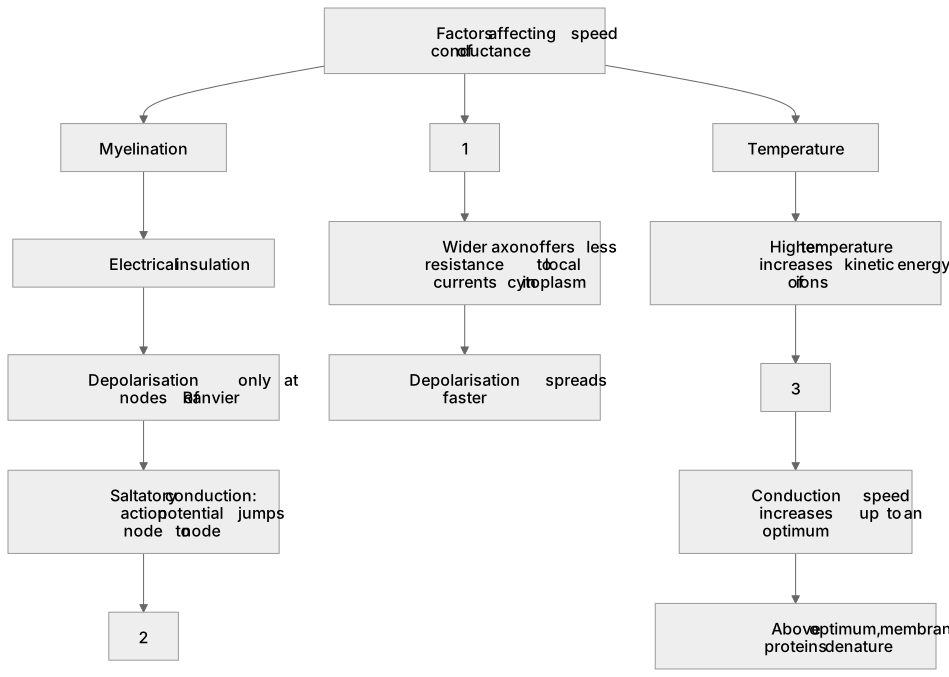
1Box 1
2Box 2
3Box 3
There is more to this lesson
The full lesson goes on to check your understanding and help you earn the marks. Create a free account to carry on, with your progress saved.
A week of Premium from your first lesson · Then the free plan continues · No card, no charge
Test your understanding of Nerve impulses (A-level only): Factors affecting the speed of conductance: myelination and saltatory conduction; axon diameter; temperature.
Active recall beats re-reading. Take an instant quiz now to test what you’ve learned and lock it into long-term memory.
A week of Premium from your first lesson · Then the free plan continues · No card, no charge