AQA · A-Level · Biology
Course version: 7402 · Version from Sept 2016
The conditions under which the principle applies.
Full specification wording
Populations (A-level only): The conditions under which the principle applies.
The model predicts constant allele frequencies only if five conditions hold: the population is large, mating is random, there is no migration into or out of it, no mutations occur, and there is no…
Checked against the AQA 7402 specification (opens in a new tab) on .
- Point 5 of 5
- 4 key terms
Study notes
From the checked teaching notes for this specification point.
The idea
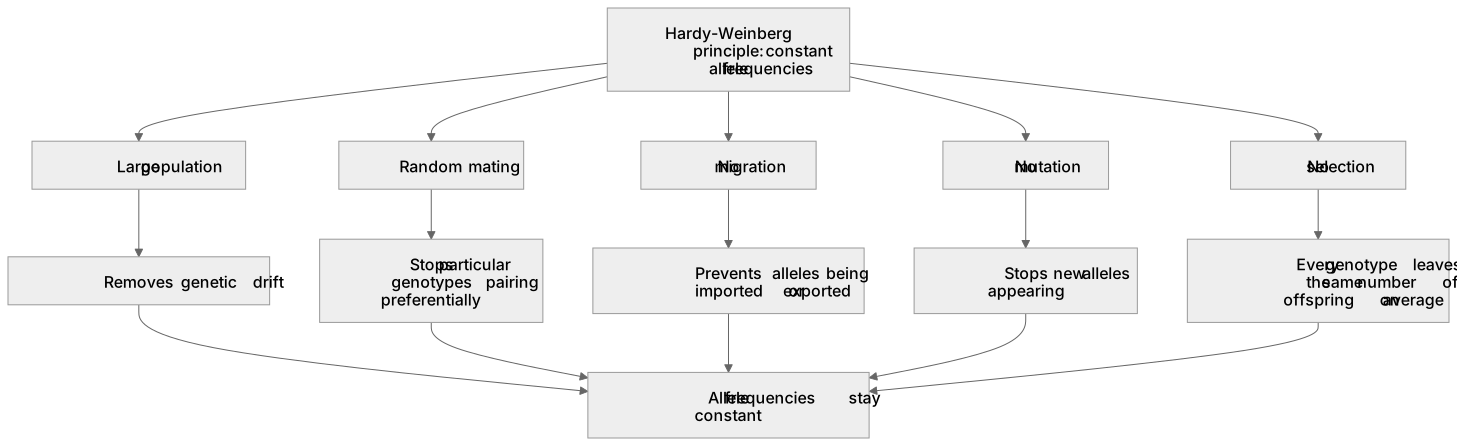
The model predicts constant allele frequencies only if five conditions hold: the population is large, mating is random, there is no migration into or out of it, no mutations occur, and there is no natural selection for or against any genotype. Each condition removes a route by which allele frequencies could change. A large population removes genetic drift, the chance sampling error that shifts frequencies when only a few individuals reproduce. Random mating stops particular genotypes pairing preferentially. No migration prevents alleles being imported or exported. No mutation stops new alleles appearing. No selection means every genotype leaves the same number of offspring on average. Real populations break at least one of these conditions, which is precisely why they evolve.
What earns the marks
- Each condition named, up to the number the question asks for, from large population, random mating, no migration, no mutation and no selection.
- Naming selection for or against a particular phenotype or allele as the reason observed frequencies have changed.
- Immigration or emigration, or the population not being isolated, as a cause of change.
- Explaining that a small population allows genetic drift, so frequencies change by chance.
Common mistakes and how to put them right
Giving the converse of a condition when asked why frequencies did change, for example offering random mating as the reason.
Listing births and deaths as a cause without qualification.
Put it right: They only change allele frequencies if they differ between genotypes (selection) or occur by chance in small populations (genetic drift).
Answering no random fertilisation when the condition concerns non-random mating.
Naming only one condition when the question asks for two, or restating the same idea in different words.
Assuming a population is large enough simply because it is described as a population.
Exam tips
- Learn the five conditions as a list you can write out in twenty seconds, then choose the ones the data point to.
- If the question asks why frequencies have changed, state the broken condition positively, as there has been selection against, not as there was no selection.
- Check the number of marks; suggest two reasons means two different conditions, not one condition explained twice.
Try the lesson
The start of the Populations (A-level only): The conditions under which the principle applies. lesson, made from checked teaching notes for this specification point.
Have a go first
Which condition is required for the Hardy–Weinberg principle to apply to a population?
Listen
The model predicts constant allele frequencies only if five conditions hold: the population is large, mating is random, there is no migration into or out of it, no mutations occur, and there is no natural selection for or against any genotype. Each condition removes a route by which allele frequencies could change. A large population removes genetic drift, the chance sampling error that shifts frequencies when only a few individuals reproduce. Random mating stops particular genotypes pairing preferentially. No migration prevents alleles being imported or exported. No mutation stops new alleles appearing. No selection means every genotype leaves the same number of offspring on average. Real populations break at least one of these conditions, which is precisely why they evolve. A strong answer earns marks for these points. each condition named, up to the number the question asks for, from large population, random mating, no migration, no mutation and no selection. naming selection for or against a particular phenotype or allele as the reason observed frequencies have changed. immigration or emigration, or the population not being isolated, as a cause of change. explaining that a small population allows genetic drift, so frequencies change by chance. Exam tip: Learn the five conditions as a list you can write out in twenty seconds, then choose the ones the data point to.
See it
Key words
Say what each word means before you turn the card.
large population
Try answering aloud or in your head before turning the card.
random mating
Try answering aloud or in your head before turning the card.
no migration
Try answering aloud or in your head before turning the card.
genetic drift
Try answering aloud or in your head before turning the card.
See every definition
- large population
- A condition that removes genetic drift, the chance sampling error that shifts frequencies when only a few individuals reproduce.
- random mating
- A condition that stops particular genotypes pairing preferentially.
- no migration
- A condition that prevents alleles being imported or exported.
- genetic drift
- The chance sampling error that shifts frequencies when only a few individuals reproduce, removed by a large population.
Label the diagram
Some boxes have lost their names. Pick the right name for each number.
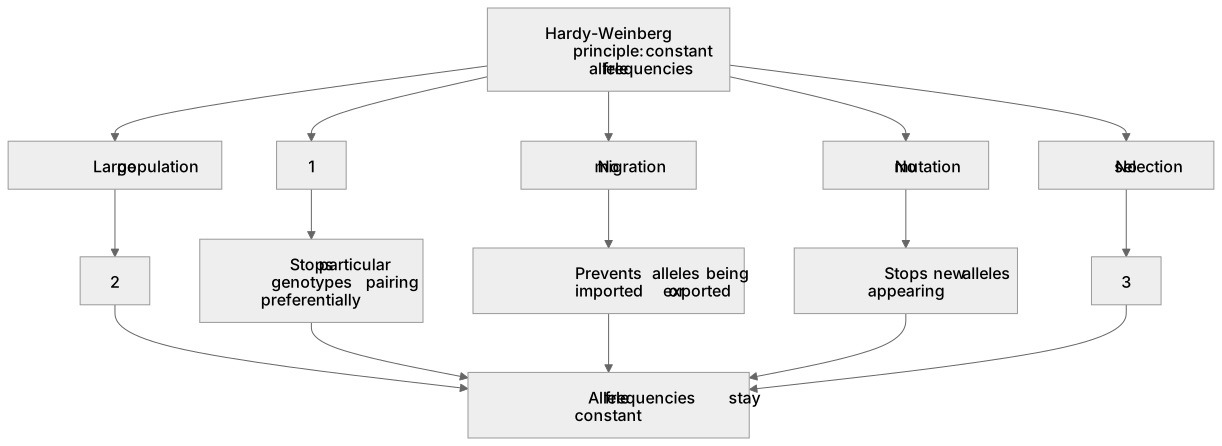
1Box 1
2Box 2
3Box 3
There is more to this lesson
The full lesson goes on to check your understanding and help you earn the marks. Create a free account to carry on, with your progress saved.
A week of Premium from your first lesson · Then the free plan continues · No card, no charge
Test your understanding of Populations (A-level only): The conditions under which the principle applies.
Active recall beats re-reading. Take an instant quiz now to test what you’ve learned and lock it into long-term memory.
A week of Premium from your first lesson · Then the free plan continues · No card, no charge