AQA · A-Level · Biology
Course version: 7402 · Version from Sept 2016
Homeostasis in mammals involves physiological control systems that…
Full specification wording
Principles of homeostasis and negative feedback (A-level only): Homeostasis in mammals involves physiological control systems that maintain the internal environment within restricted limits.
Homeostasis is the maintenance of a relatively constant internal environment despite changes outside the body and in the body's own activity.
Checked against the AQA 7402 specification (opens in a new tab) on .
- Point 1 of 6
- 4 key terms
Study notes
From the checked teaching notes for this specification point.
The idea
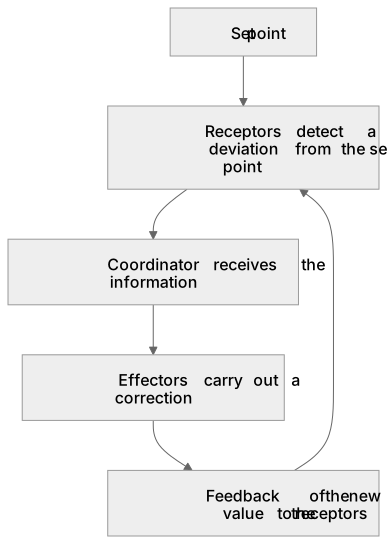
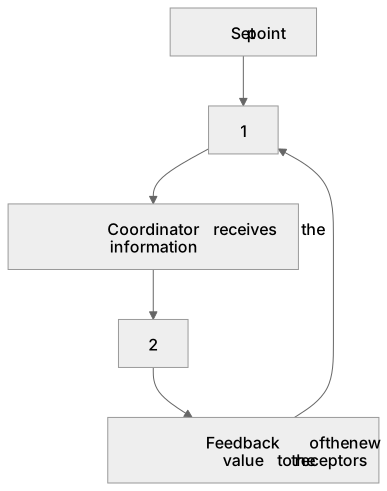
Homeostasis is the maintenance of a relatively constant internal environment despite changes outside the body and in the body's own activity. The internal environment means the blood and the tissue fluid that bathe the cells: their temperature, pH, water potential and the concentrations of glucose and ions. Every control system has the same parts: a set point, receptors that detect a deviation from it, a coordinator, usually a centre in the brain or an endocrine gland, that receives that information, effectors that carry out a correction, and feedback of the new value to the receptors. Notice the word restricted rather than constant. Levels fluctuate around the set point rather than being held exactly, because a correction can only begin once a deviation has been detected.
What earns the marks
- Defining homeostasis as the maintenance of a constant internal environment within narrow or restricted limits.
- Identifying the internal environment as the blood and tissue fluid surrounding the cells.
- Naming receptors, a coordinator and effectors as the components of a physiological control system.
- Stating that the level fluctuates around a set point rather than being held exactly constant.
- Linking stability to enzyme activity and therefore to metabolic reactions.
Common mistakes and how to put them right
Defining homeostasis as keeping conditions the same, with no mention of narrow limits or fluctuation around a set point.
Confusing the internal environment with the contents of a cell.
Listing organs rather than the roles of receptor, coordinator and effector.
Saying homeostasis keeps the external environment constant.
Forgetting that a deviation must occur before correction can begin, so the value cannot be fixed.
Exam tips
- Learn the receptor, coordinator, effector chain as a template; it structures answers on temperature, glucose and water potential alike.
- Use the phrase within restricted limits in a definition, because it separates a full mark from a partial one.
- Where an unfamiliar variable is given, identify the receptor and effector from the information rather than from memory.
Try the lesson
The start of the Principles of homeostasis and negative feedback (A-level only): Homeostasis in mammals involves physiological control systems that maintain the internal environment within restricted limits. lesson, made from checked teaching notes for this specification point.
Have a go first
In mammals, which fluid forms the immediate internal environment that surrounds the cells and is maintained by homeostasis?
Listen
Homeostasis is the maintenance of a relatively constant internal environment despite changes outside the body and in the body's own activity. The internal environment means the blood and the tissue fluid that bathe the cells: their temperature, pH, water potential and the concentrations of glucose and ions. Every control system has the same parts: a set point, receptors that detect a deviation from it, a coordinator, usually a centre in the brain or an endocrine gland, that receives that information, effectors that carry out a correction, and feedback of the new value to the receptors. Notice the word restricted rather than constant. Levels fluctuate around the set point rather than being held exactly, because a correction can only begin once a deviation has been detected. A strong answer earns marks for these points. defining homeostasis as the maintenance of a constant internal environment within narrow or restricted limits. identifying the internal environment as the blood and tissue fluid surrounding the cells. naming receptors, a coordinator and effectors as the components of a physiological control system. stating that the level fluctuates around a set point rather than being held exactly constant. Exam tip: Learn the receptor, coordinator, effector chain as a template; it structures answers on temperature, glucose and water potential alike.
See it
Key words
Say what each word means before you turn the card.
internal environment
Try answering aloud or in your head before turning the card.
set point
Try answering aloud or in your head before turning the card.
receptor, coordinator, effector
Try answering aloud or in your head before turning the card.
restricted limits
Try answering aloud or in your head before turning the card.
See every definition
- internal environment
- The blood and the tissue fluid that bathe the cells, including their temperature, pH, water potential and the concentrations of glucose and ions.
- set point
- The value that a physiological control system works around, with levels fluctuating around it rather than being held exactly.
- receptor, coordinator, effector
- The parts of every control system: receptors detect a deviation from the set point, a coordinator receives that information, and effectors carry out a correction.
- restricted limits
- The narrow range within which the internal environment is maintained, rather than being kept exactly constant.
Label the diagram
Some boxes have lost their names. Pick the right name for each number.
1Box 1
2Box 2
There is more to this lesson
The full lesson goes on to check your understanding and help you earn the marks. Create a free account to carry on, with your progress saved.
A week of Premium from your first lesson · Then the free plan continues · No card, no charge
Test your understanding of Principles of homeostasis and negative feedback (A-level only): Homeostasis in mammals involves physiological control systems that maintain the internal environment within restricted limits.
Active recall beats re-reading. Take an instant quiz now to test what you’ve learned and lock it into long-term memory.
A week of Premium from your first lesson · Then the free plan continues · No card, no charge