AQA · A-Level · Biology
Course version: 7402 · Version from Sept 2016
Deformation of stretch-mediated sodium ion channels in a Pacinian…
Full specification wording
Receptors (A-level only): Deformation of stretch-mediated sodium ion channels in a Pacinian corpuscle leads to the establishment of a generator potential.
At rest, stretch-mediated sodium ion channels in the sensory neurone ending are closed.
Checked against the AQA 7402 specification (opens in a new tab) on .
- Point 3 of 4
- 4 key terms
Study notes
From the checked teaching notes for this specification point.
The idea
At rest, stretch-mediated sodium ion channels in the sensory neurone ending are closed. The sodium-potassium pump keeps the sodium ion concentration higher outside the axon than inside, maintaining a resting potential. Pressure applied to the corpuscle deforms the lamellae and stretches the membrane of the neurone ending, changing the shape of the channel proteins so that the sodium ion channels open. Sodium ions then diffuse into the axon down their electrochemical gradient, making the inside less negative, so the membrane depolarises. This local depolarisation is the generator potential, and it is graded: the greater the pressure, the more channels are deformed, the more sodium ions enter and the larger the generator potential.
What earns the marks
- Stating that there are stretch-mediated sodium ion channels in the membrane.
- Increased pressure deforming the membrane, the lamellae or the sodium ion channels.
- The sodium ion channels opening.
- Sodium ions diffusing in, or moving in down an electrochemical gradient.
- Depolarisation, or the inside becoming less negative, leading to a generator potential.
Common mistakes and how to put them right
Writing sodium instead of sodium ions, which is biologically inaccurate as the atom and ion have different properties.
Saying the channels are voltage-gated, when in the corpuscle they are stretch-mediated and opened by deformation.
Describing sodium ions being actively transported in, when they diffuse down the electrochemical gradient.
Jumping straight to an action potential without the generator potential and the threshold.
Describing hyperpolarisation or potassium ions leaving, which belongs to repolarisation.
Exam tips
- Structure your answer logically: channels present, deformation, channels open, sodium ions diffuse in, depolarisation.
- Write Na⁺ or sodium ions every single time to ensure biological accuracy.
- Remember that a generator potential is a graded response, whereas an action potential is all-or-nothing.
Try the lesson
The start of the Receptors (A-level only): Deformation of stretch-mediated sodium ion channels in a Pacinian corpuscle leads to the establishment of a generator potential. lesson, made from checked teaching notes for this specification point.
Have a go first
What happens to stretch-mediated sodium ion channels in a Pacinian corpuscle when the membrane is deformed?
Listen
At rest, stretch-mediated sodium ion channels in the sensory neurone ending are closed. The sodium-potassium pump keeps the sodium ion concentration higher outside the axon than inside, maintaining a resting potential. Pressure applied to the corpuscle deforms the lamellae and stretches the membrane of the neurone ending, changing the shape of the channel proteins so that the sodium ion channels open. Sodium ions then diffuse into the axon down their electrochemical gradient, making the inside less negative, so the membrane depolarises. This local depolarisation is the generator potential, and it is graded: the greater the pressure, the more channels are deformed, the more sodium ions enter and the larger the generator potential. A strong answer earns marks for these points. stating that there are stretch-mediated sodium ion channels in the membrane. increased pressure deforming the membrane, the lamellae or the sodium ion channels. the sodium ion channels opening. sodium ions diffusing in, or moving in down an electrochemical gradient. Exam tip: Structure your answer logically: channels present, deformation, channels open, sodium ions diffuse in, depolarisation.
See it
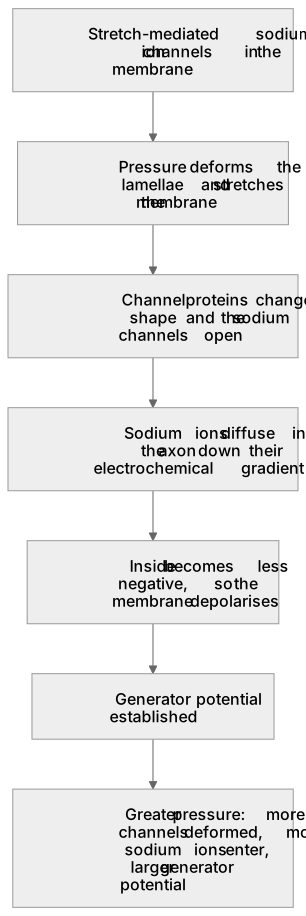
Put it in order
Put these steps in the order they happen.
- 1. Greater pressure: more channels deformed, more sodium ions enter, larger generator potential
- 2. Generator potential established
- 3. Channel proteins change shape and the sodium ion channels open
- 4. Inside becomes less negative, so the membrane depolarises
- 5. Stretch-mediated sodium ion channels in the membrane
- 6. Pressure deforms the lamellae and stretches the membrane
- 7. Sodium ions diffuse into the axon down their electrochemical gradient
Key words
Say what each word means before you turn the card.
stretch-mediated sodium ion channels
Try answering aloud or in your head before turning the card.
deformation
Try answering aloud or in your head before turning the card.
depolarisation
Try answering aloud or in your head before turning the card.
generator potential
Try answering aloud or in your head before turning the card.
See every definition
- stretch-mediated sodium ion channels
- Channels in the membrane of the neurone ending that open when pressure deforms the membrane, the lamellae or the channels themselves.
- deformation
- The change caused by pressure applied to the corpuscle, which deforms the lamellae and stretches the membrane of the neurone ending.
- depolarisation
- The inside of the axon becoming less negative as sodium ions diffuse in down their electrochemical gradient.
- generator potential
- The local depolarisation produced, which is graded: the greater the pressure, the more channels are deformed, the more sodium ions enter and the larger it is.
Label the diagram
Some boxes have lost their names. Pick the right name for each number.
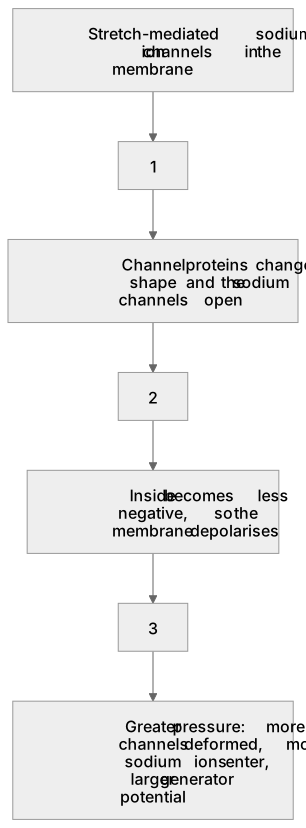
1Box 1
2Box 2
3Box 3
There is more to this lesson
The full lesson goes on to check your understanding and help you earn the marks. Create a free account to carry on, with your progress saved.
A week of Premium from your first lesson · Then the free plan continues · No card, no charge
Test your understanding of Receptors (A-level only): Deformation of stretch-mediated sodium ion channels in a Pacinian corpuscle leads to the establishment of a generator potential.
Active recall beats re-reading. Take an instant quiz now to test what you’ve learned and lock it into long-term memory.
A week of Premium from your first lesson · Then the free plan continues · No card, no charge