AQA · A-Level · Biology
Course version: 7402 · Version from Sept 2016
The addition of promoter and terminator regions to the fragments of DNA.
Full specification wording
Recombinant DNA technology (A-level only): The addition of promoter and terminator regions to the fragments of DNA.
A gene inserted into a new cell will not be expressed unless the cell's RNA polymerase knows where to begin and where to stop, so a promoter region is added to the start of the fragment and a…
Checked against the AQA 7402 specification (opens in a new tab) on .
- Point 7 of 10
- 4 key terms
Study notes
From the checked teaching notes for this specification point.
The idea
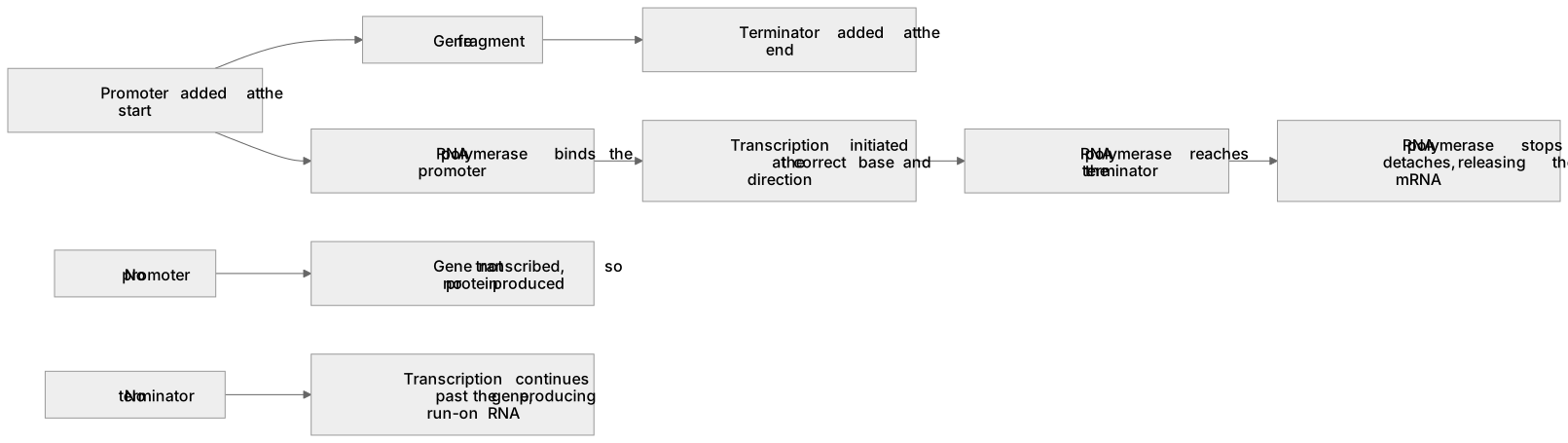
A gene inserted into a new cell will not be expressed unless the cell's RNA polymerase knows where to begin and where to stop, so a promoter region is added to the start of the fragment and a terminator region to the end. The promoter is a specific base sequence upstream of the gene to which RNA polymerase, and in eukaryotes the necessary transcription factors, bind; this positions the enzyme so transcription starts at the correct base and runs in the correct direction. Without a promoter the gene is present in the host but never transcribed, so no mRNA and therefore no protein is made. The terminator is a sequence at the far end that causes RNA polymerase to detach, releasing the mRNA and preventing the enzyme running on into neighbouring DNA. Without a terminator, transcription may continue past the gene, producing run-on RNA rather than correctly ended mRNA.
What earns the marks
- Naming the region added at the start of the gene as the promoter and the region at the end as the terminator.
- The promoter being the binding site for RNA polymerase, or for transcription factors, so that transcription is initiated.
- The terminator causing RNA polymerase to stop and detach, releasing the mRNA.
- Explaining that without a promoter the gene is not transcribed, so the protein is not produced.
- Explaining that without a terminator transcription may continue past the gene, producing run-on RNA rather than correctly ended mRNA.
- A promoter determining in which cells or tissue the gene is expressed.
Common mistakes and how to put them right
Saying the promoter is where translation begins, or confusing it with the start codon on the mRNA (correct.
Put it right: The promoter is a DNA sequence where transcription is initiated).
Stating that RNA polymerase binds to the terminator region (correct.
Put it right: RNA polymerase binds the promoter and is released at the terminator).
Believing the promoter and terminator are never transcribed (correct.
Put it right: The terminator may be transcribed into RNA, though it is not translated into protein).
Writing that adding a promoter 'makes more protein' with no mention of transcription (correct.
Put it right: Link the promoter to initiation of transcription).
Adding only a promoter and assuming transcription will stop by itself (correct.
Put it right: A terminator is also needed to release RNA polymerase and end transcription).
Exam tips
- On a diagram of a DNA fragment, the region before the gene is usually the promoter and the region after it the terminator, but check the labels rather than assuming.
- Tie each region to RNA polymerase - starting for the promoter, detaching for the terminator.
- If asked why a transgenic gene is not expressed, a missing promoter is usually the intended answer.
Try the lesson
The start of the Recombinant DNA technology (A-level only): The addition of promoter and terminator regions to the fragments of DNA. lesson, made from checked teaching notes for this specification point.
Have a go first
In recombinant DNA technology, why is a promoter region added to a DNA fragment before it is inserted into a host cell?
Listen
A gene inserted into a new cell will not be expressed unless the cell's RNA polymerase knows where to begin and where to stop, so a promoter region is added to the start of the fragment and a terminator region to the end. The promoter is a specific base sequence upstream of the gene to which RNA polymerase, and in eukaryotes the necessary transcription factors, bind; this positions the enzyme so transcription starts at the correct base and runs in the correct direction. Without a promoter the gene is present in the host but never transcribed, so no mRNA and therefore no protein is made. The terminator is a sequence at the far end that causes RNA polymerase to detach, releasing the mRNA and preventing the enzyme running on into neighbouring DNA. Without a terminator, transcription may continue past the gene, producing run-on RNA rather than correctly ended mRNA. A strong answer earns marks for these points. naming the region added at the start of the gene as the promoter and the region at the end as the terminator. the promoter being the binding site for RNA polymerase, or for transcription factors, so that transcription is initiated. the terminator causing RNA polymerase to stop and detach, releasing the mRNA. explaining that without a promoter the gene is not transcribed, so the protein is not produced. Exam tip: On a diagram of a DNA fragment, the region before the gene is usually the promoter and the region after it the terminator, but check the labels rather than assuming.
See it
Key words
Say what each word means before you turn the card.
promoter region
Try answering aloud or in your head before turning the card.
terminator region
Try answering aloud or in your head before turning the card.
RNA polymerase binding
Try answering aloud or in your head before turning the card.
initiating transcription
Try answering aloud or in your head before turning the card.
See every definition
- promoter region
- A specific base sequence upstream of the gene to which RNA polymerase, and in eukaryotes the necessary transcription factors, bind.
- terminator region
- A sequence at the far end that causes RNA polymerase to detach, releasing the mRNA and preventing the enzyme running on into neighbouring DNA.
- RNA polymerase binding
- Occurs at the promoter, positioning the enzyme so transcription starts at the correct base and runs in the correct direction.
- initiating transcription
- Begins when RNA polymerase, and in eukaryotes the necessary transcription factors, bind to the promoter region.
Label the diagram
Some boxes have lost their names. Pick the right name for each number.
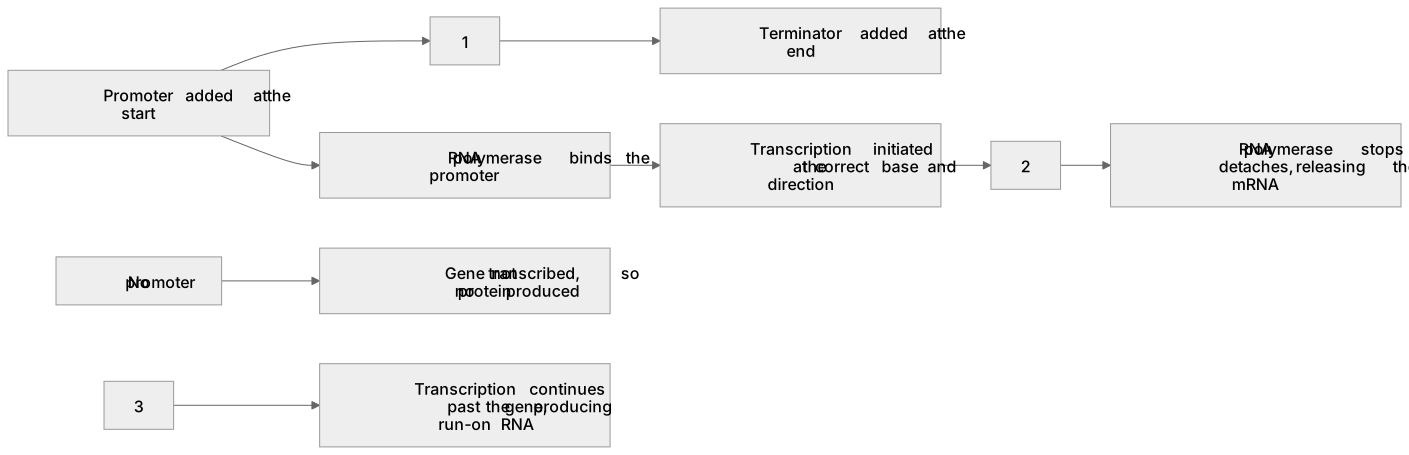
1Box 1
2Box 2
3Box 3
There is more to this lesson
The full lesson goes on to check your understanding and help you earn the marks. Create a free account to carry on, with your progress saved.
A week of Premium from your first lesson · Then the free plan continues · No card, no charge
Test your understanding of Recombinant DNA technology (A-level only): The addition of promoter and terminator regions to the fragments of DNA.
Active recall beats re-reading. Take an instant quiz now to test what you’ve learned and lock it into long-term memory.
A week of Premium from your first lesson · Then the free plan continues · No card, no charge