AQA · A-Level · Biology
Course version: 7402 · Version from Sept 2016
Epigenetics involves heritable changes in gene function, without changes…
Full specification wording
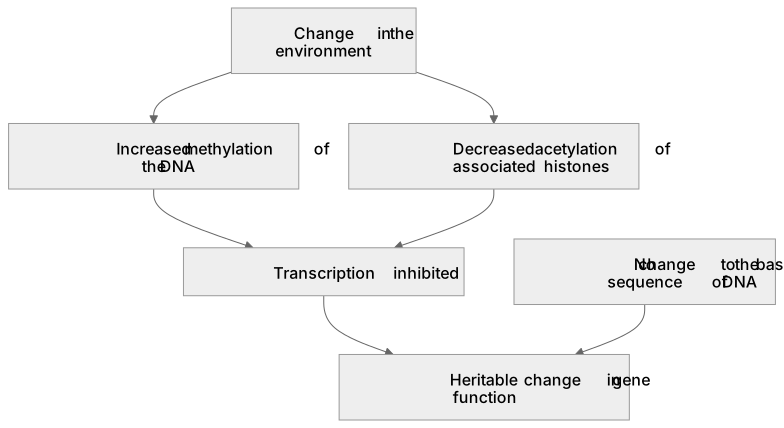
Regulation of transcription and translation (A-level only): Epigenetics involves heritable changes in gene function, without changes to the base sequence of DNA. These changes are caused by changes in the environment that inhibit transcription by: increased methylation of the DNA or decreased acetylation of associated histones.
Epigenetics is defined as heritable changes in gene function that occur without any change to the base sequence of DNA.
Checked against the AQA 7402 specification (opens in a new tab) on .
- Point 4 of 7
- 4 key terms
Study notes
From the checked teaching notes for this specification point.
The idea
Epigenetics is defined as heritable changes in gene function that occur without any change to the base sequence of DNA. The tags that carry these changes make up the epigenome, and it is the epigenome, not the genome, that responds to the environment: diet, smoking, stress and toxins can all alter it. Two changes inhibit transcription and both must be learned in the right direction. Increased methylation means methyl groups attach to cytosine bases in the promoter region; transcription factors can no longer bind there and the DNA coils more tightly, so the gene is not transcribed. Decreased acetylation means acetyl groups are removed from the histones by histone deacetylase; the histones become more positively charged, bind the negatively charged DNA more strongly, the chromatin condenses and RNA polymerase cannot reach the promoter.
What earns the marks
- Defining epigenetics as a heritable change in gene function with no change to the base sequence of the DNA.
- Increased methylation of the DNA or gene, accepting the promoter region, inhibiting transcription or expression.
- Decreased acetylation of histones inhibiting transcription or expression.
- The converse pair, decreased methylation or increased acetylation stimulating transcription.
- Identifying a change in the environment as the cause of the altered methylation or acetylation.
Common mistakes and how to put them right
Writing 'methylation of histones' or 'acetylation of DNA' - examiners ignore both, so the whole mark is lost.
Saying the gene is 'switched off' with no reference to transcription or expression, which is ignored.
Claiming epigenetic changes alter the DNA base sequence, which contradicts the definition being tested.
Getting the direction wrong and writing that increased acetylation inhibits transcription.
Saying the change cannot be inherited, when heritability is part of the definition.
Exam tips
- The specification wording is a reliable guide to what is expected: increased methylation of DNA, decreased acetylation of histones. Use that phrasing.
- State the direction before the effect - 'increased methylation of the DNA inhibits transcription' scores, 'methylation affects transcription' does not.
- For a definition mark, include the idea that the base sequence of DNA is unchanged.
Try the lesson
The start of the Regulation of transcription and translation (A-level only): Epigenetics involves heritable changes in gene function, without changes to the base sequence of DNA. These changes are caused by changes in the environment that inhibit transcription by: increased methylation of the DNA or decreased acetylation of associated histones. lesson, made from checked teaching notes for this specification point.
Have a go first
A study finds that people exposed to a particular environmental pollutant have increased methylation of a tumour suppressor gene. Which statement best explains the effect of this change?
Listen
Epigenetics is defined as heritable changes in gene function that occur without any change to the base sequence of DNA. The tags that carry these changes make up the epigenome, and it is the epigenome, not the genome, that responds to the environment: diet, smoking, stress and toxins can all alter it. Two changes inhibit transcription and both must be learned in the right direction. Increased methylation means methyl groups attach to cytosine bases in the promoter region; transcription factors can no longer bind there and the DNA coils more tightly, so the gene is not transcribed. Decreased acetylation means acetyl groups are removed from the histones by histone deacetylase; the histones become more positively charged, bind the negatively charged DNA more strongly, the chromatin condenses and RNA polymerase cannot reach the promoter. A strong answer earns marks for these points. defining epigenetics as a heritable change in gene function with no change to the base sequence of the DNA. increased methylation of the DNA or gene, accepting the promoter region, inhibiting transcription or expression. decreased acetylation of histones inhibiting transcription or expression. the converse pair, decreased methylation or increased acetylation stimulating transcription. Exam tip: The specification wording is a reliable guide to what is expected: increased methylation of DNA, decreased acetylation of histones. Use that phrasing.
See it
Key words
Say what each word means before you turn the card.
definition of epigenetics
Try answering aloud or in your head before turning the card.
increased DNA methylation
Try answering aloud or in your head before turning the card.
decreased histone acetylation
Try answering aloud or in your head before turning the card.
environmental trigger
Try answering aloud or in your head before turning the card.
See every definition
- definition of epigenetics
- Heritable changes in gene function, without changes to the base sequence of DNA.
- increased DNA methylation
- Methyl groups attach to cytosine bases in the promoter region, so transcription factors can no longer bind there and the DNA coils more tightly, so the gene is not transcribed.
- decreased histone acetylation
- Acetyl groups are removed from the histones by histone deacetylase, the histones become more positively charged, bind the negatively charged DNA more strongly, the chromatin condenses and RNA polymerase cannot reach the promoter.
- environmental trigger
- A change in the environment that causes the altered methylation or acetylation.
Label the diagram
Some boxes have lost their names. Pick the right name for each number.
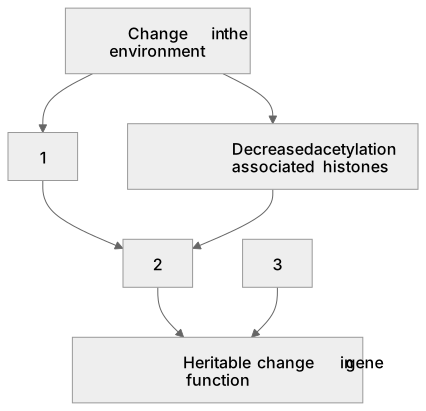
1Box 1
2Box 2
3Box 3
There is more to this lesson
The full lesson goes on to check your understanding and help you earn the marks. Create a free account to carry on, with your progress saved.
A week of Premium from your first lesson · Then the free plan continues · No card, no charge
Test your understanding of Regulation of transcription and translation (A-level only): Epigenetics involves heritable changes in gene function, without changes to the base sequence of DNA. These changes are caused by changes in the environment that inhibit transcription by: increased methylation of the DNA or decreased acetylation of associated histones.
Active recall beats re-reading. Take an instant quiz now to test what you’ve learned and lock it into long-term memory.
A week of Premium from your first lesson · Then the free plan continues · No card, no charge