AQA · A-Level · Biology
Course version: 7402 · Version from Sept 2016
The role of the steroid hormone, oestrogen, in initiating transcription.
Full specification wording
Regulation of transcription and translation (A-level only): The role of the steroid hormone, oestrogen, in initiating transcription.
Oestrogen is a steroid hormone, so it is lipid-soluble and diffuses straight through the phospholipid bilayer of the cell-surface membrane rather than binding on the outside.
Checked against the AQA 7402 specification (opens in a new tab) on .
- Point 2 of 7
- 4 key terms
Study notes
From the checked teaching notes for this specification point.
The idea
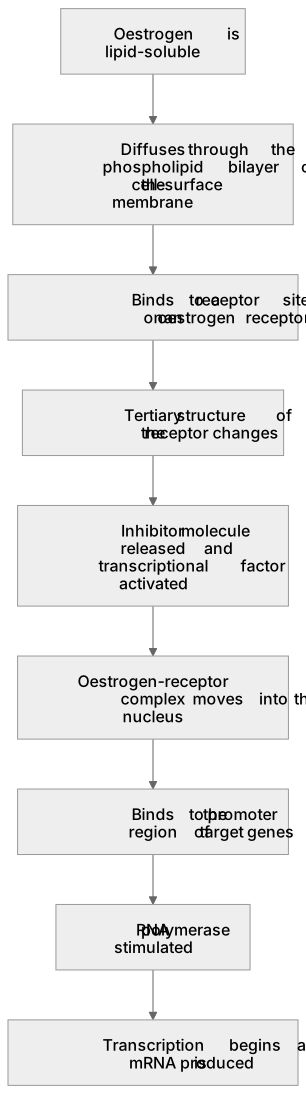
Oestrogen is a steroid hormone, so it is lipid-soluble and diffuses straight through the phospholipid bilayer of the cell-surface membrane rather than binding on the outside. Inside the cell it binds to a receptor site on an oestrogen receptor, which is part of a transcriptional factor held inactive in the cytoplasm. Binding changes the tertiary structure of the receptor, releasing an inhibitor molecule and activating the factor. The oestrogen-receptor complex then moves into the nucleus and binds to the promoter region of its target genes, where it stimulates RNA polymerase so that transcription begins. mRNA is produced, translated at ribosomes, and the resulting proteins drive processes such as cell division in breast tissue.
What earns the marks
- Oestrogen being lipid-soluble and diffusing through the cell-surface membrane.
- Oestrogen binding to a specific receptor on the transcriptional factor and changing its tertiary shape, activating it.
- The oestrogen-receptor complex entering the nucleus and binding to the promoter region.
- RNA polymerase being stimulated or activated, so the target gene is transcribed.
- One mark, for a drug question, for the drug binding the oestrogen receptor and preventing oestrogen binding, so no or fewer transcriptional factors bind the promoter.
Common mistakes and how to put them right
Describing oestrogen binding its receptor as forming an enzyme-substrate complex or entering an active site, which is explicitly rejected.
Saying oestrogen binds to a receptor on the outside of the cell-surface membrane, as a protein hormone would.
Saying oestrogen itself binds to the promoter, when it is the activated receptor complex that does.
Writing that the oestrogen-like drug 'kills the cancer cells' with no mention of receptors or transcription.
Leaving out the shape change, so there is nothing to explain why the factor becomes active.
Exam tips
- Build the chain in order: lipid-soluble, diffuses in, binds receptor, shape change, into nucleus, promoter, RNA polymerase, transcription.
- In ER-positive breast cancer questions each of the three marks is a separate link - receptor binding, oestrogen blocked, fewer factors at the promoter.
- Name the receptor as a transcriptional factor if you can; mark schemes accept 'inactive transcriptional factor' for receptor.
Try the lesson
The start of the Regulation of transcription and translation (A-level only): The role of the steroid hormone, oestrogen, in initiating transcription. lesson, made from checked teaching notes for this specification point.
Have a go first
Oestrogen is a steroid hormone that can initiate transcription. Through which membrane does oestrogen pass to enter a target cell?
Listen
Oestrogen is a steroid hormone, so it is lipid-soluble and diffuses straight through the phospholipid bilayer of the cell-surface membrane rather than binding on the outside. Inside the cell it binds to a receptor site on an oestrogen receptor, which is part of a transcriptional factor held inactive in the cytoplasm. Binding changes the tertiary structure of the receptor, releasing an inhibitor molecule and activating the factor. The oestrogen-receptor complex then moves into the nucleus and binds to the promoter region of its target genes, where it stimulates RNA polymerase so that transcription begins. mRNA is produced, translated at ribosomes, and the resulting proteins drive processes such as cell division in breast tissue. A strong answer earns marks for these points. oestrogen being lipid-soluble and diffusing through the cell-surface membrane. oestrogen binding to a specific receptor on the transcriptional factor and changing its tertiary shape, activating it. the oestrogen-receptor complex entering the nucleus and binding to the promoter region. RNA polymerase being stimulated or activated, so the target gene is transcribed. Exam tip: Build the chain in order: lipid-soluble, diffuses in, binds receptor, shape change, into nucleus, promoter, RNA polymerase, transcription.
See it
Key words
Say what each word means before you turn the card.
steroid hormone
Try answering aloud or in your head before turning the card.
oestrogen receptor
Try answering aloud or in your head before turning the card.
transcriptional factor activation
Try answering aloud or in your head before turning the card.
promoter region
Try answering aloud or in your head before turning the card.
See every definition
- steroid hormone
- A lipid-soluble substance that diffuses straight through the phospholipid bilayer of the cell-surface membrane rather than binding on the outside.
- oestrogen receptor
- Part of a transcriptional factor held inactive in the cytoplasm, with a receptor site to which oestrogen binds.
- transcriptional factor activation
- Binding changes the tertiary structure of the receptor, releasing an inhibitor molecule and activating the factor.
- promoter region
- The site of its target genes to which the oestrogen-receptor complex binds after moving into the nucleus, stimulating RNA polymerase so that transcription begins.
Label the diagram
Some boxes have lost their names. Pick the right name for each number.
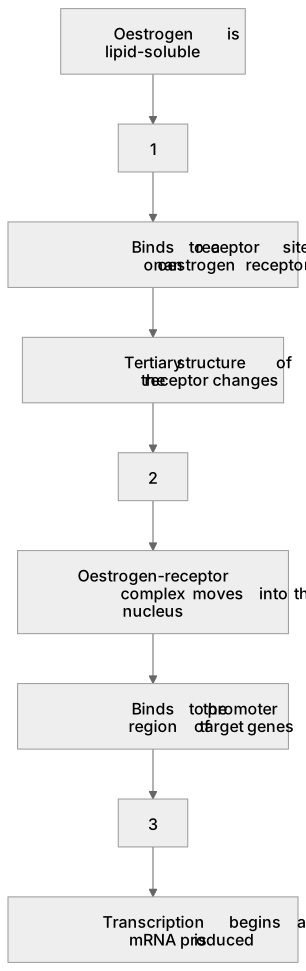
1Box 1
2Box 2
3Box 3
There is more to this lesson
The full lesson goes on to check your understanding and help you earn the marks. Create a free account to carry on, with your progress saved.
A week of Premium from your first lesson · Then the free plan continues · No card, no charge
Test your understanding of Regulation of transcription and translation (A-level only): The role of the steroid hormone, oestrogen, in initiating transcription.
Active recall beats re-reading. Take an instant quiz now to test what you’ve learned and lock it into long-term memory.
A week of Premium from your first lesson · Then the free plan continues · No card, no charge