AQA · A-Level · Biology
Course version: 7402 · Version from Sept 2016
A DNA molecule is a double helix with two polynucleotide chains held…
Full specification wording
Structure of DNA and RNA: A DNA molecule is a double helix with two polynucleotide chains held together by hydrogen bonds between specific complementary base pairs.
Two antiparallel polynucleotide strands twist into a double helix.
Checked against the AQA 7402 specification (opens in a new tab) on .
- Point 5 of 7
- 4 key terms
Study notes
From the checked teaching notes for this specification point.
The idea
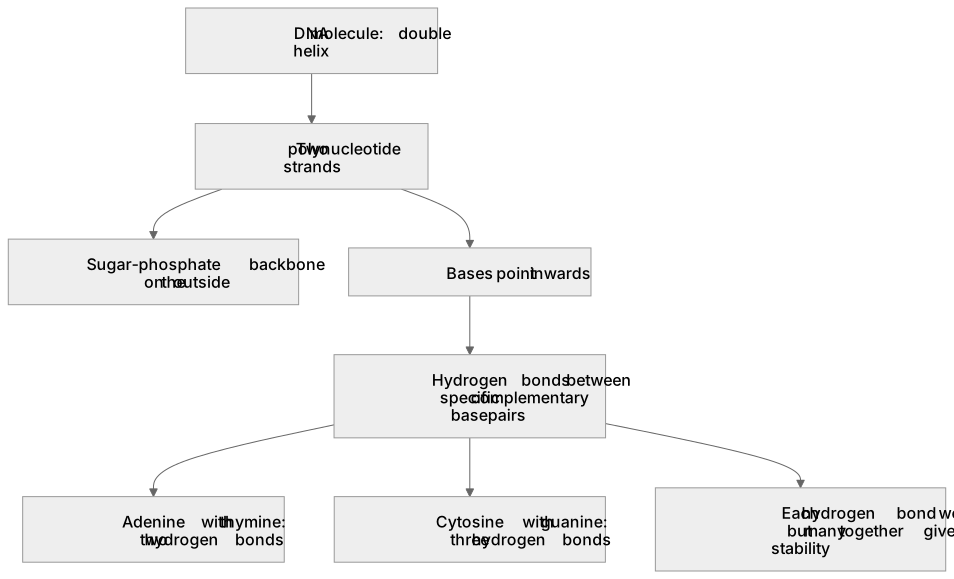
Two antiparallel polynucleotide strands twist into a double helix. The sugar-phosphate backbones lie on the outside, protecting the bases, which point inwards and pair up. Hydrogen bonds hold the specific complementary pairs: adenine with thymine (two hydrogen bonds), and cytosine with guanine (three hydrogen bonds). Pairing is specific because a double-ringed purine always pairs with a single-ringed pyrimidine, keeping the backbones a constant distance apart, and only these combinations have matching hydrogen-bonding groups. Each hydrogen bond is weak, allowing strand separation for replication and transcription. However, the vast number of hydrogen bonds along the molecule makes it very stable; regions rich in cytosine and guanine are even more stable.
What earns the marks
- Two polynucleotide strands wound into a double helix.
- The strands being held together by hydrogen bonds between the bases.
- Specific complementary base pairing, adenine with thymine and cytosine with guanine.
- Two hydrogen bonds between adenine and thymine and three between cytosine and guanine.
- The sugar-phosphate backbone lying on the outside with the bases on the inside.
Common mistakes and how to put them right
Giving base pairs as letters when the question asks you to name the bases.
Put it right by writing the full names of the bases.
Saying the two strands are joined by phosphodiester bonds, which join nucleotides within a strand.
Put it right by stating that hydrogen bonds join the strands.
Swapping the numbers, so adenine and thymine are given three hydrogen bonds and cytosine and guanine two.
Put it right by remembering A–T has two and C–G has three.
Describing hydrogen bonds as strong, instead of explaining that many weak bonds together give stability.
Put it right by stating that individual hydrogen bonds are weak but numerous.
Saying the strands are identical rather than complementary.
Put it right by stating that the strands are complementary, with A opposite T and C opposite G.
Exam tips
- If a question mentions stability, write both halves: each hydrogen bond is weak, but there are very many of them.
- If a question mentions strand separation, the same fact works the other way: individually weak bonds are easy to break.
- State the specific base pairs clearly (adenine with thymine, cytosine with guanine) rather than just saying 'complementary base pairing', to ensure you secure the mark.
Try the lesson
The start of the Structure of DNA and RNA: A DNA molecule is a double helix with two polynucleotide chains held together by hydrogen bonds between specific complementary base pairs. lesson, made from checked teaching notes for this specification point.
Have a go first
In a DNA molecule, which base pairs with adenine?
Listen
Two antiparallel polynucleotide strands twist into a double helix. The sugar-phosphate backbones lie on the outside, protecting the bases, which point inwards and pair up. Hydrogen bonds hold the specific complementary pairs: adenine with thymine (two hydrogen bonds), and cytosine with guanine (three hydrogen bonds). Pairing is specific because a double-ringed purine always pairs with a single-ringed pyrimidine, keeping the backbones a constant distance apart, and only these combinations have matching hydrogen-bonding groups. Each hydrogen bond is weak, allowing strand separation for replication and transcription. However, the vast number of hydrogen bonds along the molecule makes it very stable; regions rich in cytosine and guanine are even more stable. A strong answer earns marks for these points. two polynucleotide strands wound into a double helix. the strands being held together by hydrogen bonds between the bases. specific complementary base pairing, adenine with thymine and cytosine with guanine. two hydrogen bonds between adenine and thymine and three between cytosine and guanine. A common slip: giving base pairs as letters when the question asks you to name the bases. Instead, writing the full names of the bases. Exam tip: If a question mentions stability, write both halves: each hydrogen bond is weak, but there are very many of them.
See it
Key words
Say what each word means before you turn the card.
double helix
Try answering aloud or in your head before turning the card.
hydrogen bonds
Try answering aloud or in your head before turning the card.
complementary base pairing
Try answering aloud or in your head before turning the card.
sugar-phosphate backbone
Try answering aloud or in your head before turning the card.
See every definition
- double helix
- A DNA molecule is a double helix with two polynucleotide chains wound together.
- hydrogen bonds
- These hold the two polynucleotide chains together between specific complementary base pairs, and each one is weak.
- complementary base pairing
- Specific pairs are held by hydrogen bonds: adenine with thymine, and cytosine with guanine.
- sugar-phosphate backbone
- This lies on the outside of the molecule, with the bases pointing inwards.
Label the diagram
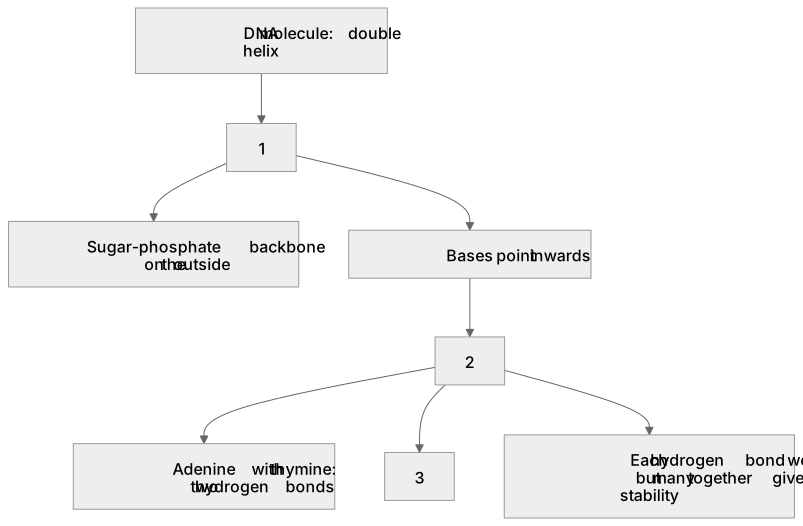
Some boxes have lost their names. Pick the right name for each number.
1Box 1
2Box 2
3Box 3
There is more to this lesson
The full lesson goes on to check your understanding and help you earn the marks. Create a free account to carry on, with your progress saved.
A week of Premium from your first lesson · Then the free plan continues · No card, no charge
Test your understanding of Structure of DNA and RNA: A DNA molecule is a double helix with two polynucleotide chains held together by hydrogen bonds between specific complementary base pairs.
Active recall beats re-reading. Take an instant quiz now to test what you’ve learned and lock it into long-term memory.
A week of Premium from your first lesson · Then the free plan continues · No card, no charge