AQA · A-Level · Biology
Course version: 7402 · Version from Sept 2016
Students should be able to appreciate that the relative simplicity of DNA…
Full specification wording
Structure of DNA and RNA: Students should be able to appreciate that the relative simplicity of DNA led many scientists to doubt that it carried the genetic code.
Until the mid-20th century, many biologists believed proteins carried inherited information.
Checked against the AQA 7402 specification (opens in a new tab) on .
- Point 7 of 7
- 4 key terms
Study notes
From the checked teaching notes for this specification point.
The idea
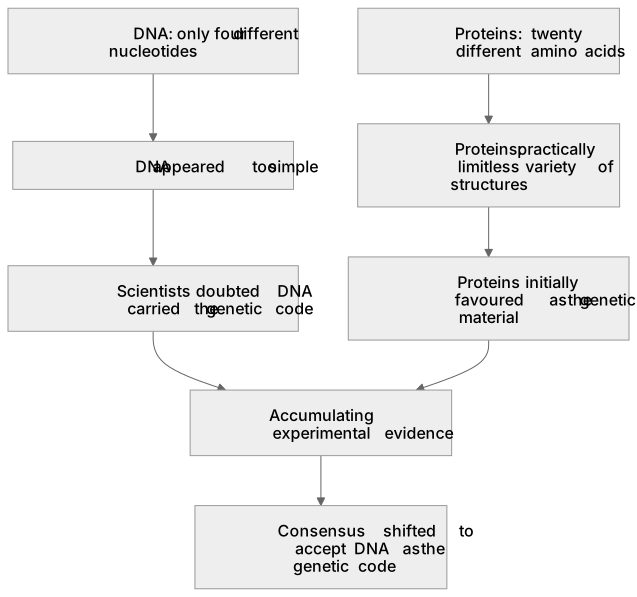
Until the mid-20th century, many biologists believed proteins carried inherited information. Proteins are built from twenty different amino acids, allowing a practically limitless variety of structures. In contrast, DNA appeared too simple, consisting of only four different nucleotides. Early hypotheses suggested these four bases simply repeated in a fixed, monotonous sequence, which scientists argued could not possibly encode the vast complexity of an organism. Consequently, DNA was widely doubted as the genetic material. This consensus only shifted as accumulating experimental evidence demonstrated that DNA, rather than protein, was responsible for bacterial transformation and viral infection, proving it carried the genetic code.
What earns the marks
- State that DNA contains only four different bases, whereas proteins are built from twenty different amino acids.
- Explain that scientists believed DNA lacked the chemical diversity to carry complex genetic information.
- Identify that proteins were initially favoured as the genetic material due to their limitless structural variety.
- Describe how accumulating experimental evidence shifted scientific consensus to accept DNA as the genetic code.
Common mistakes and how to put them right
Assuming scientists doubted DNA because it had not yet been discovered.
Put it right by noting its chemical composition was known well before its function was accepted.
Stating that DNA is too short to carry the code.
Put it right by explaining the doubt was based on its chemical simplicity (only four bases), not its physical length.
Treating the acceptance of DNA as a single sudden discovery.
Put it right by recognising it as a gradual shift in consensus driven by accumulating peer-reviewed evidence.
Exam tips
- When asked why scientists doubted DNA, explicitly contrast the four bases of DNA with the twenty amino acids of proteins.
- Emphasise the phrase 'relative simplicity' when describing early views of DNA's structure.
Try the lesson
The start of the Structure of DNA and RNA: Students should be able to appreciate that the relative simplicity of DNA led many scientists to doubt that it carried the genetic code. lesson, made from checked teaching notes for this specification point.
Have a go first
Why did many scientists doubt that DNA carried the genetic code?
Listen
Until the mid-20th century, many biologists believed proteins carried inherited information. Proteins are built from twenty different amino acids, allowing a practically limitless variety of structures. In contrast, DNA appeared too simple, consisting of only four different nucleotides. Early hypotheses suggested these four bases simply repeated in a fixed, monotonous sequence, which scientists argued could not possibly encode the vast complexity of an organism. Consequently, DNA was widely doubted as the genetic material. This consensus only shifted as accumulating experimental evidence demonstrated that DNA, rather than protein, was responsible for bacterial transformation and viral infection, proving it carried the genetic code. A strong answer earns marks for these points. State that DNA contains only four different bases, whereas proteins are built from twenty different amino acids. Explain that scientists believed DNA lacked the chemical diversity to carry complex genetic information. Identify that proteins were initially favoured as the genetic material due to their limitless structural variety. Describe how accumulating experimental evidence shifted scientific consensus to accept DNA as the genetic code. A common slip: Assuming scientists doubted DNA because it had not yet been discovered. Instead, noting its chemical composition was known well before its function was accepted. Exam tip: When asked why scientists doubted DNA, explicitly contrast the four bases of DNA with the twenty amino acids of proteins.
See it
Key words
Say what each word means before you turn the card.
relative simplicity of DNA
Try answering aloud or in your head before turning the card.
four bases and twenty amino acids
Try answering aloud or in your head before turning the card.
scientific consensus
Try answering aloud or in your head before turning the card.
evidence and acceptance
Try answering aloud or in your head before turning the card.
See every definition
- relative simplicity of DNA
- DNA appeared too simple, consisting of only four different nucleotides, which led many scientists to doubt that it carried the genetic code.
- four bases and twenty amino acids
- DNA contains only four different bases, whereas proteins are built from twenty different amino acids, allowing a practically limitless variety of structures.
- scientific consensus
- DNA was widely doubted as the genetic material, and this consensus only shifted as accumulating experimental evidence demonstrated that DNA carried the genetic code.
- evidence and acceptance
- Accumulating experimental evidence demonstrated that DNA, rather than protein, was responsible for bacterial transformation and viral infection, proving it carried the genetic code.
Label the diagram
Some boxes have lost their names. Pick the right name for each number.
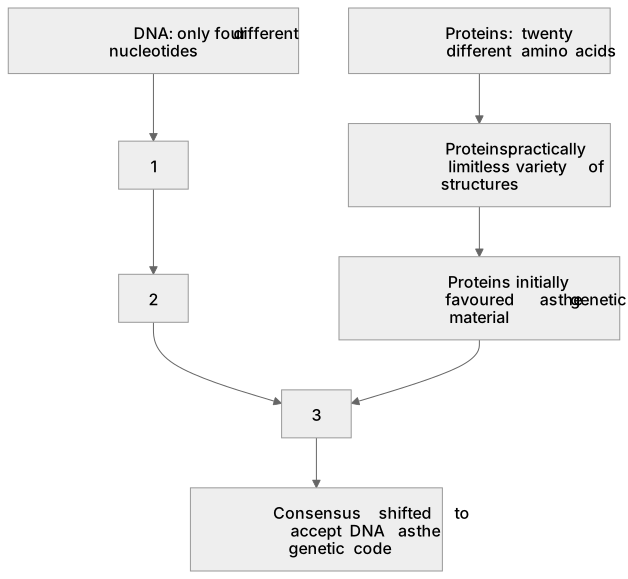
1Box 1
2Box 2
3Box 3
There is more to this lesson
The full lesson goes on to check your understanding and help you earn the marks. Create a free account to carry on, with your progress saved.
A week of Premium from your first lesson · Then the free plan continues · No card, no charge
Test your understanding of Structure of DNA and RNA: Students should be able to appreciate that the relative simplicity of DNA led many scientists to doubt that it carried the genetic code.
Active recall beats re-reading. Take an instant quiz now to test what you’ve learned and lock it into long-term memory.
A week of Premium from your first lesson · Then the free plan continues · No card, no charge