AQA · A-Level · Biology
Course version: 7402 · Version from Sept 2016
Prokaryotic cells are much smaller than eukaryotic cells. They also differ…
Full specification wording
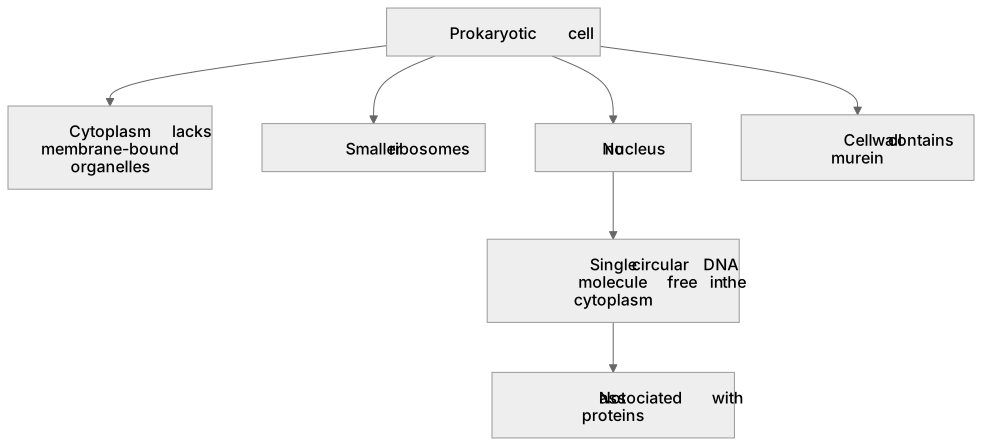
Structure of prokaryotic cells and of viruses: Prokaryotic cells are much smaller than eukaryotic cells. They also differ from eukaryotic cells in having: cytoplasm that lacks membrane-bound organelles smaller ribosomes no nucleus; instead they have a single circular DNA molecule that is free in the cytoplasm and is not associated with proteins a cell wall that contains murein, a glycoprotein.
Prokaryotes are typically 0.5-5 micrometres across against 10-100 micrometres for a eukaryotic cell, and the differences are not just of scale.
Checked against the AQA 7402 specification (opens in a new tab) on .
- Point 1 of 3
- 4 key terms
Study notes
From the checked teaching notes for this specification point.
The idea
Prokaryotes are typically 0.5-5 micrometres across against 10-100 micrometres for a eukaryotic cell, and the differences are not just of scale. Prokaryotic cytoplasm contains no membrane-bound organelles at all: no nucleus, mitochondria, endoplasmic reticulum, Golgi apparatus or chloroplasts, so respiratory enzymes are located on the cell-surface membrane instead. Its ribosomes are smaller, 70S rather than the 80S of eukaryotes. Its genetic material is one circular DNA molecule lying free in the cytoplasm as a nucleoid, not wound around histone proteins and not enclosed by a nuclear envelope, whereas a eukaryote has several linear chromosomes associated with histones inside a nucleus.
What earns the marks
- Giving features true of all prokaryotes, for example no membrane-bound organelles and murein in the cell wall.
- A single circular DNA molecule free in the cytoplasm, with nucleoid accepted, and not associated with proteins or histones.
- Smaller ribosomes, with 70S accepted as the alternative wording.
- A cell wall containing murein, with peptidoglycan accepted.
- The contrast with eukaryotes, whose linear DNA is enclosed in a nucleus and associated with histones.
Common mistakes and how to put them right
Offering a plasmid, a capsule or a flagellum as a feature of all prokaryotic cells, which is incorrect because only some prokaryotes have them.
Writing nucleosome instead of nucleoid, or calling the circular DNA a eukaryotic chromosome.
Saying prokaryotes have no ribosomes rather than smaller (70S) ribosomes.
Describing the prokaryotic cell wall as cellulose or chitin instead of murein.
Writing no organelles unqualified, when the credited point is no membrane-bound organelles.
Exam tips
- If the question says features of all prokaryotic cells, cross out anything only some of them have before you write: plasmid, capsule and flagellum are incorrect here.
- Ensure you explicitly state 'membrane-bound' when discussing the lack of organelles in prokaryotes.
- Use the specification's own words, murein and 70S ribosomes, rather than paraphrases like tough wall or small ribosomes.
Try the lesson
The start of the Structure of prokaryotic cells and of viruses: Prokaryotic cells are much smaller than eukaryotic cells. They also differ from eukaryotic cells in having: cytoplasm that lacks membrane-bound organelles smaller ribosomes no nucleus; instead they have a single circular DNA molecule that is free in the cytoplasm and is not associated with proteins a cell wall that contains murein, a glycoprotein. lesson, made from checked teaching notes for this specification point.
Have a go first
Which statement correctly describes the structure of a prokaryotic cell?
Listen
Prokaryotes are typically 0.5-5 micrometres across against 10-100 micrometres for a eukaryotic cell, and the differences are not just of scale. Prokaryotic cytoplasm contains no membrane-bound organelles at all: no nucleus, mitochondria, endoplasmic reticulum, Golgi apparatus or chloroplasts, so respiratory enzymes are located on the cell-surface membrane instead. Its ribosomes are smaller, 70S rather than the 80S of eukaryotes. Its genetic material is one circular DNA molecule lying free in the cytoplasm as a nucleoid, not wound around histone proteins and not enclosed by a nuclear envelope, whereas a eukaryote has several linear chromosomes associated with histones inside a nucleus. A strong answer earns marks for these points. giving features true of all prokaryotes, for example no membrane-bound organelles and murein in the cell wall. a single circular DNA molecule free in the cytoplasm, with nucleoid accepted, and not associated with proteins or histones. smaller ribosomes, with 70S accepted as the alternative wording. a cell wall containing murein, with peptidoglycan accepted. Exam tip: If the question says features of all prokaryotic cells, cross out anything only some of them have before you write: plasmid, capsule and flagellum are incorrect here.
See it
Key words
Say what each word means before you turn the card.
circular DNA and nucleoid
Try answering aloud or in your head before turning the card.
murein cell wall
Try answering aloud or in your head before turning the card.
70S ribosomes
Try answering aloud or in your head before turning the card.
no membrane-bound organelles
Try answering aloud or in your head before turning the card.
See every definition
- circular DNA and nucleoid
- A single circular DNA molecule that is free in the cytoplasm and is not associated with proteins, lying as a nucleoid.
- murein cell wall
- A cell wall that contains murein, a glycoprotein.
- 70S ribosomes
- Smaller ribosomes than those of eukaryotes, which are 80S.
- no membrane-bound organelles
- Cytoplasm that lacks membrane-bound organelles, so respiratory enzymes are located on the cell-surface membrane instead.
Label the diagram
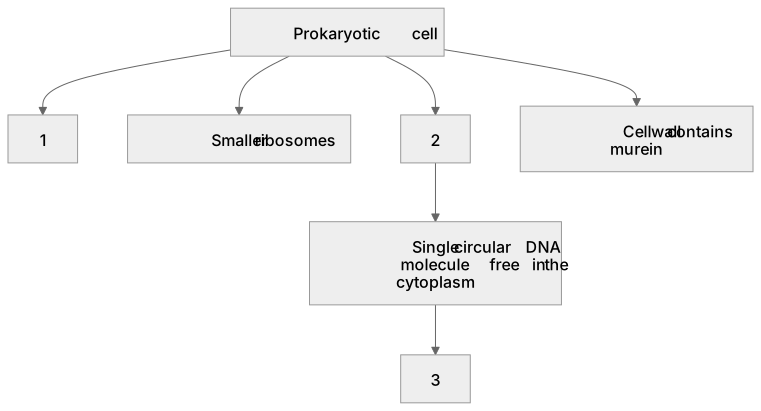
Some boxes have lost their names. Pick the right name for each number.
1Box 1
2Box 2
3Box 3
There is more to this lesson
The full lesson goes on to check your understanding and help you earn the marks. Create a free account to carry on, with your progress saved.
A week of Premium from your first lesson · Then the free plan continues · No card, no charge
Test your understanding of Structure of prokaryotic cells and of viruses: Prokaryotic cells are much smaller than eukaryotic cells. They also differ from eukaryotic cells in having: cytoplasm that lacks membrane-bound organelles smaller ribosomes no nucleus; instead they have a single circular DNA molecule that is free in the cytoplasm and is not associated with proteins a cell wall that contains murein, a glycoprotein.
Active recall beats re-reading. Take an instant quiz now to test what you’ve learned and lock it into long-term memory.
A week of Premium from your first lesson · Then the free plan continues · No card, no charge