AQA · A-Level · Biology
Course version: 7402 · Version from Sept 2016
Viruses are acellular and non-living. The structure of virus particles to…
Full specification wording
Structure of prokaryotic cells and of viruses: Viruses are acellular and non-living. The structure of virus particles to include genetic material, capsid and attachment protein.
A virus particle is not a cell.
Checked against the AQA 7402 specification (opens in a new tab) on .
- Point 3 of 3
- 4 key terms
Study notes
From the checked teaching notes for this specification point.
The idea
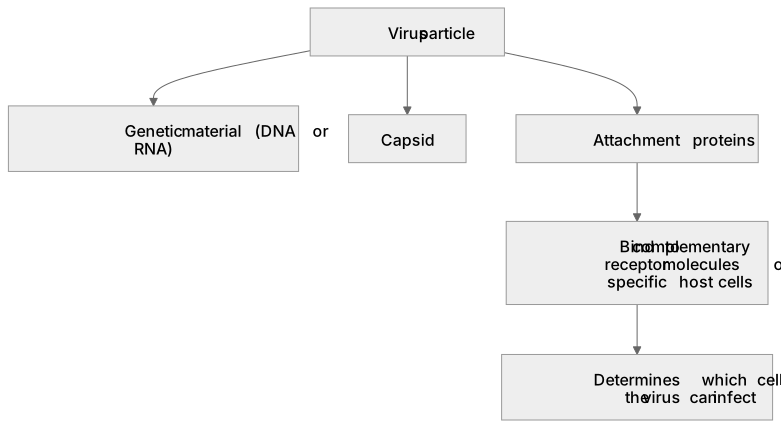
A virus particle is not a cell. It is described as acellular because it lacks a cell-surface membrane, cytoplasm and organelles. It is non-living because it has no independent metabolism and cannot replicate without a host cell. Viral structure includes genetic material (DNA or RNA) that codes for viral proteins, enclosed within a protein coat called a capsid. Attachment proteins project from the surface and bind to complementary receptor molecules on specific host cells, determining which cells the virus can infect. While these three features are universal, some viruses, such as HIV, possess additional structures like a lipid envelope and viral enzymes.
What earns the marks
- Acellular means lacking a cell-surface membrane, cytoplasm and organelles.
- Non-living means lacking independent metabolism and being unable to replicate without a host cell.
- Core viral structure includes genetic material (DNA or RNA), a protein capsid and attachment proteins.
- Attachment proteins bind to complementary receptor molecules on specific host cells.
- Antibiotics are ineffective against viruses because viruses lack bacterial structures, such as a murein cell wall, and metabolic pathways.
Common mistakes and how to put them right
Stating viruses are cells with no organelles.
Put it right: Viruses are acellular, meaning they are not cells and lack a cell-surface membrane and cytoplasm.
Calling the viral surface protein a receptor.
Put it right: The virus has attachment proteins, which bind to complementary receptors on the host cell.
Stating genetic material is only DNA.
Put it right: Viral genetic material can be either DNA or RNA.
Using capsomere as a synonym for capsid.
Put it right: Capsomeres are the individual protein subunits that assemble to form the capsid structure.
Exam tips
- When explaining why viruses are acellular and non-living, provide distinct reasons for each term rather than grouping them together.
- If asked for the function of a viral structure, explicitly name the structure before stating its function to ensure clarity.
Try the lesson
The start of the Structure of prokaryotic cells and of viruses: Viruses are acellular and non-living. The structure of virus particles to include genetic material, capsid and attachment protein. lesson, made from checked teaching notes for this specification point.
Have a go first
A virus particle attaches to a host cell. Which component of the virus particle is directly responsible for this attachment?
Listen
A virus particle is not a cell. It is described as acellular because it lacks a cell-surface membrane, cytoplasm and organelles. It is non-living because it has no independent metabolism and cannot replicate without a host cell. Viral structure includes genetic material (DNA or RNA) that codes for viral proteins, enclosed within a protein coat called a capsid. Attachment proteins project from the surface and bind to complementary receptor molecules on specific host cells, determining which cells the virus can infect. While these three features are universal, some viruses, such as HIV, possess additional structures like a lipid envelope and viral enzymes. A strong answer earns marks for these points. Acellular means lacking a cell-surface membrane, cytoplasm and organelles. Non-living means lacking independent metabolism and being unable to replicate without a host cell. Core viral structure includes genetic material (DNA or RNA), a protein capsid and attachment proteins. Attachment proteins bind to complementary receptor molecules on specific host cells. A common slip: Stating viruses are cells with no organelles. Instead, Viruses are acellular, meaning they are not cells and lack a cell-surface membrane and cytoplasm. Exam tip: When explaining why viruses are acellular and non-living, provide distinct reasons for each term rather than grouping them together.
See it
Key words
Say what each word means before you turn the card.
acellular structure
Try answering aloud or in your head before turning the card.
non-living and metabolism
Try answering aloud or in your head before turning the card.
capsid and genetic material
Try answering aloud or in your head before turning the card.
attachment proteins and host receptors
Try answering aloud or in your head before turning the card.
See every definition
- acellular structure
- Lacking a cell-surface membrane, cytoplasm and organelles, so a virus particle is not a cell.
- non-living and metabolism
- Lacking independent metabolism and being unable to replicate without a host cell.
- capsid and genetic material
- Genetic material (DNA or RNA) that codes for viral proteins, enclosed within a protein coat.
- attachment proteins and host receptors
- Proteins projecting from the surface that bind to complementary receptor molecules on specific host cells, determining which cells the virus can infect.
Label the diagram
Some boxes have lost their names. Pick the right name for each number.
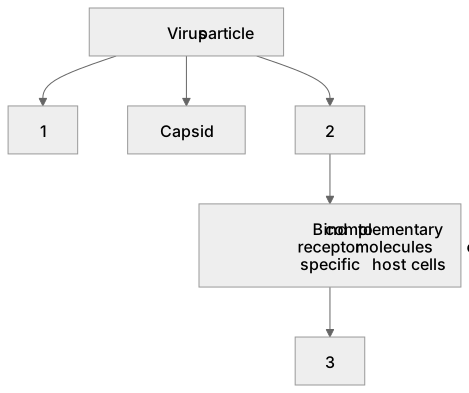
1Box 1
2Box 2
3Box 3
There is more to this lesson
The full lesson goes on to check your understanding and help you earn the marks. Create a free account to carry on, with your progress saved.
A week of Premium from your first lesson · Then the free plan continues · No card, no charge
Test your understanding of Structure of prokaryotic cells and of viruses: Viruses are acellular and non-living. The structure of virus particles to include genetic material, capsid and attachment protein.
Active recall beats re-reading. Take an instant quiz now to test what you’ve learned and lock it into long-term memory.
A week of Premium from your first lesson · Then the free plan continues · No card, no charge