AQA · A-Level · Biology
Course version: 7402 · Version from Sept 2016
Students should be able to: explain the adaptations of specialised cells…
Full specification wording
Transport across cell membranes: Students should be able to: explain the adaptations of specialised cells in relation to the rate of transport across their internal and external membranes explain how surface area, number of channel or carrier proteins and differences in gradients of concentration or water potential affect the rate of movement across cell membranes.
The rate of movement across membranes depends on three variables.
Checked against the AQA 7402 specification (opens in a new tab) on .
- Point 6 of 8
- 4 key terms
Study notes
From the checked teaching notes for this specification point.
The idea
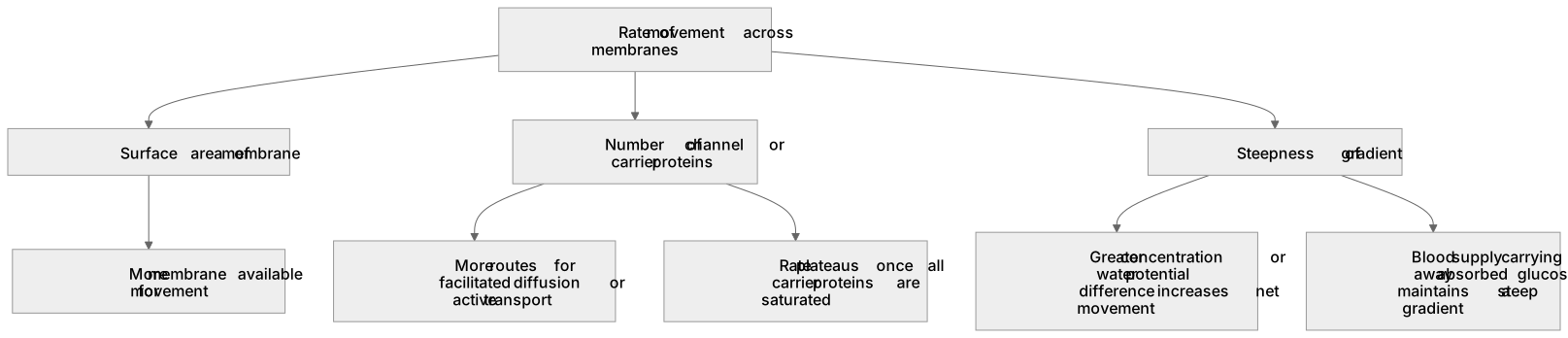
The rate of movement across membranes depends on three variables. Surface area: more membrane allows more particles to cross per unit time. External membranes may have microvilli (e.g. ileum), while internal membranes like mitochondrial cristae are folded mainly to increase surface area for the electron transport chain and ATP synthase, though they also increase membrane area generally. Number of channel or carrier proteins: channel proteins provide routes for facilitated diffusion of charged or polar solutes, while carrier proteins mediate facilitated diffusion and active transport (pumps). Rate rises with protein number until all are occupied (saturation). Steepness of the gradient: a greater concentration or water potential difference increases net movement rate. A blood supply carrying away absorbed glucose maintains a steep gradient.
What earns the marks
- A greater surface area of internal or external membranes increases the rate of transport, because more membrane is available for movement.
- More channel proteins increase the rate of facilitated diffusion, and more carrier proteins increase the rate of facilitated diffusion or active transport.
- The rate plateaus once all carrier proteins are saturated, because they are occupied and cannot work faster.
- A steeper concentration or water potential gradient increases the rate of net movement.
- Folded internal membranes, such as cristae, increase membrane surface area; their main role is to support the electron transport chain and ATP synthase, so use them as a transport example only with that qualification.
Common mistakes and how to put them right
Answering a contrast question with facts about only one process.
Put it right: Both sides of the difference are needed.
Saying the rate rises indefinitely with concentration in facilitated diffusion.
Put it right: It plateaus once carrier proteins are saturated.
Describing an adaptation without connecting it to a rate.
Put it right: State the mechanism by which the adaptation changes the rate.
Ignoring internal membranes when asked about cellular adaptations for transport.
Put it right: Include cristae or other folded internal membranes, qualified by their main role.
Stating that channel proteins carry out active transport.
Put it right: Active transport requires carrier proteins (pumps); channel proteins only allow facilitated diffusion.
Exam tips
- If a graph plateaus for carrier-mediated transport, name the limiting factor: all carrier proteins are occupied.
- Check what the stem has already ruled out, since questions often say 'other than surface area'.
Try the lesson
The start of the Transport across cell membranes: Students should be able to: explain the adaptations of specialised cells in relation to the rate of transport across their internal and external membranes explain how surface area, number of channel or carrier proteins and differences in gradients of concentration or water potential affect the rate of movement across cell membranes. lesson, made from checked teaching notes for this specification point.
Have a go first
Which change would increase the rate of diffusion of oxygen across a cell membrane?
Listen
The rate of movement across membranes depends on three variables. Surface area: more membrane allows more particles to cross per unit time. External membranes may have microvilli (e.g. ileum), while internal membranes like mitochondrial cristae are folded mainly to increase surface area for the electron transport chain and ATP synthase, though they also increase membrane area generally. Number of channel or carrier proteins: channel proteins provide routes for facilitated diffusion of charged or polar solutes, while carrier proteins mediate facilitated diffusion and active transport (pumps). Rate rises with protein number until all are occupied (saturation). Steepness of the gradient: a greater concentration or water potential difference increases net movement rate. A blood supply carrying away absorbed glucose maintains a steep gradient. A strong answer earns marks for these points. A greater surface area of internal or external membranes increases the rate of transport, because more membrane is available for movement. More channel proteins increase the rate of facilitated diffusion, and more carrier proteins increase the rate of facilitated diffusion or active transport. The rate plateaus once all carrier proteins are saturated, because they are occupied and cannot work faster. A steeper concentration or water potential gradient increases the rate of net movement. A common slip: Answering a contrast question with facts about only one process. Instead, both sides of the difference are needed. Exam tip: If a graph plateaus for carrier-mediated transport, name the limiting factor: all carrier proteins are occupied.
See it
Key words
Say what each word means before you turn the card.
surface area
Try answering aloud or in your head before turning the card.
number of transport proteins
Try answering aloud or in your head before turning the card.
saturation
Try answering aloud or in your head before turning the card.
gradient
Try answering aloud or in your head before turning the card.
See every definition
- surface area
- A greater area of internal or external membranes increases the rate of transport, because more membrane is available for movement.
- number of transport proteins
- More channel proteins increase the rate of facilitated diffusion, and more carrier proteins increase the rate of facilitated diffusion or active transport.
- saturation
- The rate plateaus once all carrier proteins are saturated, because they are occupied and cannot work faster.
- gradient
- A steeper concentration or water potential gradient increases the rate of net movement.
Label the diagram
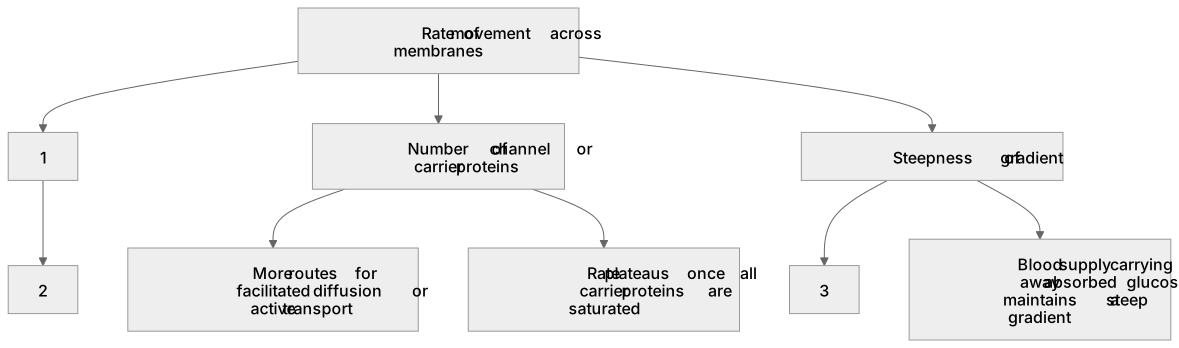
Some boxes have lost their names. Pick the right name for each number.
1Box 1
2Box 2
3Box 3
There is more to this lesson
The full lesson goes on to check your understanding and help you earn the marks. Create a free account to carry on, with your progress saved.
A week of Premium from your first lesson · Then the free plan continues · No card, no charge
Test your understanding of Transport across cell membranes: Students should be able to: explain the adaptations of specialised cells in relation to the rate of transport across their internal and external membranes explain how surface area, number of channel or carrier proteins and differences in gradients of concentration or water potential affect the rate of movement across cell membranes.
Active recall beats re-reading. Take an instant quiz now to test what you’ve learned and lock it into long-term memory.
A week of Premium from your first lesson · Then the free plan continues · No card, no charge