AQA · A-Level · Biology
Course version: 7402 · Version from Sept 2016
Sequencing methods are continuously updated and have become automated.
Full specification wording
Using genome projects (A-level only): Sequencing methods are continuously updated and have become automated.
Early sequencing was slow and done largely by hand: the chain-termination method read a few hundred bases at a time, and the first human genome took more than a decade and enormous expense.
Checked against the AQA 7402 specification (opens in a new tab) on .
- Point 5 of 5
- 3 key terms
Study notes
From the checked teaching notes for this specification point.
The idea
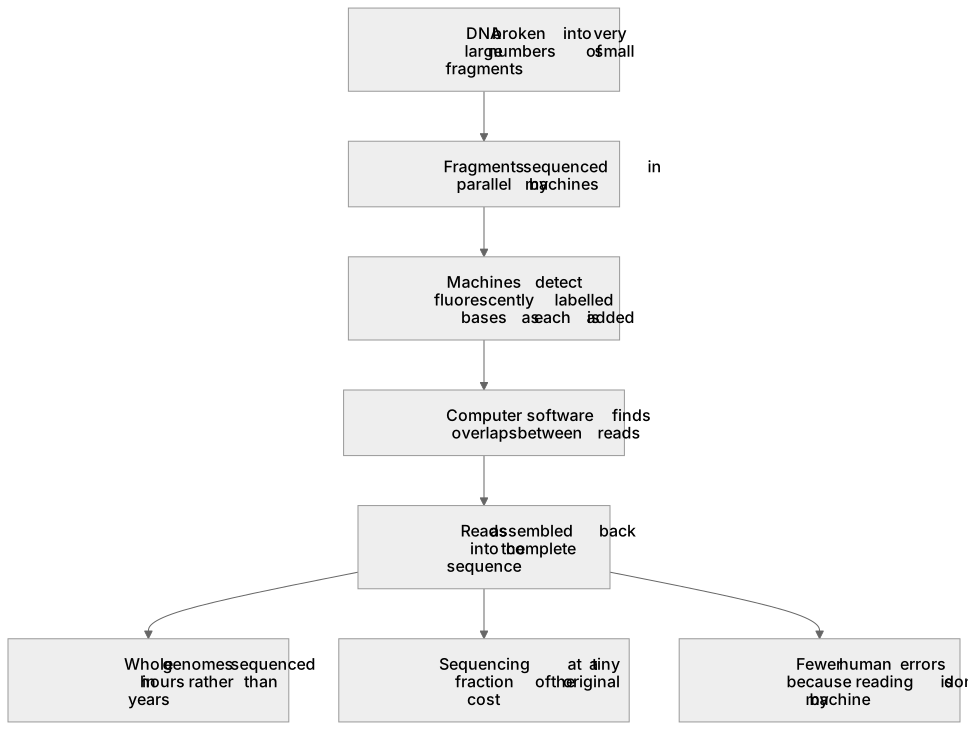
Early sequencing was slow and done largely by hand: the chain-termination method read a few hundred bases at a time, and the first human genome took more than a decade and enormous expense. Modern high-throughput methods are automated. The DNA is broken into very large numbers of small fragments, these are sequenced in parallel by machines that detect fluorescently labelled bases as each is added, and computer software then finds the overlaps between reads and assembles them back into the complete sequence. The consequences matter more than the chemistry: whole genomes can now be sequenced in hours rather than years, at a tiny fraction of the original cost, and with fewer human errors because the reading is done by machine.
What earns the marks
- Sequencing now being automated, carried out by machines rather than by hand.
- The DNA being cut into many fragments that are sequenced at the same time and reassembled by computer.
- The consequence being that sequencing is faster and cheaper, with fewer errors.
- An application made possible, such as DNA or base sequencing evidence leading to species being reclassified or renamed.
- Whole genomes of individuals being sequenced, allowing screening and personalised medicine.
Common mistakes and how to put them right
Writing that modern methods sequence the protein, when sequencing reads the order of DNA bases.
Answering only 'it is automated' when the question asks for an advantage, so never stating faster, cheaper or more accurate.
Claiming a machine reads a whole chromosome in one pass, with no fragmentation or reassembly step.
Confusing DNA sequencing with genetic fingerprinting, which compares fragment lengths and never reads bases.
Saying improved technology changed the genetic code rather than our ability to read it.
Exam tips
- Advantages need a comparison - faster than what, cheaper than what - so name the old method or the old timescale.
- Link automation to a biological consequence; the mark is rarely for the technology on its own.
- If a question asks why a classification has been revised, name the evidence precisely - base sequencing scores, and so does electron microscopy of greater resolution or improved staining, so do not cross a microscopy answer out.
Try the lesson
The start of the Using genome projects (A-level only): Sequencing methods are continuously updated and have become automated. lesson, made from checked teaching notes for this specification point.
Have a go first
What has happened to DNA sequencing methods over time?
Listen
Early sequencing was slow and done largely by hand: the chain-termination method read a few hundred bases at a time, and the first human genome took more than a decade and enormous expense. Modern high-throughput methods are automated. The DNA is broken into very large numbers of small fragments, these are sequenced in parallel by machines that detect fluorescently labelled bases as each is added, and computer software then finds the overlaps between reads and assembles them back into the complete sequence. The consequences matter more than the chemistry: whole genomes can now be sequenced in hours rather than years, at a tiny fraction of the original cost, and with fewer human errors because the reading is done by machine. A strong answer earns marks for these points. sequencing now being automated, carried out by machines rather than by hand. the DNA being cut into many fragments that are sequenced at the same time and reassembled by computer. the consequence being that sequencing is faster and cheaper, with fewer errors. an application made possible, such as DNA or base sequencing evidence leading to species being reclassified or renamed. Exam tip: Advantages need a comparison - faster than what, cheaper than what - so name the old method or the old timescale.
See it
Key words
Say what each word means before you turn the card.
automated sequencing
Try answering aloud or in your head before turning the card.
high-throughput methods
Try answering aloud or in your head before turning the card.
fragment assembly
Try answering aloud or in your head before turning the card.
See every definition
- automated sequencing
- Sequencing carried out by machines rather than by hand, with methods that are continuously updated.
- high-throughput methods
- Modern automated methods in which very large numbers of small DNA fragments are sequenced in parallel by machines.
- fragment assembly
- Computer software finds the overlaps between reads and assembles them back into the complete sequence.
Label the diagram
Some boxes have lost their names. Pick the right name for each number.
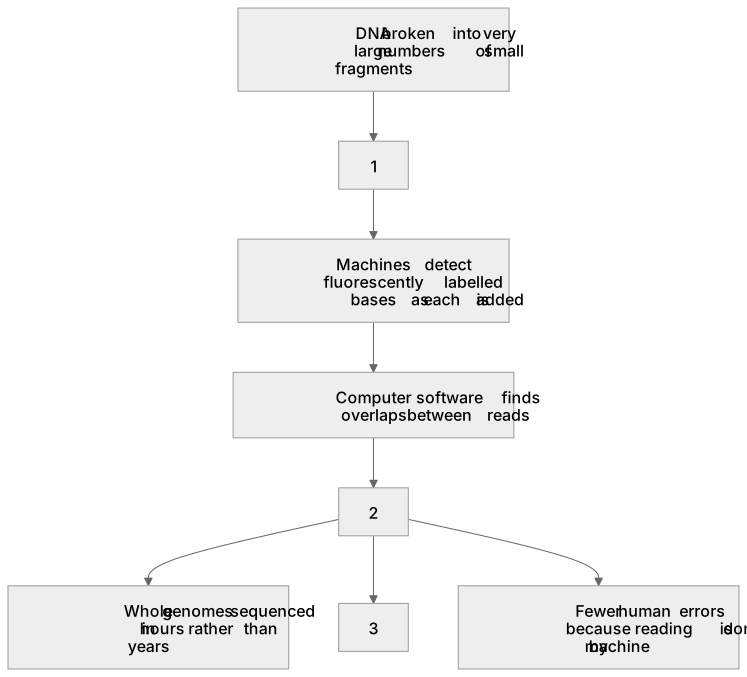
1Box 1
2Box 2
3Box 3
There is more to this lesson
The full lesson goes on to check your understanding and help you earn the marks. Create a free account to carry on, with your progress saved.
A week of Premium from your first lesson · Then the free plan continues · No card, no charge
Test your understanding of Using genome projects (A-level only): Sequencing methods are continuously updated and have become automated.
Active recall beats re-reading. Take an instant quiz now to test what you’ve learned and lock it into long-term memory.
A week of Premium from your first lesson · Then the free plan continues · No card, no charge