AQA · A-Level · Biology
Course version: 7402 · Version from Sept 2016
Water is a major component of cells. It has several properties that are…
Full specification wording
Water: Water is a major component of cells. It has several properties that are important in biology. In particular, water: is a metabolite in many metabolic reactions, including condensation and hydrolysis reactions is an important solvent in which metabolic reactions occur has a relatively high heat capacity, buffering changes in temperature has a relatively large latent heat of vaporisation, providing a cooling effect with little loss of water through evaporation has strong cohesion between water molecules; this supports columns of water in the tube-like transport cells of plants and produces surface tension where water meets air.
Water is polar, forming hydrogen bonds between molecules.
Checked against the AQA 7402 specification (opens in a new tab) on .
Study notes
From the checked teaching notes for this specification point.
The idea
Water is polar, forming hydrogen bonds between molecules. This gives it five key biological properties. 1) It is a metabolite in condensation and hydrolysis reactions. 2) It is an important solvent for metabolic reactions, as polar molecules dissolve easily. 3) It has a high specific heat capacity, buffering temperature changes because energy breaks hydrogen bonds rather than raising kinetic energy, protecting enzymes from denaturation. 4) It has a large latent heat of vaporisation, providing a cooling effect (e.g. sweating) with little water loss. 5) Strong cohesion between molecules supports continuous water columns in plant xylem under tension, and produces surface tension where water meets air, supporting small organisms.
What earns the marks
- Cohesion between water molecules, caused by hydrogen bonds, supporting an unbroken column of water in the xylem.
- A high specific heat capacity buffering changes in temperature, so enzymes are not denatured.
- Water acting as a metabolite in a named condensation or hydrolysis reaction.
- Water acting as a solvent allowing metabolic reactions to occur.
- A large latent heat of vaporisation providing a cooling effect through evaporation with little water loss.
Common mistakes and how to put them right
Saying water molecules are held together by hydrogen bonds within the molecule, when the bonds inside a molecule are covalent and hydrogen bonds form between molecules.
Explaining cohesion as water sticking to the walls of the xylem, which is adhesion.
Calling water a solvent without saying it is polar, or claiming that it dissolves non-polar lipids.
Confusing latent heat of vaporisation with specific heat capacity when explaining sweating.
Exam tips
- In xylem questions, write cohesion, continuous column and tension in the same answer; a correct cohesion-tension statement is creditworthy even if the individual points are loosely worded.
- Match the property to the context asked for; listing all five properties when one is asked for wastes time and risks contradiction.
- Every property answer should end with a biological consequence, not just the physics.
Try the lesson
The start of the Water: Water is a major component of cells. It has several properties that are important in biology. In particular, water: is a metabolite in many metabolic reactions, including condensation and hydrolysis reactions is an important solvent in which metabolic reactions occur has a relatively high heat capacity, buffering changes in temperature has a relatively large latent heat of vaporisation, providing a cooling effect with little loss of water through evaporation has strong cohesion between water molecules; this supports columns of water in the tube-like transport cells of plants and produces surface tension where water meets air. lesson, made from checked teaching notes for this specification point.
Have a go first
Which property of water allows it to act as a solvent for many metabolic reactions in cells?
Listen
Water is polar, forming hydrogen bonds between molecules. This gives it five key biological properties. 1) It is a metabolite in condensation and hydrolysis reactions. 2) It is an important solvent for metabolic reactions, as polar molecules dissolve easily. 3) It has a high specific heat capacity, buffering temperature changes because energy breaks hydrogen bonds rather than raising kinetic energy, protecting enzymes from denaturation. 4) It has a large latent heat of vaporisation, providing a cooling effect (e.g. sweating) with little water loss. 5) Strong cohesion between molecules supports continuous water columns in plant xylem under tension, and produces surface tension where water meets air, supporting small organisms. A strong answer earns marks for these points. cohesion between water molecules, caused by hydrogen bonds, supporting an unbroken column of water in the xylem. a high specific heat capacity buffering changes in temperature, so enzymes are not denatured. water acting as a metabolite in a named condensation or hydrolysis reaction. water acting as a solvent allowing metabolic reactions to occur. Exam tip: In xylem questions, write cohesion, continuous column and tension in the same answer; a correct cohesion-tension statement is creditworthy even if the individual points are loosely worded.
See it

Label the diagram
Some boxes have lost their names. Pick the right name for each number.
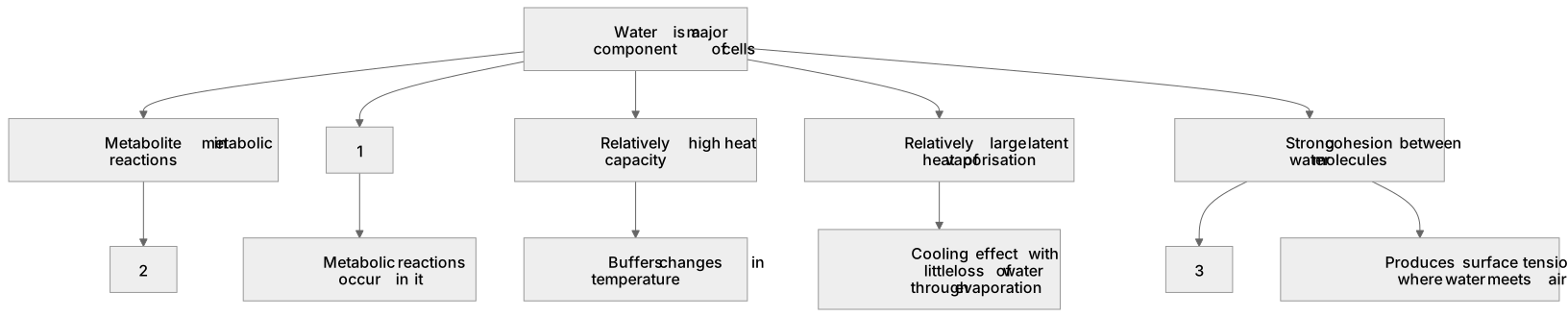
1Box 1
2Box 2
3Box 3
There is more to this lesson
The full lesson goes on to check your understanding and help you earn the marks. Create a free account to carry on, with your progress saved.
A week of Premium from your first lesson · Then the free plan continues · No card, no charge
Test your understanding of Water: Water is a major component of cells. It has several properties that are important in biology. In particular, water: is a metabolite in many metabolic reactions, including condensation and hydrolysis reactions is an important solvent in which metabolic reactions occur has a relatively high heat capacity, buffering changes in temperature has a relatively large latent heat of vaporisation, providing a cooling effect with little loss of water through evaporation has strong cohesion between water molecules; this supports columns of water in the tube-like transport cells of plants and produces surface tension where water meets air.
Active recall beats re-reading. Take an instant quiz now to test what you’ve learned and lock it into long-term memory.
A week of Premium from your first lesson · Then the free plan continues · No card, no charge