Pearson Edexcel · A-Level · Biology
ATP
Master the molecular basis of life and disease. This topic bridges the gap between DNA structure and real-world health conditions like Cystic Fibrosis, testing your ability to link microscopic mutations to macroscopic symptoms.
- 7 min read
- 3 worked examples
- 5 practice questions
- 6 key terms
Study Notes
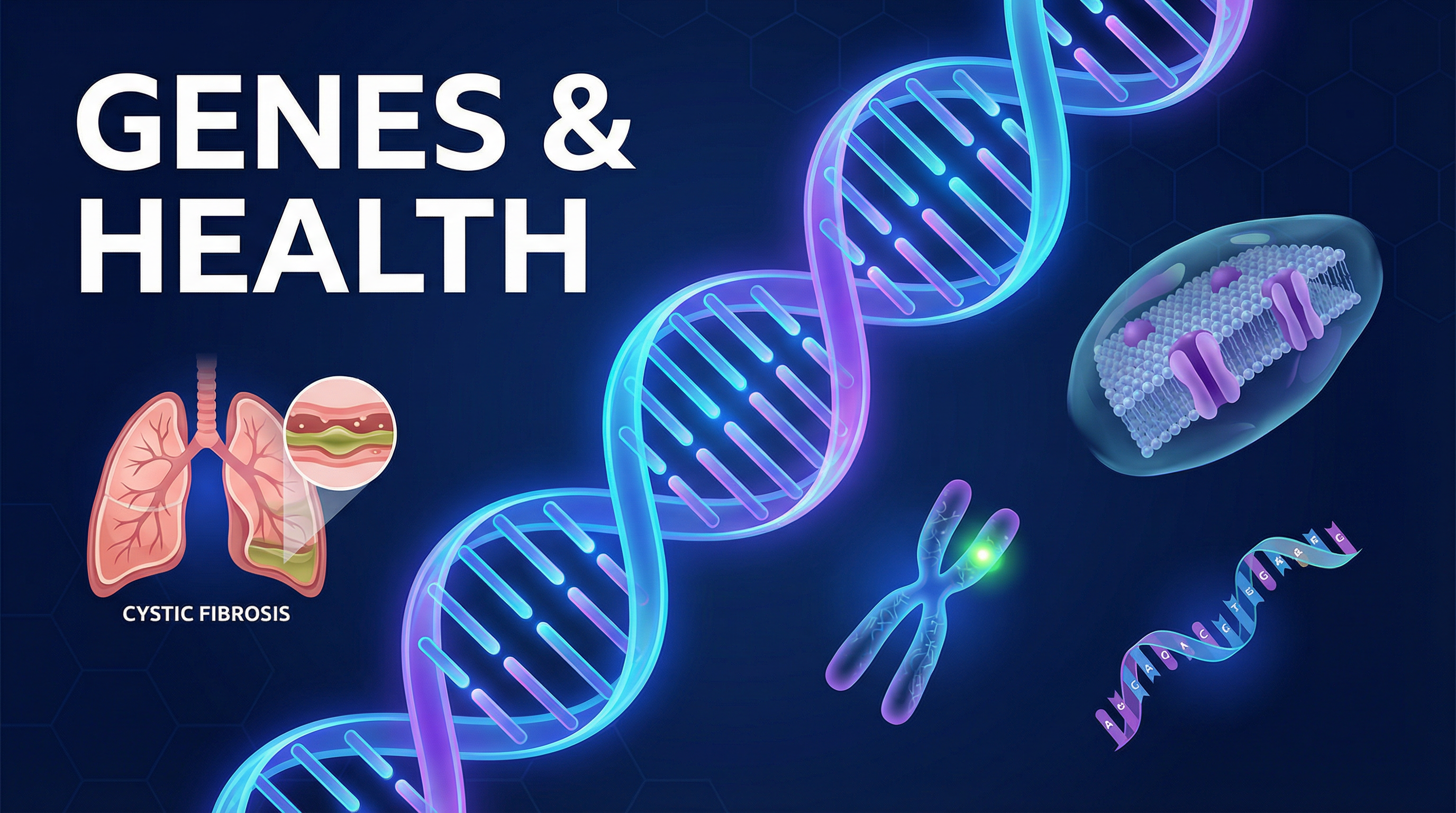
Overview
Welcome to Topic 2: Genes and Health. This is a foundational topic that connects the molecular world of DNA to the macroscopic world of human health and disease. You will explore how the genetic code stored in the nucleus is translated into functional proteins, and crucially, what happens when that code contains errors. Examiners love this topic because it allows them to test your understanding across multiple levels of biological organisation—from the sequence of bases in a gene, to the structure of a cell membrane protein, to the physiological symptoms experienced by a patient.
The core case study for this topic is Cystic Fibrosis (CF). You must be able to explain the inheritance of CF, the specific mutation involved, and how this mutation alters the properties of mucus in the respiratory, digestive, and reproductive systems. This topic links heavily to biological molecules (Topic 1), cell structure, and transport across membranes. Expect synoptic questions that ask you to apply your knowledge of osmosis and protein structure to the context of CF.
Listen to the companion podcast for a detailed walkthrough of the core concepts:
Key Concepts
Concept 1: The Structure and Function of DNA and RNA
DNA (Deoxyribonucleic Acid) is the molecule of inheritance. It consists of two polynucleotide strands twisted into a double helix. Each nucleotide contains a deoxyribose sugar, a phosphate group, and a nitrogenous base (Adenine, Thymine, Cytosine, or Guanine). The two strands are held together by hydrogen bonds between complementary base pairs: A pairs with T (2 hydrogen bonds), and C pairs with G (3 hydrogen bonds).
RNA (Ribonucleic Acid) is a single-stranded polynucleotide. It differs from DNA in three key ways: it contains a ribose sugar instead of deoxyribose, it contains the base Uracil (U) instead of Thymine (T), and it is generally much shorter. There are two main types of RNA you need to know for protein synthesis: messenger RNA (mRNA) and transfer RNA (tRNA).
Examiner Tip: When asked to compare DNA and RNA, always use comparative language (e.g., "DNA is double-stranded whereas RNA is single-stranded").
Concept 2: Protein Synthesis (Transcription and Translation)
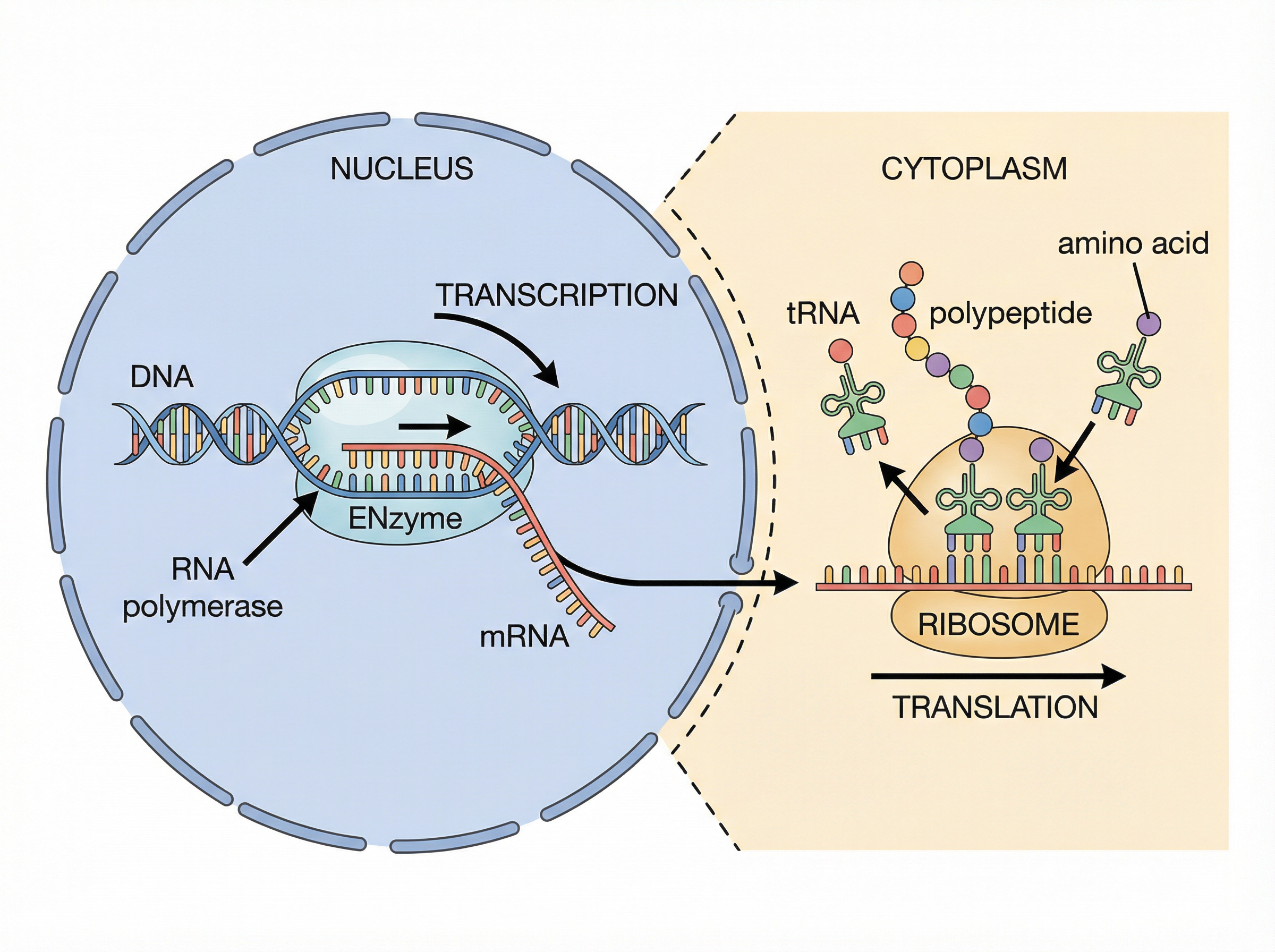
Protein synthesis is the process by which the genetic code is used to build proteins. It occurs in two main stages: transcription (in the nucleus) and translation (at the ribosome).
Transcription:
- The DNA double helix unwinds and the hydrogen bonds between bases break, separating the strands.
- One strand acts as a template (the antisense strand).
- Free RNA nucleotides align opposite their complementary bases on the template strand (A with U, C with G).
- The enzyme RNA polymerase joins the RNA nucleotides together to form a strand of mRNA.
- The mRNA leaves the nucleus through a nuclear pore.
Translation:
- The mRNA attaches to a ribosome in the cytoplasm.
- The ribosome reads the mRNA in groups of three bases called codons.
- tRNA molecules bring specific amino acids to the ribosome.
- Each tRNA has an anticodon that is complementary to the mRNA codon.
- The ribosome catalyses the formation of peptide bonds between adjacent amino acids, forming a polypeptide chain.
Concept 3: Mutations and Cystic Fibrosis
A mutation is a change in the sequence of bases in DNA. Because the sequence of bases determines the sequence of amino acids in a protein (the primary structure), a mutation can alter the protein's 3D shape (tertiary structure) and function.
Cystic Fibrosis is caused by a mutation in the CFTR gene (Cystic Fibrosis Transmembrane conductance Regulator). The most common mutation is a deletion of three bases, resulting in the loss of one amino acid (phenylalanine). This causes the CFTR protein to misfold.
Concept 4: The Cell Membrane and Ion Transport
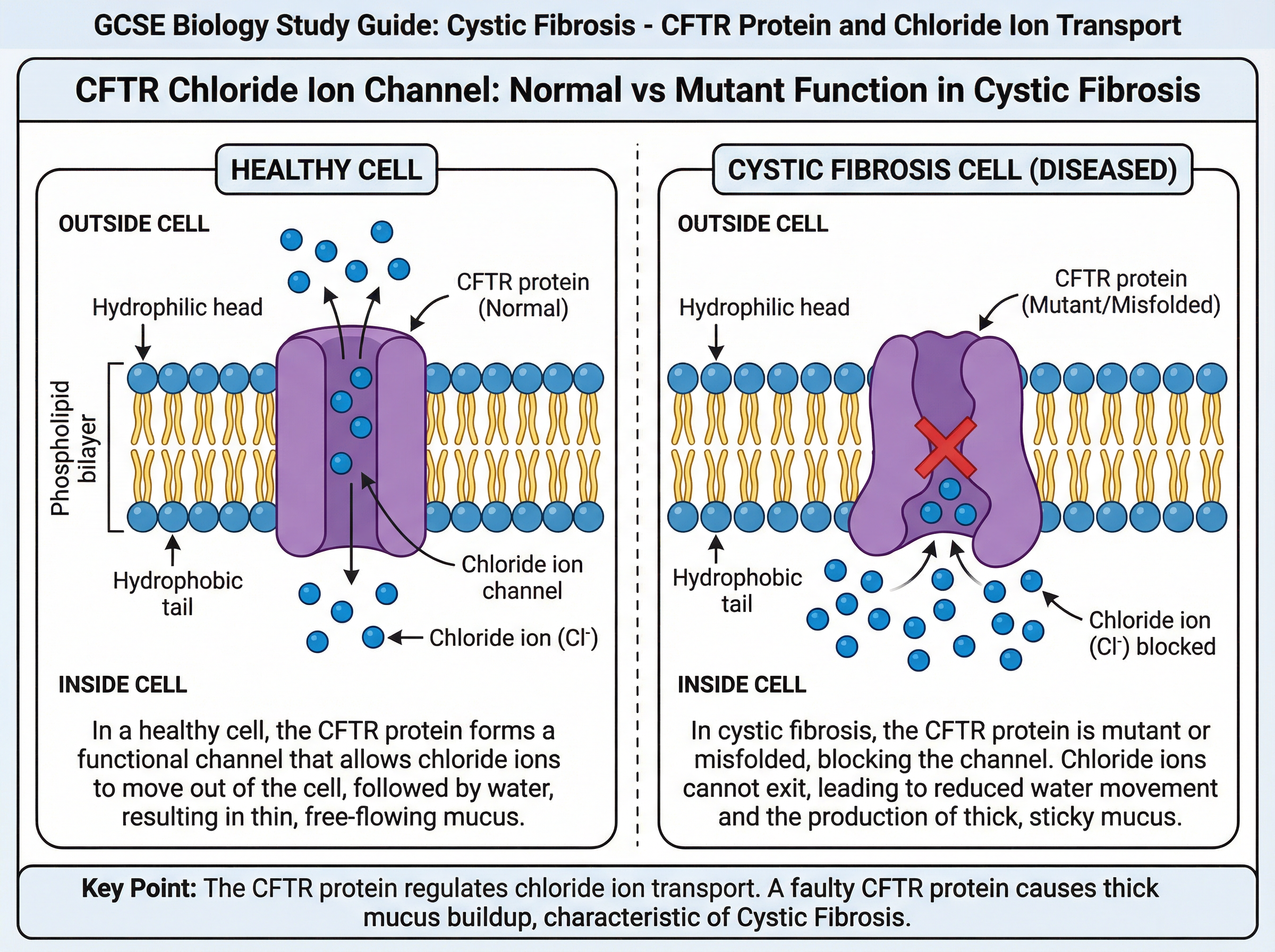
The cell membrane is described by the fluid mosaic model. It consists of a phospholipid bilayer with embedded proteins. The CFTR protein is a channel protein that spans the membrane.
In a healthy person, the CFTR channel actively pumps chloride ions (Cl⁻) out of cells and into the surrounding mucus. This lowers the water potential of the mucus, causing water to move out of the cells by osmosis. This keeps the mucus thin and watery.
In a person with CF, the mutant CFTR channel is non-functional or absent. Chloride ions cannot be pumped out, so water does not move into the mucus by osmosis. The result is thick, sticky mucus.
Concept 5: Symptoms and Treatment of Cystic Fibrosis
The thick mucus in CF affects several body systems:
- Respiratory System: The mucus blocks airways, reducing the surface area for gas exchange. It also traps bacteria, leading to frequent lung infections.
- Digestive System: The mucus blocks the pancreatic duct, preventing digestive enzymes from reaching the small intestine. This leads to poor digestion and absorption of nutrients.
- Reproductive System: The mucus can block the cervix in females and the vas deferens in males, often causing infertility.
Treatments include physiotherapy to clear mucus, antibiotics to treat infections, and enzyme supplements to aid digestion.
Concept 6: Inheritance and Genetic Testing
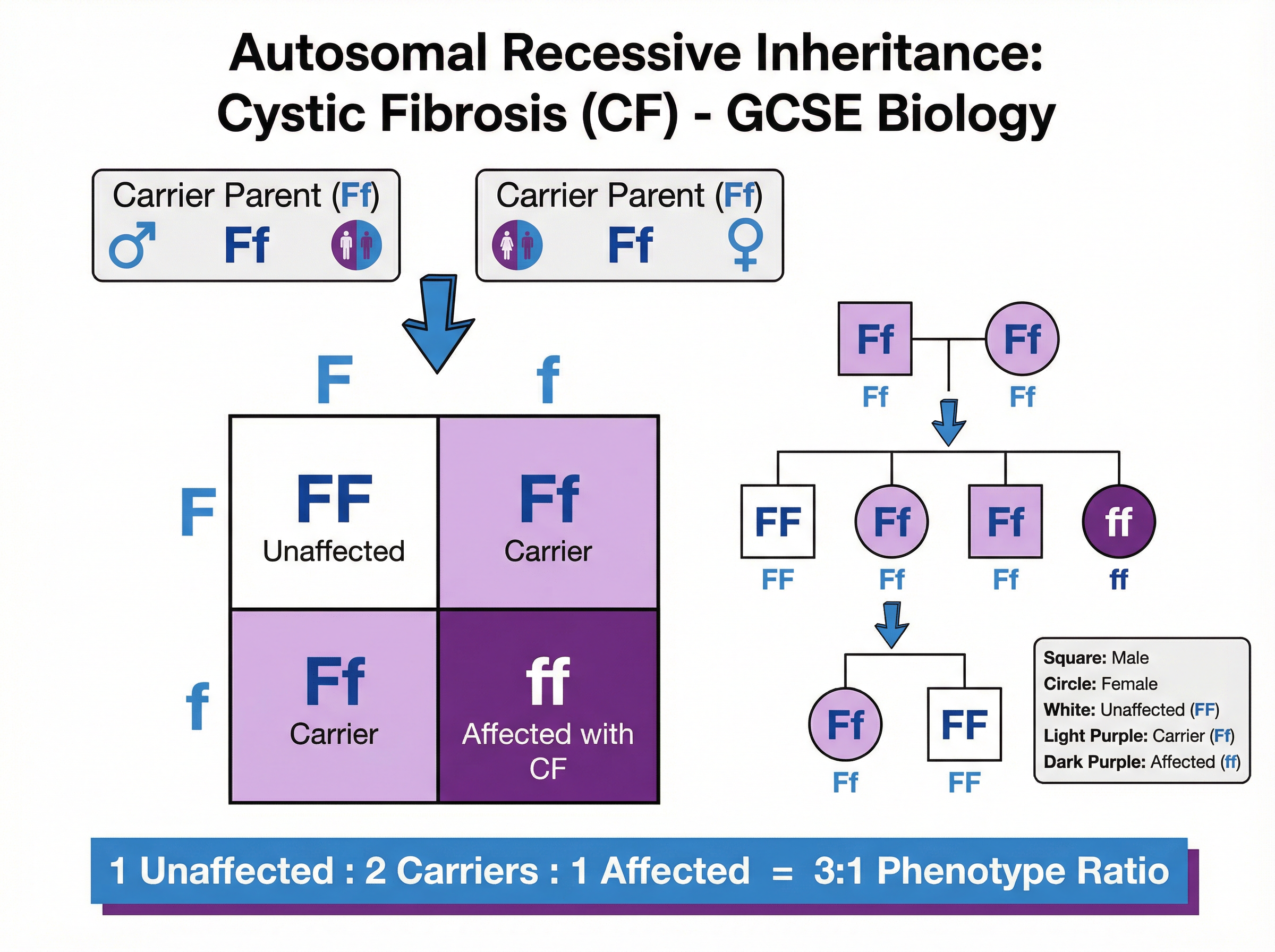
Cystic Fibrosis is an autosomal recessive condition. This means the gene is located on an autosome (a non-sex chromosome) and a person must inherit two copies of the faulty allele (homozygous recessive, ff) to have the disease. A person with one faulty allele and one normal allele (heterozygous, Ff) is a carrier.
Genetic testing can identify carriers and screen embryos or foetuses for the CF mutation. This raises significant ethical issues, such as the risk of miscarriage with prenatal testing (amniocentesis or chorionic villus sampling) and the moral implications of terminating a pregnancy or selecting embryos (pre-implantation genetic diagnosis).
Mathematical/Scientific Relationships
Probability and Ratios in Genetics
When calculating the probability of offspring inheriting a condition, always use a Punnett square. The probability can be expressed as a fraction, a percentage, or a ratio.
- Fraction: e.g., 1/4 chance of having CF.
- Percentage: e.g., 25% chance of having CF.
- Ratio: e.g., 3:1 ratio of unaffected to affected offspring.
Examiner Tip: If a question asks for a probability, any of these formats is usually acceptable, but if it specifically asks for a percentage or ratio, you must provide it in that format to gain the mark.
Visual Resources
3 diagrams and illustrations
Interactive Diagrams
2 interactive diagrams to visualise key concepts
Conceptual Flow Outline
Flowchart showing the sequence of events from DNA to protein, and how a mutation leads to disease.
Conceptual Flow Outline
Concept map of autosomal recessive inheritance.
Worked Examples
3 worked examples — open one to explore the question and available guidance.
Practice Questions
Test your understanding — click to reveal model answers
State the type of bond that joins amino acids together in a polypeptide chain. (1 mark)
Hint: Think about the name of the chain.
Compare the structure of DNA and RNA. (3 marks)
Hint: Think about the strands, the sugar, and the bases. Remember to use comparative language.
Explain how the structure of the cell membrane controls the movement of substances into and out of the cell. (4 marks)
Hint: Mention the phospholipid bilayer and the different types of proteins.
A woman who is a carrier for cystic fibrosis has a child with a man who does not have the CF allele. Calculate the probability that their child will have cystic fibrosis. (2 marks)
Hint: What is the genotype of the man if he does not have the allele at all?
Evaluate the use of pre-implantation genetic diagnosis (PGD) for couples who are carriers of the cystic fibrosis allele. (6 marks)
Hint: Provide arguments for and against, and conclude.