OCR · GCSE · Biology
Biodiversity
Master the intricate web of life with this comprehensive guide to Community Level Systems. From the delicate balance of ecosystems to the complex cycling of vital nutrients, you'll discover how every organism plays a crucial role in nature's grand design, preparing you to tackle high-mark exam questions with confidence.
- 6 min read
- 3 worked examples
- 5 practice questions
- 6 key terms
Study Notes
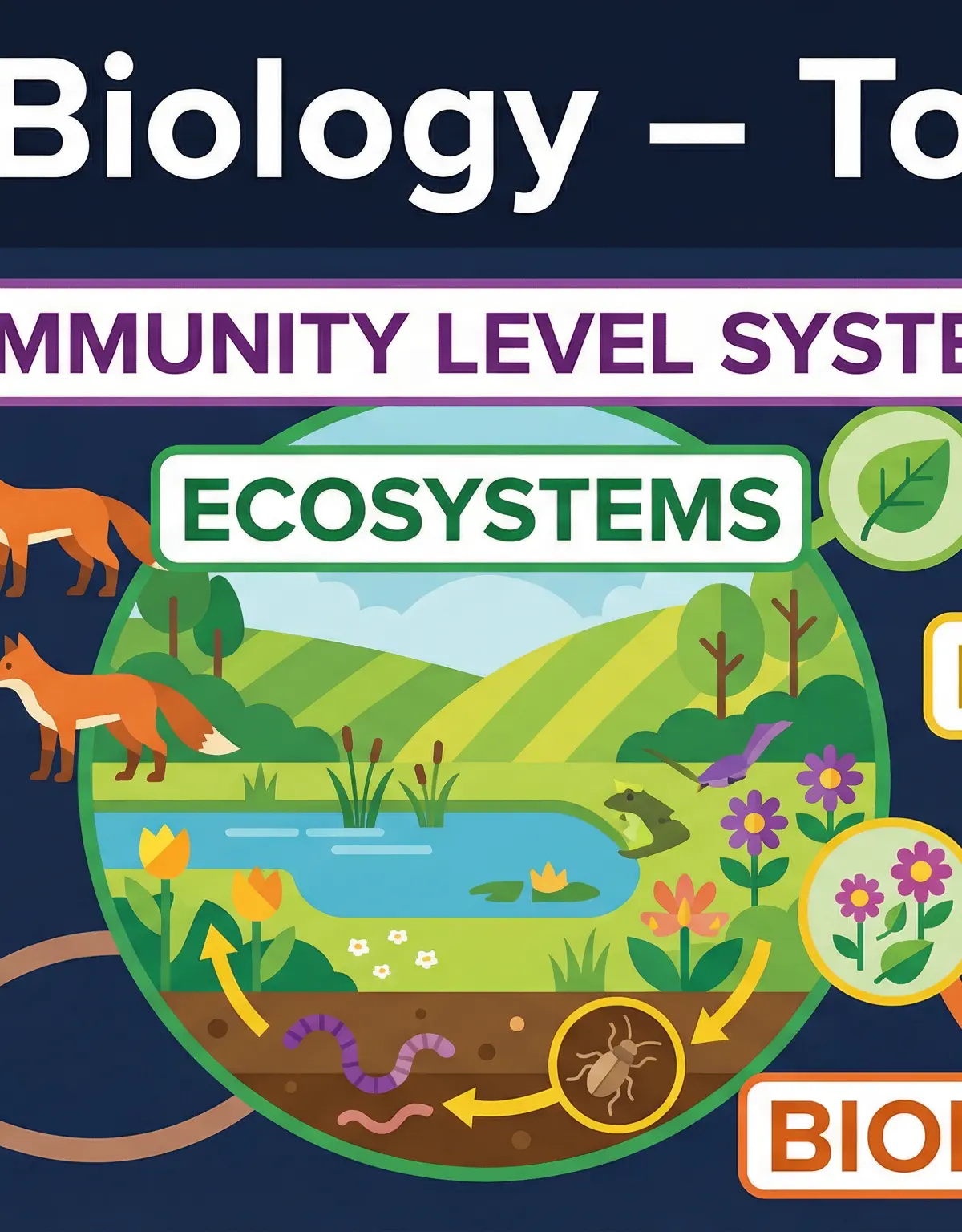
Overview
Welcome to Topic B4: Community Level Systems! This topic explores the fascinating connections between living organisms and their environment. It's a cornerstone of Biology because it explains how life sustains itself on Earth. You'll learn how energy flows through food webs, how vital nutrients like carbon and nitrogen are recycled, and why biodiversity is essential for our planet's survival.
Examiners love this topic because it tests your ability to connect different concepts. You'll often face data-rich questions, such as interpreting predator-prey graphs or explaining the impact of environmental changes on an ecosystem. By mastering the terminology and understanding the underlying processes, you'll be well-equipped to secure those top marks.
Key Concepts
Concept 1: Ecosystems and Interdependence
An ecosystem is the interaction of a community of living organisms (biotic) with the non-living (abiotic) parts of their environment. Within a community, each species depends on other species for food, shelter, pollination, and seed dispersal. This is called interdependence.
If one species is removed, it can affect the whole community. A stable community is one where all the species and environmental factors are in balance so that population sizes remain fairly constant.
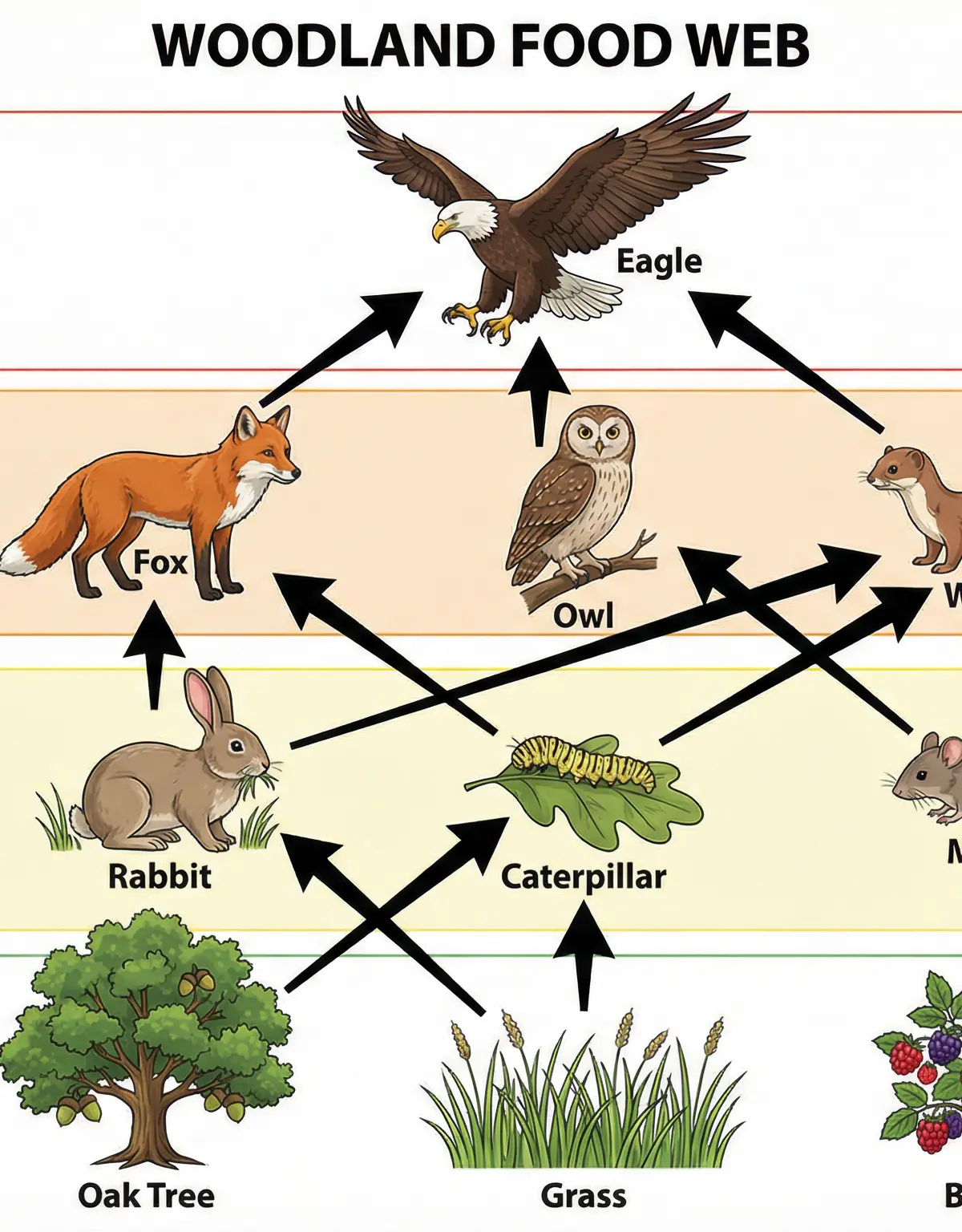
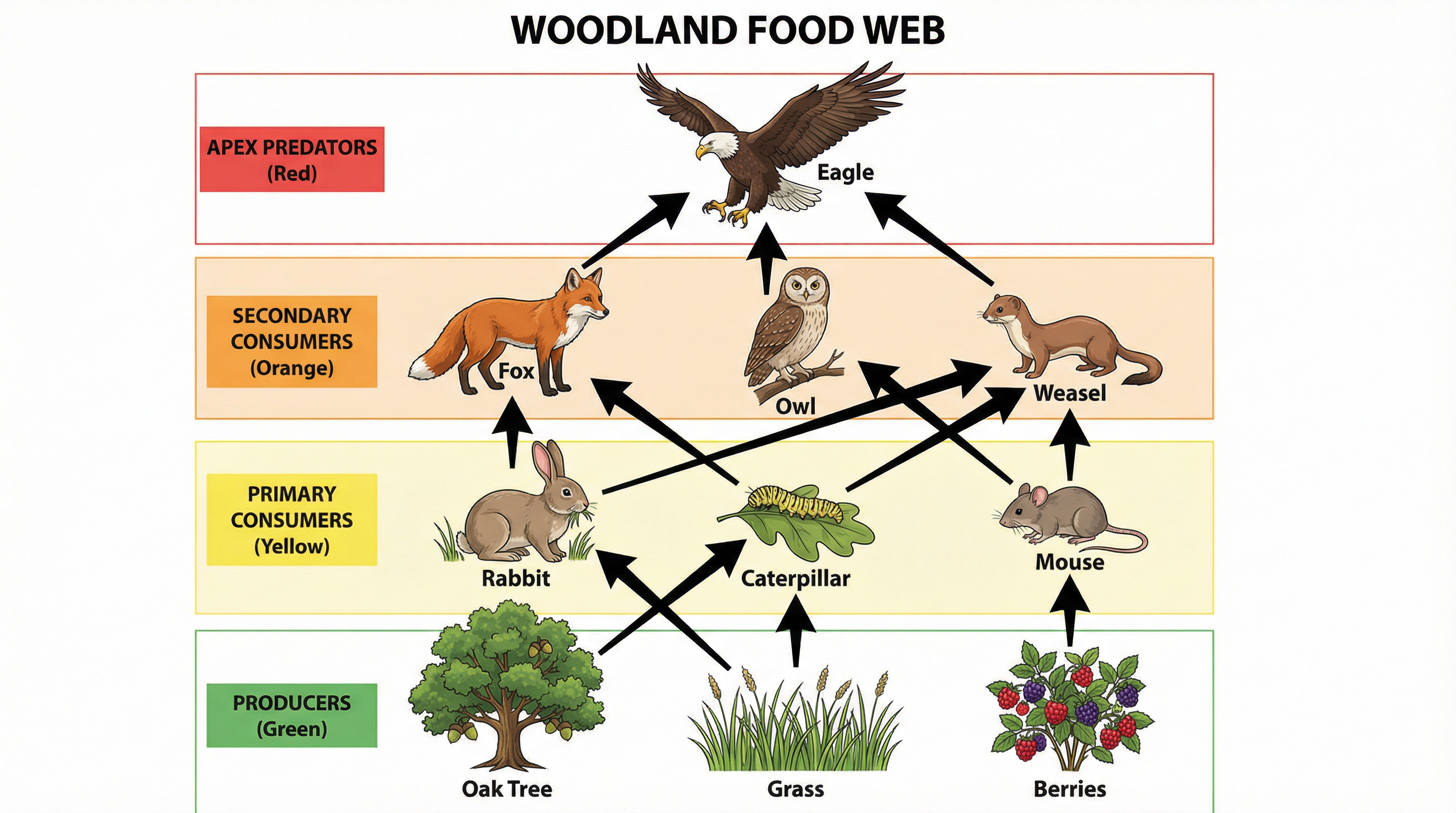
Example: In a woodland ecosystem, rabbits depend on grass for food. Foxes depend on rabbits. If a disease wipes out the rabbits, the foxes will have less food and their population will decrease, while the grass population might increase due to less grazing.
Concept 2: Abiotic and Biotic Factors
Abiotic factors are non-living elements that affect a community. These include:
- Light intensity
- Temperature
- Moisture levels
- Soil pH and mineral content
- Wind intensity and direction
- Carbon dioxide levels for plants
- Oxygen levels for aquatic animals
Biotic factors are living elements that affect a community. These include:
- Availability of food
- New predators arriving
- New pathogens
- One species outcompeting another so the numbers are no longer sufficient to breed
Concept 3: Biomass and Energy Flow
Photosynthetic organisms are the producers of biomass for life on Earth. They are the start of all food chains.
Food chains represent feeding relationships within a community.
Producer -> Primary Consumer -> Secondary Consumer -> Tertiary Consumer
Crucial Examiner Point: The arrows in a food chain represent the direction of energy transfer.
Only about 10% of the biomass from each trophic level is transferred to the level above it. Losses of biomass are due to:
- Not all the ingested material is absorbed, some is egested as faeces
- Some absorbed material is lost as waste, such as carbon dioxide and water in respiration and water and urea in urine
- Large amounts of glucose are used in respiration to provide energy for movement and maintaining body temperature
Concept 4: The Carbon Cycle
The carbon cycle returns carbon from organisms to the atmosphere as carbon dioxide to be used by plants in photosynthesis.
- Photosynthesis: Removes CO2 from the atmosphere.
- Respiration: Returns CO2 to the atmosphere (plants, animals, and decomposers all respire).
- Combustion: Burning fossil fuels releases CO2.
- Decomposition: Microorganisms break down dead matter, releasing CO2 as they respire.
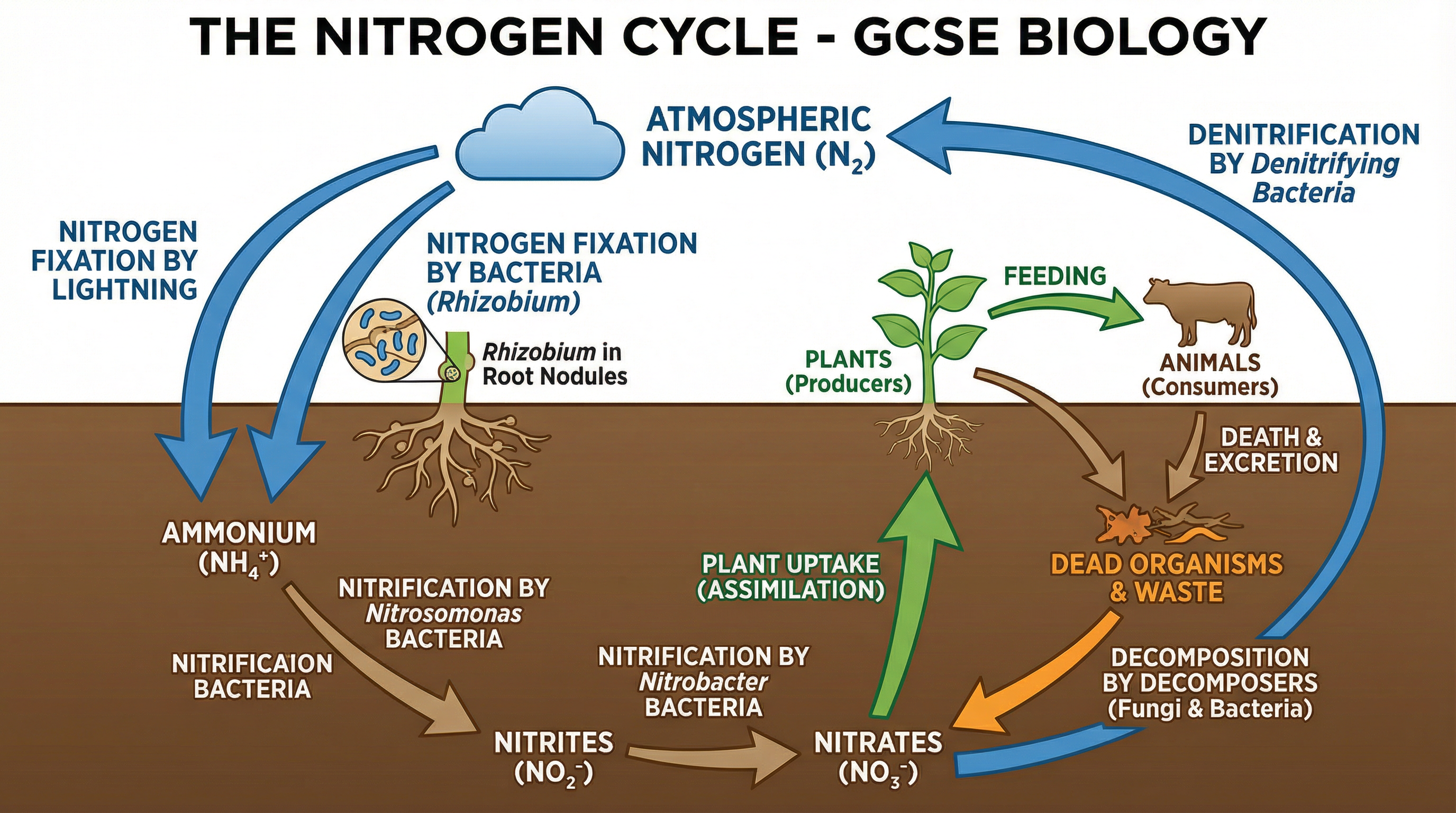
Concept 5: The Nitrogen Cycle
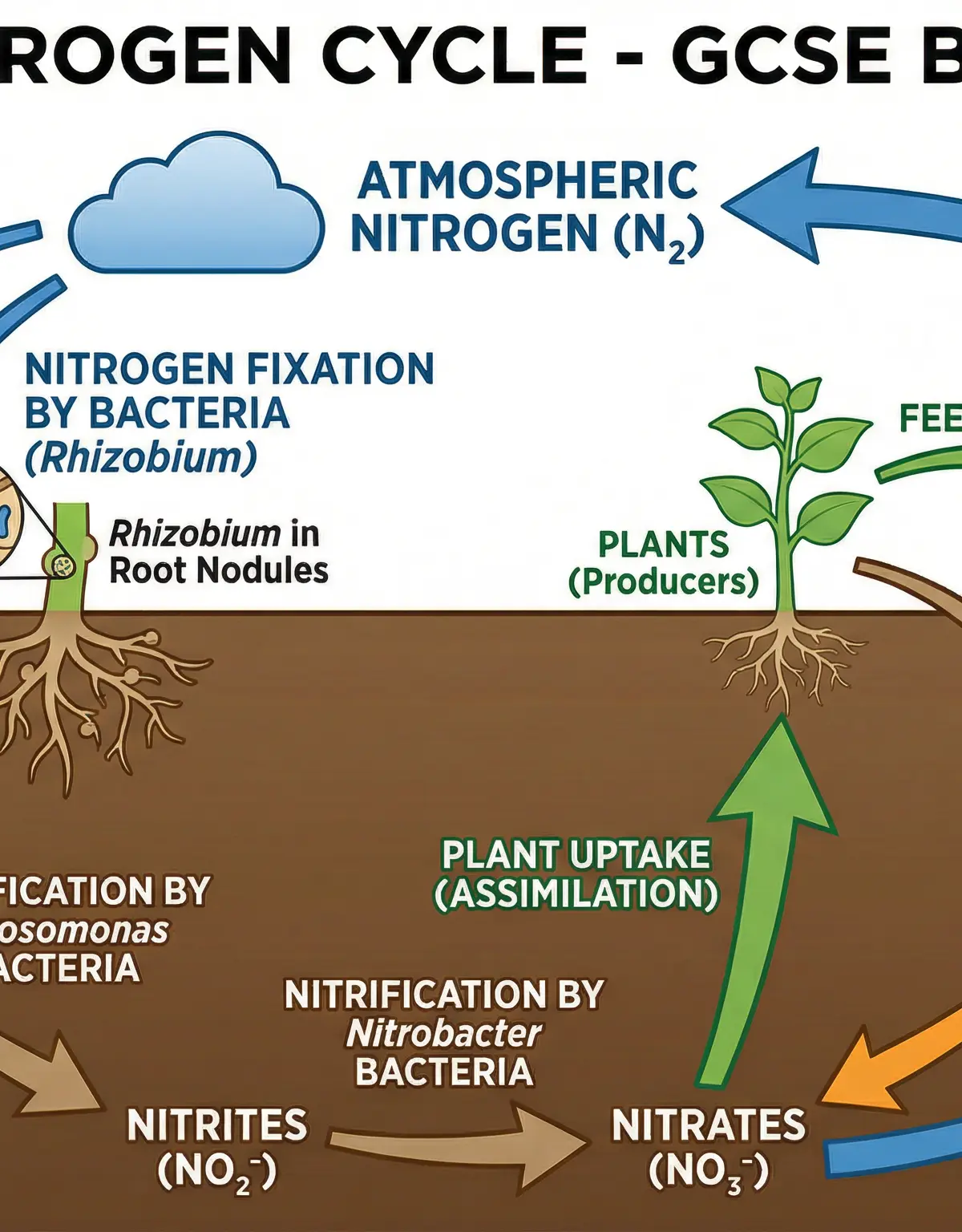
The nitrogen cycle details how nitrogen moves between the atmosphere, soil, and organisms.
- Nitrogen Fixation: Nitrogen-fixing bacteria (in soil or root nodules) convert N2 gas into nitrates.
- Nitrification: Nitrifying bacteria convert ammonia (from decomposition) into nitrites, then nitrates.
- Assimilation: Plants absorb nitrates from the soil to make proteins.
- Denitrification: Denitrifying bacteria convert nitrates back into N2 gas (usually in waterlogged soil).
Mathematical/Scientific Relationships
Efficiency of Biomass Transfer
Efficiency = (Biomass transferred to the next level / Biomass available at the previous level) x 100
What it means: This formula calculates the percentage of biomass that successfully moves up the food chain.
When to use it: When asked to calculate the efficiency of energy transfer between trophic levels in a food chain or pyramid of biomass. You must memorise this formula.
Practical Applications
Required Practical: Investigating Population SizeStudents often use quadrats and transects to estimate the population size of a species in a habitat.
- Apparatus: 0.5m x 0.5m quadrat, 20m tape measure, random number generator.
- Method (Random Sampling): Use a random number generator to select coordinates. Place the quadrat at those coordinates. Count the number of the target species. Repeat at least 10 times. Calculate the mean.
- Method (Systematic Sampling - Transect): Lay a tape measure along an environmental gradient (e.g., from the shade of a tree into the sun). Place quadrats at regular intervals (e.g., every 2m). Record the number of the target species and the abiotic factor (e.g., light intensity) at each point.
- Common Errors: Throwing the quadrat (not random), not placing the quadrat consistently (e.g., always placing the bottom left corner on the coordinate).
- Examiner Focus: They will test your understanding of why random sampling is important (to avoid bias) and how to calculate estimated total population size (
Total Area / Area of one quadrat x Mean number per quadrat).
Interactive Diagrams
2 interactive diagrams to visualise key concepts
Conceptual Flow Outline
Energy flow and loss through trophic levels
Conceptual Flow Outline
Simplified Carbon Cycle
Worked Examples
3 worked examples — open one to explore the question and available guidance.
Practice Questions
Test your understanding — click to reveal model answers
State two abiotic factors that could affect the distribution of plants in a field.
Hint: Think about non-living things plants need to grow.
Explain why food chains rarely have more than four trophic levels.
Hint: Think about what happens to energy at each stage.
Describe the role of decomposers in the carbon cycle.
Hint: What do they break down, and what gas do they release?
A farmer decides to remove all the hedges around his fields to make more room for crops. Evaluate the impact of this decision on the local ecosystem.
Hint: Evaluate means you need to look at both sides (pros and cons for the farmer vs the ecosystem).
Explain how nitrogen in the atmosphere is made available to plants.
Hint: Which specific bacteria are involved?
Test your understanding of Biodiversity
Active recall beats re-reading. Take an instant quiz now to test what you’ve learned and lock it into long-term memory.
7 days Premium · Then free forever · No card, no charge