AQA · GCSE · Business
Course version: 8132 · Version from Sept 2017
Business in the real world
Master the fundamentals of how businesses operate in the real world. This core topic underpins your entire GCSE, covering everything from legal structures to stakeholder conflicts and the critical role of the entrepreneur.
- 5 min read
- 3 worked examples
- 5 practice questions
- 6 key terms
Check what you remember
Read the wording for your board, then hide it and explain Entrepreneur in your own words. Rough notes are fine. This is a self-check, with no mark or grade.
Reference: AQA
An individual who takes the financial risk of starting and managing a new business.
Study Notes

Overview
This study guide covers the fundamental concepts of 'Business in the Real World', a cornerstone topic for GCSE Business. It explores why businesses exist, how they are structured legally, what their objectives are, and how they grow. Examiners expect candidates to not only recall these facts but to apply them to specific business scenarios. Understanding the interplay between stakeholders, the implications of limited liability, and the nuances of economies of scale is crucial for accessing higher-level marks. This topic forms the foundation upon which all other business functions (marketing, finance, operations, HR) are built.
Listen to our comprehensive revision podcast to reinforce these concepts:
Core Concepts
The Purpose of Business Activity
Businesses exist to satisfy needs (essential for survival, e.g., water, shelter) and wants (desires, e.g., luxury cars). They do this by combining the factors of production:
- Land: Natural resources (e.g., fields, oil).
- Labour: Human effort.
- Capital: Machinery, equipment, and finance.
- Enterprise: The risk-taking and decision-making role of the entrepreneur.
Opportunity Cost
A critical concept examiners frequently test. Opportunity cost is the next best alternative foregone when making a decision. For example, if a business spends £10,000 on a new marketing campaign, the opportunity cost might be the new machinery they could have bought with that money.
Business Sectors
- Primary: Extraction of raw materials (farming, mining).
- Secondary: Manufacturing and construction (car assembly, building).
- Tertiary: Provision of services (banking, retail, education).
Legal Structures
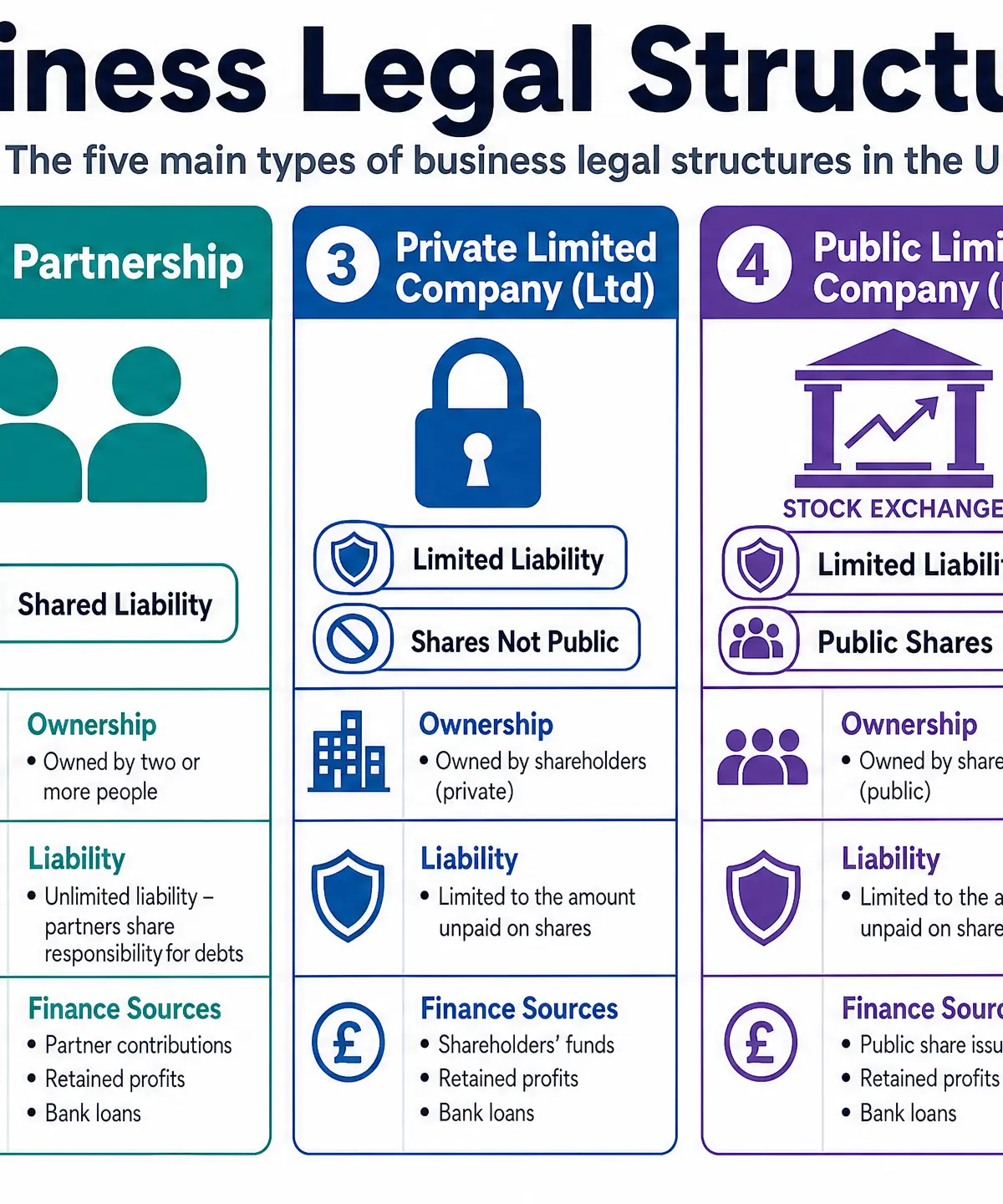
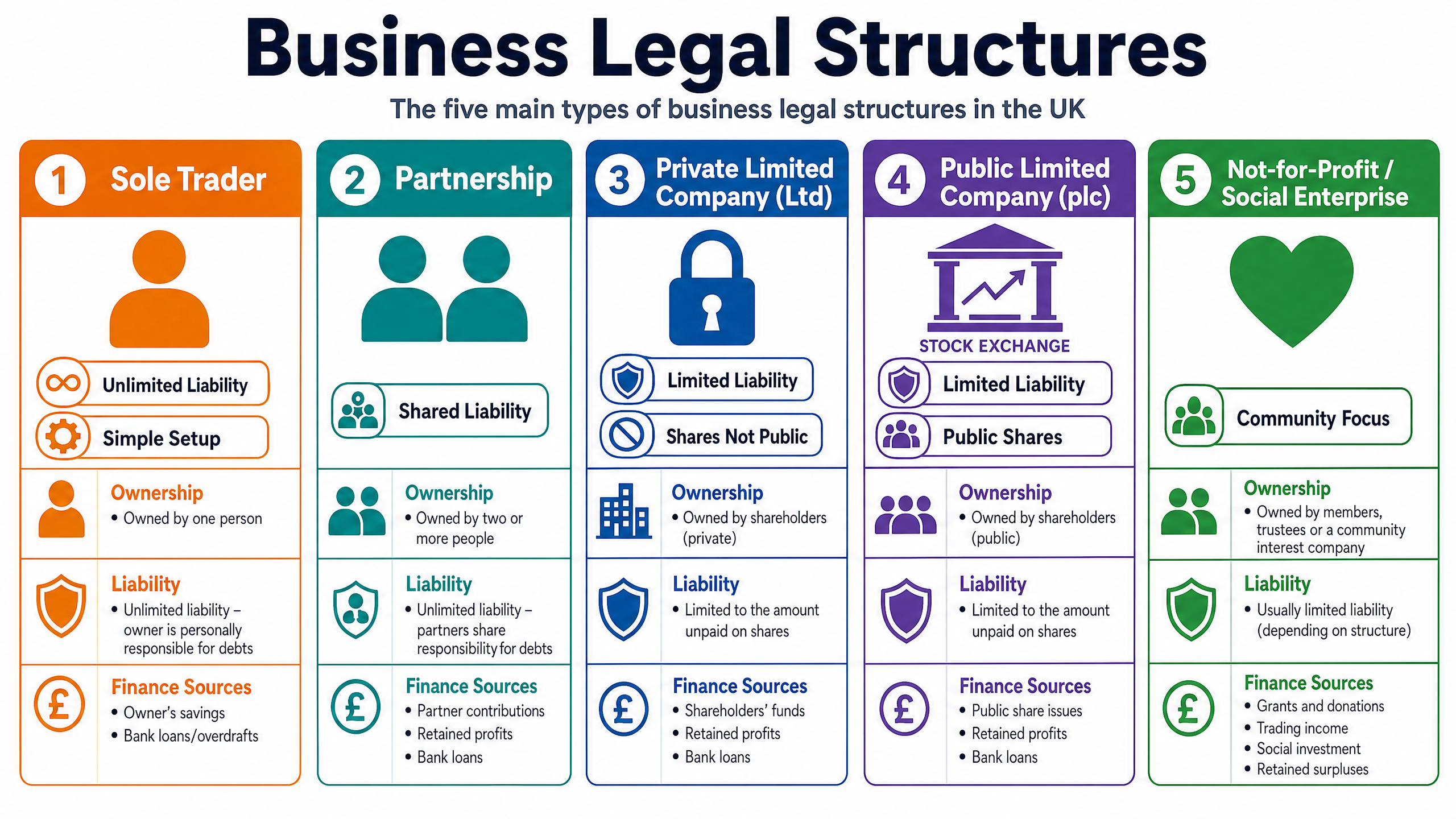
Choosing the right legal structure is a vital early decision for any business.
- Sole Trader: Owned by one person. Easy to set up, owner keeps all profit, but has unlimited liability (personally responsible for business debts).
- Partnership: Owned by 2-20 people. Shared workload and capital, but still unlimited liability and potential for conflict.
- Private Limited Company (Ltd): Shares sold privately. Owners have limited liability (only lose their investment), but accounts must be published.
- Public Limited Company (plc): Shares sold on the stock exchange. Can raise massive capital, limited liability, but risk of hostile takeover and complex regulations.
- Not-for-Profit: Driven by social/ethical goals rather than profit maximisation.
Business Objectives
Objectives are specific targets (often SMART: Specific, Measurable, Achievable, Realistic, Time-bound). Common objectives include:
- Survival (especially for start-ups)
- Profit maximisation
- Growth
- Increasing market share
- Social/ethical goals
Stakeholders
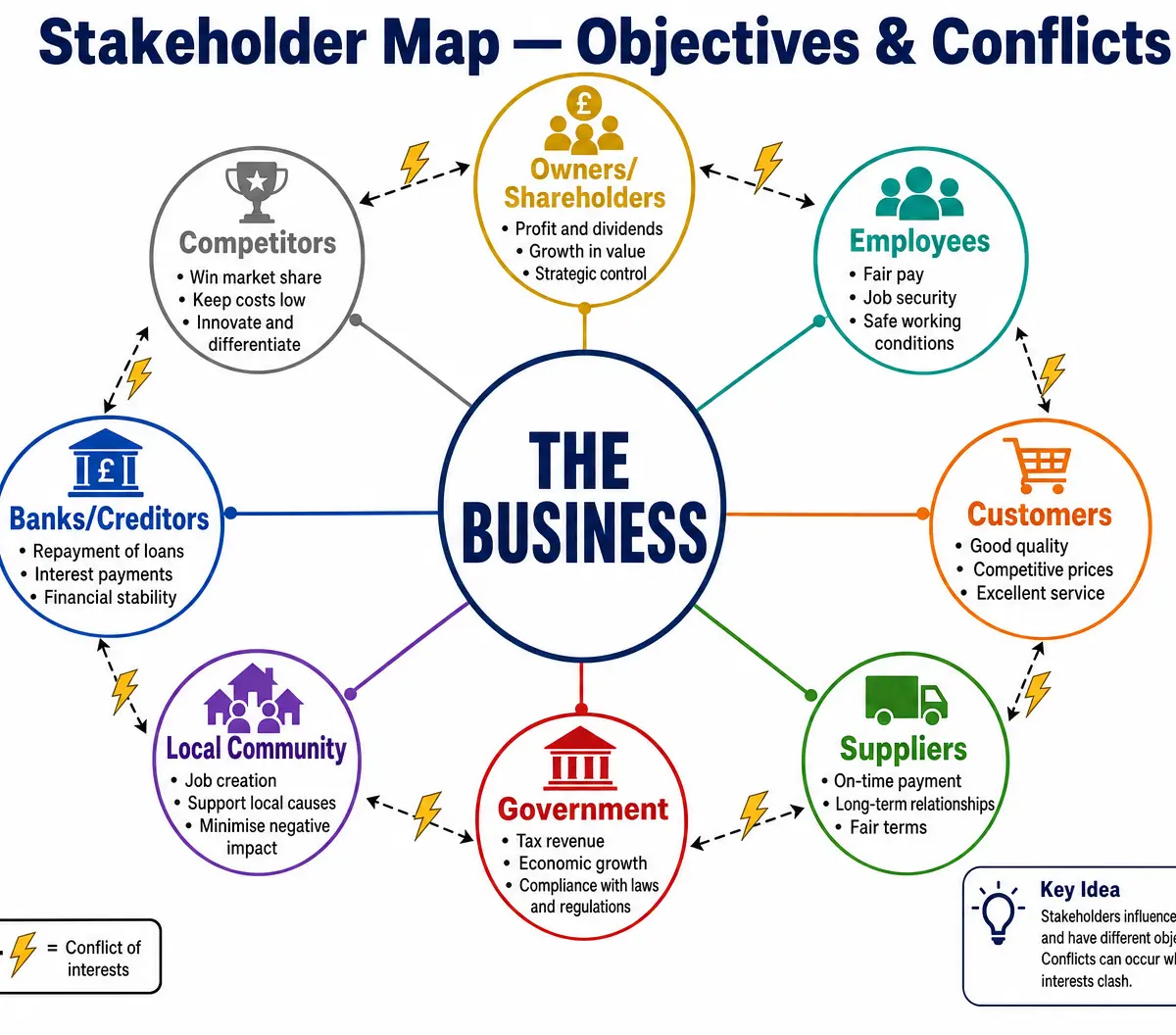
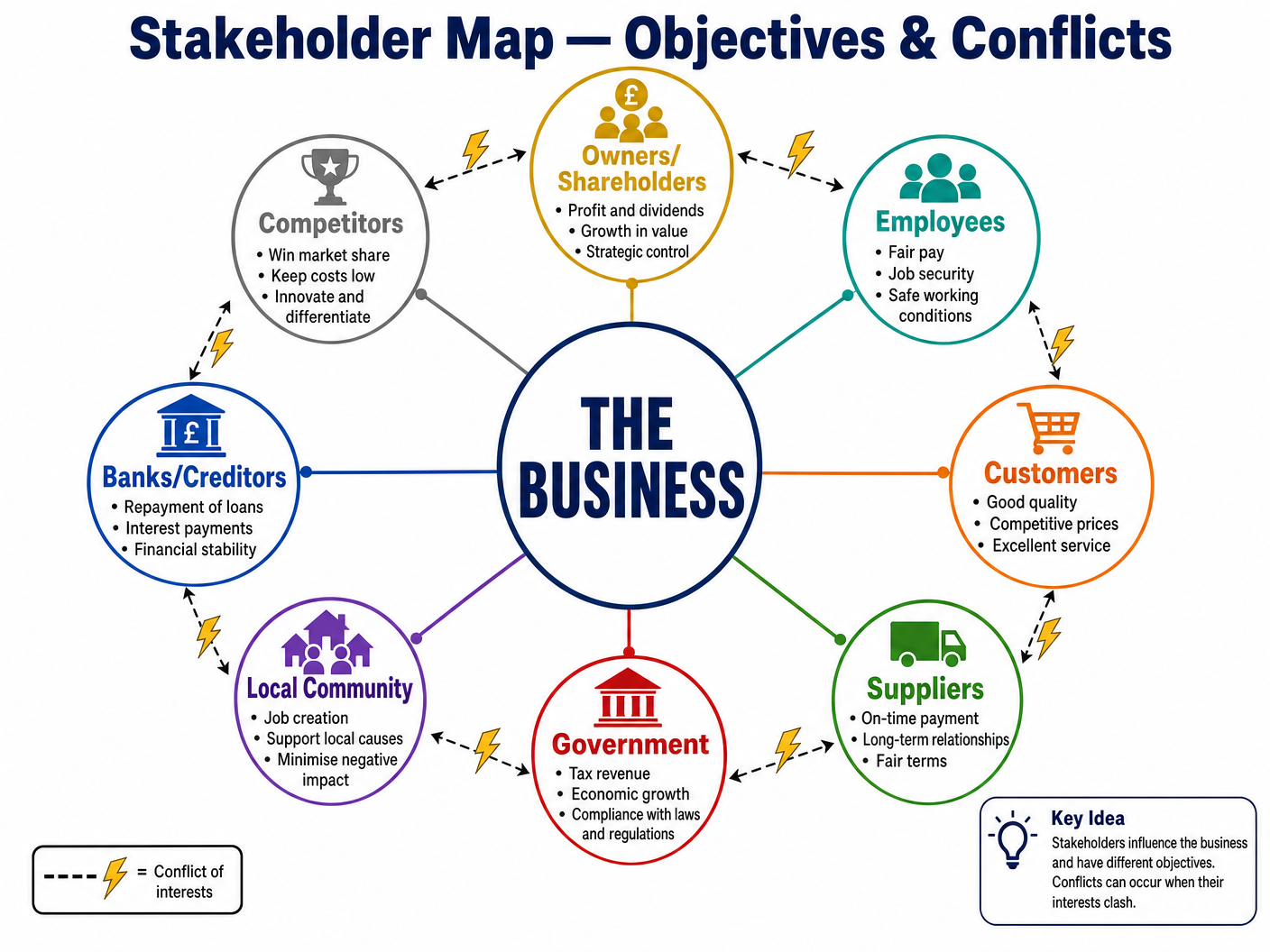
Stakeholders are individuals or groups with an interest in the business. Examiners love questions about stakeholder conflict. For instance, shareholders want higher dividends (profit), which might conflict with employees wanting higher wages, or customers wanting lower prices.
Location
Deciding where to locate depends on:
- Proximity to market (customers)
- Proximity to raw materials
- Labour supply (skills and cost)
- Infrastructure (transport, internet)
- Costs (rent, rates)
Business Planning
A business plan is crucial for securing finance and reducing risk. It outlines the business idea, market research, financial forecasts (cash flow), and marketing strategy.
Expansion and Scale
Businesses can grow organically (internal growth, e.g., opening a new store) or externally (mergers and acquisitions). Franchising is another method, allowing a franchisor to expand rapidly using franchisees' capital.
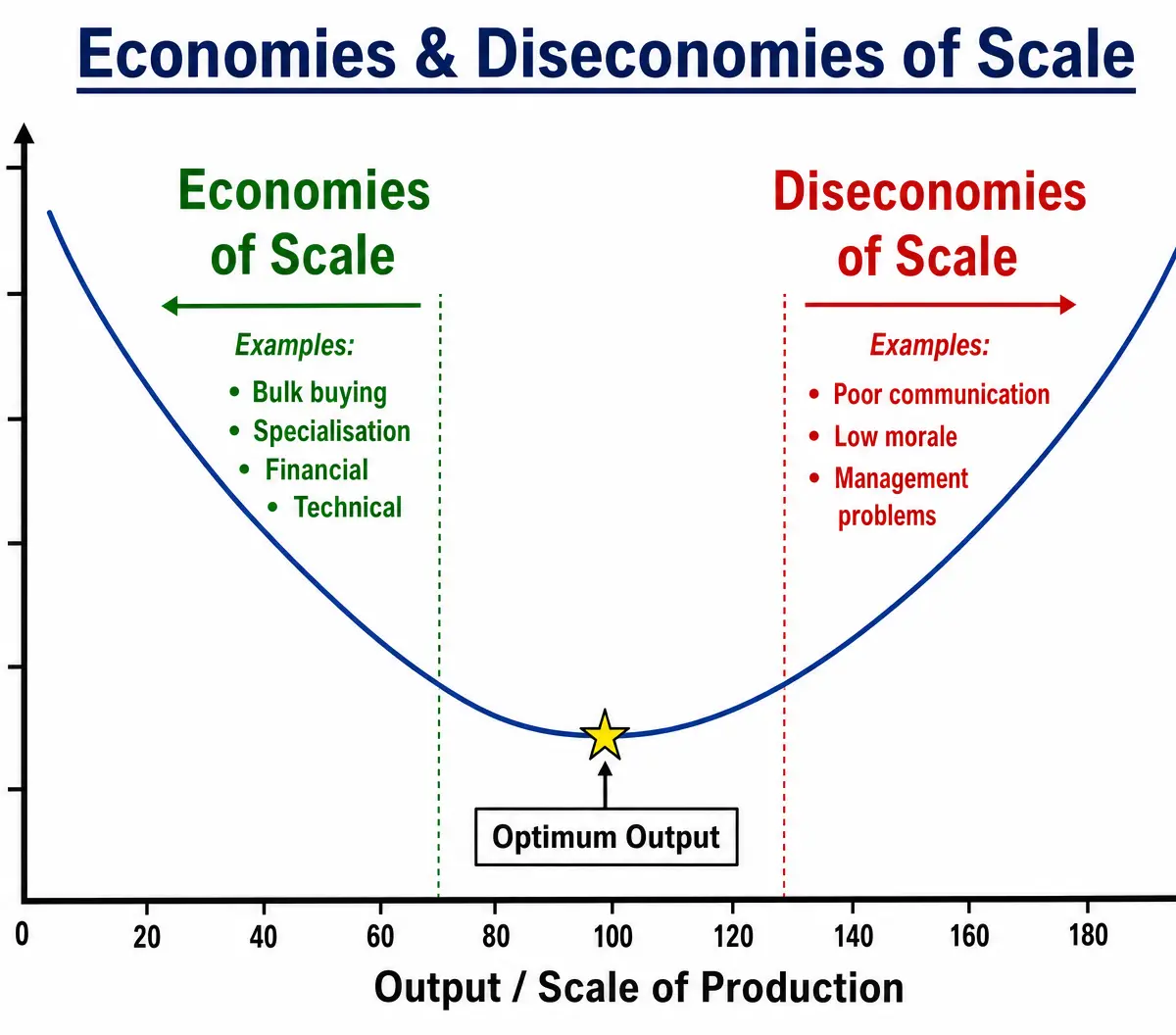
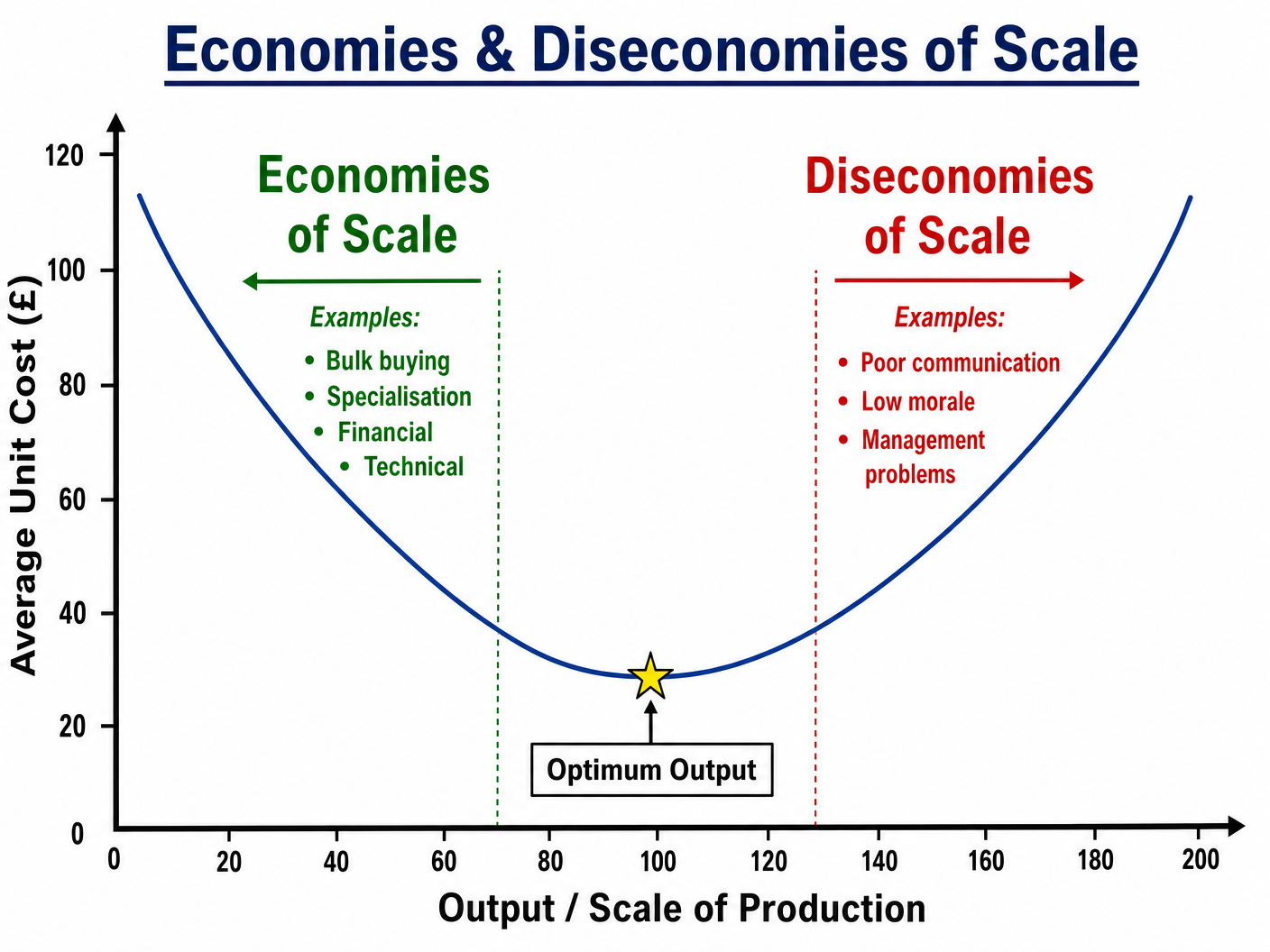
As businesses grow, they experience Economies of Scale (falling average unit costs due to bulk buying, specialisation, etc.). However, if they grow too large, they face Diseconomies of Scale (rising average unit costs due to poor communication and coordination).
Worked Examples
3 worked examples — open one to explore the question and available guidance.
Practice Questions
Try the question, then reveal an answer plan or example response
State two factors of production. (2 marks)
Hint: Think of the LLCE mnemonic.
Explain how the objectives of a start-up business might differ from those of an established multinational corporation. (4 marks)
Hint: Consider survival vs. profit/growth.
Analyse how a decision to increase prices to maximise profit might cause conflict between two stakeholder groups. (6 marks)
Hint: Identify the two groups (e.g., owners and customers) and explain their opposing reactions.
A sole trader is considering expanding by opening a second shop. Recommend whether they should use a bank loan or take on a partner to finance this. (9 marks)
Hint: Evaluate the pros/cons of debt (loan) vs equity/shared ownership (partnership), then make a choice.
Explain two reasons why a business plan is important for an entrepreneur starting a new business. (4 marks)
Hint: Think about finance and risk.
Exam technique
How to turn what you know into marks
How to approach the question
Always identify the command word first. Highlight the business context (e.g., 'a small local bakery') and ensure every point links back to it.
How to structure your answer
- Essay questions
- Introduction (define key terms) -> Paragraph 1 (Point For, applied to context) -> Paragraph 2 (Point Against, applied to context) -> Conclusion (Clear judgement with justification).
- Source questions
- Read the case study carefully. Extract specific data (numbers, facts) to support your arguments.
- Explain questions
- State the point, then use 'This means that...' or 'Therefore...' to explain the impact on the business.
Timing
Approximately 1 minute per mark. For a 9-mark or 12-mark question, spend 2-3 minutes planning.
Common pitfalls
- Listing points without explaining them (e.g., saying 'it has limited liability' without explaining what that means).
- Ignoring the context (writing a generic answer that doesn't relate to the specific business in the case study).
- Confusing economies of scale (costs falling) with diseconomies of scale (costs rising).
What the command words want
- Analyse
- Examine the consequences of an action or decision in detail.
- Explain
- Make a point and develop it to show cause and effect.
- State/Identify
- Give a brief factual answer. No explanation needed.
- Evaluate/Recommend
- Look at both sides of an argument and make a final decision, explaining *why* you chose that option over the other.
Watch or listen (optional)
Test your understanding of Business in the real world
Active recall beats re-reading. Take an instant quiz now to test what you’ve learned and lock it into long-term memory.
7 days Premium · Then the free plan continues · No card, no charge